NOVA had one of the strongest Proof of Talk pitches because it did something many Bittensor projects still struggle to do.
It made the subnet easy to understand before asking anyone to care about the token.
Micaela Bazo presented NOVA as a drug discovery subnet built by Metanova Labs on Bittensor. The argument was not abstract. Modern medicine still leaves many conditions with inadequate treatment options. Drug discovery is slow, expensive, secretive, and full of dead ends. NOVA is trying to turn part of that process into an open competition where miners search through huge chemical spaces more efficiently.
That is the clean version.
NOVA is not interesting because it says AI and biotech in the same sentence.
NOVA is interesting because it gives Bittensor a hard problem with measurable outputs.
What Metanova Labs is building
Metanova Labs describes itself as a crypto native biotech company focused on drug discovery. Its public language is unusually specific for a Bittensor project: the company says it is developing therapeutics that regulate mental states and restore critical biological processes.
That matters because NOVA has to be judged as more than a dashboard, a narrative, or a synthetic benchmark.
It is tied to an actual biotech thesis.
Metanova wants to use decentralized compute and collective intelligence to explore chemical spaces that are too large for traditional brute force search. On Bittensor, that becomes NOVA, Subnet 68, a decentralized drug discovery subnet where participants compete to generate better molecular candidates and better search strategies.
The Metanova site frames NOVA as a system for screening billions of synthesizable compounds for potential therapeutic applications. The project also emphasizes that traditional drug development can take more than a decade, cost enormous amounts of capital, and still fail at very high rates.
That is the backdrop.
If you want to understand NOVA, start with the bottleneck: the chemical universe is too large, the old process is too slow, and closed labs do not naturally reward open exploration.
What Micaela Bazo said at Proof of Talk
During the SubnetSummer stream from Proof of Talk, Micaela Bazo introduced NOVA as a Bittensor drug discovery subnet and made the strongest case for why science benefits from being done in the open.
Her pitch had three important pieces.
First, Metanova is working toward automated drug discovery, where AI agents can eventually push requests into robotic labs. She was careful about the current state of the field. The direction is still clear: better search, better models, and more automated validation.
Second, NOVA is using Bittensor to coordinate different forms of intelligence. Experts, non experts, agents, miners, and model builders can all compete inside machine learning competitions. That is the point. NOVA does not need every miner to be a biologist. It needs the subnet to make the scoring problem clear enough that good optimizers can contribute.
Third, NOVA is running competitions across small molecules, nanobodies, and chemical search algorithms. That gives the subnet more than one way to improve. It can search for candidate molecules, explore precise therapeutic formats like nanobodies, and reward algorithms that navigate massive chemical spaces more intelligently.
This is where the pitch started to feel like Bittensor at its best.
Not a vague AI story.
A contest.
A measurable output.
A scoring problem.
A reason for miners to get smarter.
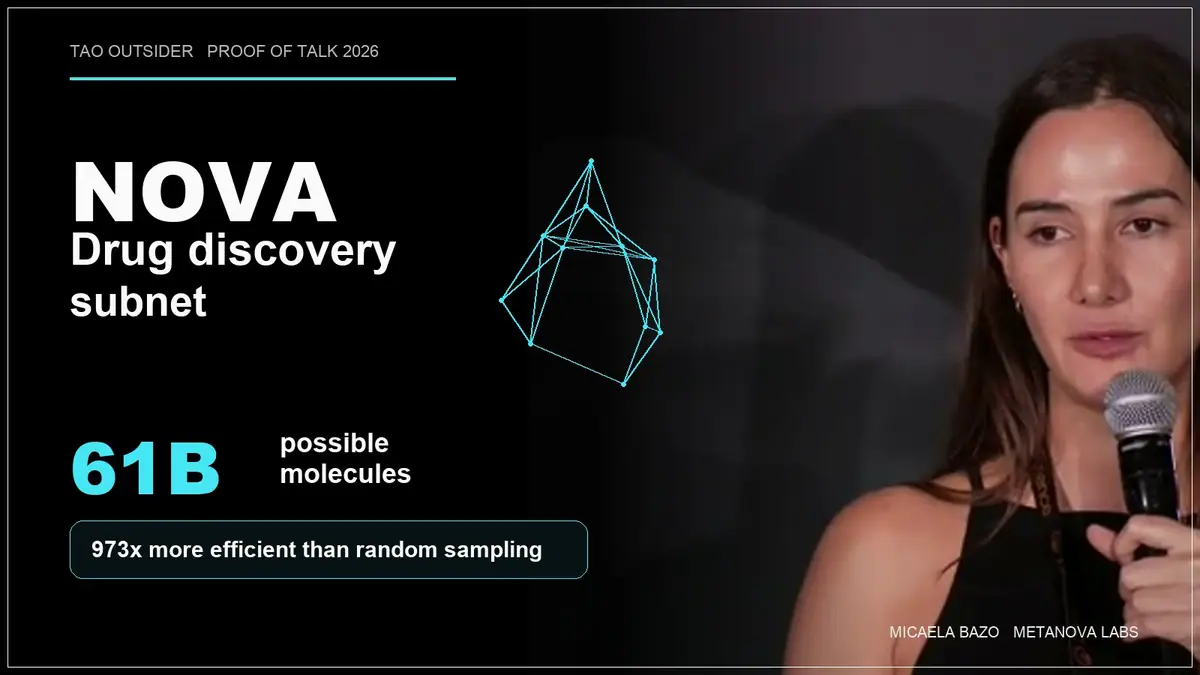
The number everyone should remember: 61 billion
The number that should travel from the stream is simple:
61 billion possible molecules.
Micaela said NOVA participants were building algorithms to find high scoring molecules inside a universe of 61 billion possibilities. Brute forcing that problem would be slow and expensive. The better way is to turn it into a search problem and reward strategies that find better candidates faster.
That is the Bittensor angle.
Mining is usually misunderstood by outsiders because they hear the word and think only of hash power or passive yield.
NOVA makes the mining problem more legible. A miner shows up with compute, but the real target is a better search strategy for a scientific bottleneck.
In the stream, NOVA said one winning algorithm was 973 times more efficient than random sampling at finding high scoring molecules. The same segment also described the winning approach as using an optimization strategy that had not previously been applied to drug discovery.
That is exactly the kind of claim a subnet should want to make in public.
It can be understood.
It can be challenged.
It can be improved.
Why the miner story matters
The most human part of the NOVA pitch came later in the stream, during the discussion around miners and incentives.
Micaela said one miner told her he no longer mines other subnets because NOVA is inspiring, challenging, and forces him to think instead of spam.
That line is important.
Bittensor has a miner problem that serious people already know about: if the incentive is lazy, miners will optimize lazily. If the scoring mechanism rewards spam, miners will spam. If the task is shallow, the network may still produce activity, but not much meaning.
NOVA is trying to build a different miner relationship.
The subnet asks participants to study the problem, understand the scoring logic, and develop strategies that improve over time. Micaela also said Metanova has to communicate goals and progress clearly because the work is technical and must be translated without losing scientific rigor.
That is a useful standard for every serious subnet.
If miners are expected to do meaningful work, subnet teams need to explain the mission, the benchmark, the scoring mechanism, and the path from better submissions to real value.
How NOVA says the competition works
Metanova’s public NOVA page describes two competition models: NOVA Compound and Blueprint.
NOVA Compound is about submitting sets of molecules for defined drug targets. Blueprint is about search algorithms that can plug into datasets or models. Submissions are scored by a deterministic oracle, and the highest scoring miner receives NOVA rewards.
The details will keep changing as the protocol evolves, but the architecture is easy to grasp:
Miners submit candidates or search methods.
Validators score submissions.
Rewards push the field toward better outputs.
The system keeps running.
The official Metanova whitepaper page describes NOVA as a self improving, adversarial, and model agnostic drug discovery engine. That language matters because the project is aiming beyond a few interesting molecules. The larger goal is a repeated competition layer for better discovery.
The GitHub repository also shows a real implementation surface. It describes NOVA as high throughput machine learning driven drug screening powered by Bittensor, with validator and miner setup instructions, GPU related requirements, and active code history.
That does not prove scientific success.
It does show that NOVA is more than a landing page.
The real world bridge: synthesis and validation
The honest caveat is obvious.
A computationally promising molecule is not a drug.
Drug discovery still needs synthesis, testing, validation, toxicology, clinical work, regulatory paths, capital, and time. A subnet can accelerate the early search layer, but it does not remove the hard biology that follows.
This is why Metanova’s partnership surface matters.
Tao Media reported in May 2026 that Metanova partnered with ONEPOT.AI, an AI driven robotic synthesis lab, so candidate compounds found through NOVA could move from virtual screening toward physical synthesis faster. The report said the partnership could allow identified candidates to be synthesized and delivered in five to seven business days.
That is the kind of bridge NOVA needs.
If the subnet only produces leaderboard outputs, the story stays inside Bittensor.
If the subnet can move candidates toward real world synthesis and validation, the story starts to matter to biotech people who do not care about subnet markets.
Why NOVA is a better Bittensor story than most
NOVA is one of the easier subnets to explain to an outsider because the value chain is visible.
There is a hard problem: drug discovery.
There is a large search space: billions of possible molecules and molecule target combinations.
There is a clear computational task: find candidates and search methods that score better.
There is a reason for competition: no single closed lab can explore everything.
There is a reason for Bittensor: the network can reward distributed participants who improve the search.
That does not make NOVA low risk.
It makes NOVA legible.
In Bittensor, legibility is underrated. Many subnets sound impressive until someone asks what the miner actually does, what the validator actually measures, and how the output becomes useful outside the token economy.
NOVA can answer those questions better than most.
What to watch next
The next phase for NOVA is not about sounding good on stage.
The next phase is evidence.
I would watch five things:
How the competitions evolve across small molecules, nanobodies, and search algorithms.
Whether the scoring system keeps rewarding quality instead of volume.
Whether miners continue to develop novel approaches instead of converging on easy exploits.
Whether Metanova can move computational hits toward synthesis and validation.
Whether external biotech partners start treating NOVA output as useful research infrastructure.
The investment story will follow the evidence. It should not lead it.
The takeaway
NOVA matters because it gives Bittensor a serious example of useful work.
It is not a subnet that can be explained only through emissions or chart performance. It has to be judged by whether open competition can improve scientific search.
That is why the Proof of Talk pitch landed.
Micaela Bazo did not need to make Bittensor sound mystical. She made it sound practical.
A hard problem.
A huge search space.
A measurable competition.
A path from better algorithms to better candidates.
If more subnets explain themselves this way, Bittensor becomes much easier to take seriously.
Sources: Metanova Labs about page, NOVA official page, NOVA whitepapers, Metanova Labs NOVA GitHub, SubnetSummer Proof of Talk broadcast, Tao Media on the Metanova and ONEPOT.AI partnership, Bittensor.ai learning hub on SN68, Crypto Briefing on SN68 Metanova.
Was this article useful?
One tap feedback helps us improve each post.