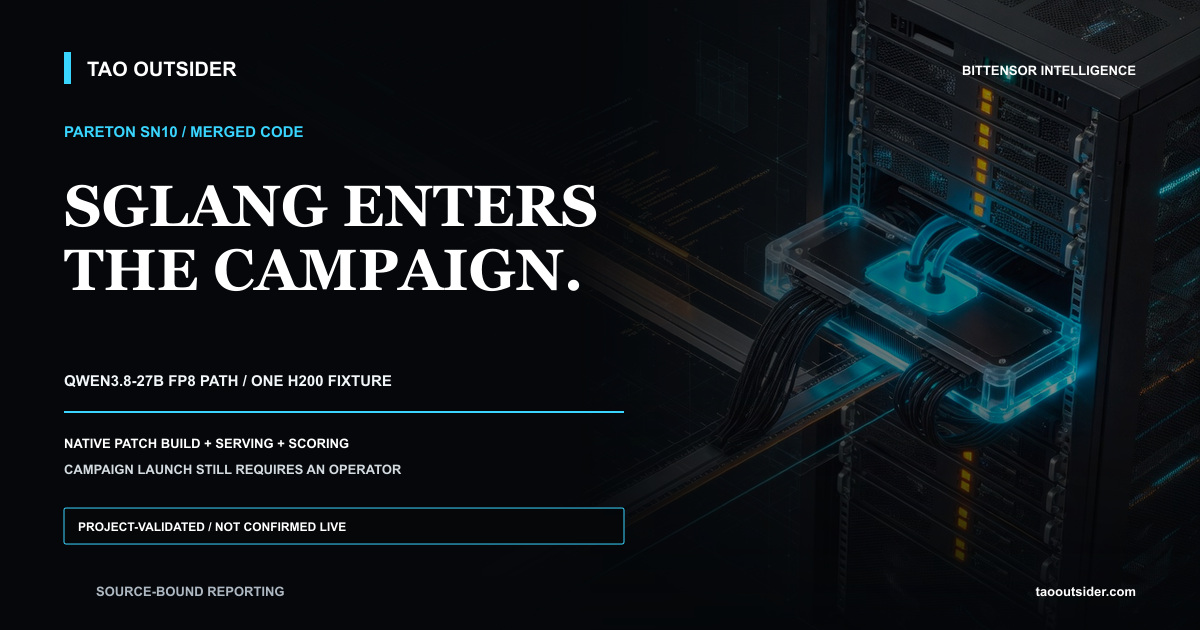
Pareton SN10 has merged a second inference-engine path into its campaign system. Miners can now submit native SGLang patches under a pinned build, serving and scoring pipeline, while existing vLLM campaigns keep their previous defaults.
The same change packages a Qwen/Qwen3.8-27B-FP8 campaign fixture for one H200. That combination makes the update more than a cosmetic framework option. SGLang brings its own tokenization behavior, native CUDA and Rust build surfaces, serving flags and correctness risks. Pareton had to define how all of those pieces enter a miner competition without silently changing the vLLM path already in use.
The code is merged. The campaign is not automatically live.
Pareton’s pull request says an operator still needs to deploy the merged revision and run a one-time seed command. It also warns that the additional campaign is configured with both emission weights set to zero. That is a campaign setting, not a claim that SN10 has zero on-chain emission.
Why SGLang support changes the competition surface
Pareton is designed around a specific kind of Bittensor work. A campaign pins an inference stack, model and evaluation environment. Miners modify the allowed implementation surface, and a scorer checks whether a candidate preserves correctness while improving the target behavior.
Until this merge, the documented campaign path assumed vLLM. Pull request 148 adds an explicit engine field with two accepted values: vllm and sglang.
That distinction reaches much deeper than a command-line switch.
SGLang campaigns use framework-native endpoints for tokenization, detokenization and generation input log probabilities. Pareton says this is necessary because the scoring path cannot depend on OpenAI-style echo log probabilities for the same evidence. Unicode continuations and leading newlines can merge with prompt tokens, so the scorer verifies native token IDs rather than assuming textual boundaries remain stable.
The SGLang scorer receives seven additional context slots and two untimed warmups. Replay remains fixed at 8,192 tokens. Pareton says the existing vLLM warmups, thresholds and scoring behavior remain unchanged.
These details matter because an optimization contest can reward the wrong thing if the baseline and candidate do not receive equivalent work. A fast answer with shifted tokens or truncated context is not a valid speed improvement.
Native patches expand both opportunity and risk
The merged policy allows miners to change selected files under SGLang’s Python and Rust trees, including CMake registration for custom CUDA sources. Packaging changes, nested tests and other build surfaces remain restricted.
Pareton also added an offline installer that rebuilds Python code, the AOT sglang-kernel and Rust Python extensions inside the trusted environment. Pinned CMake dependencies and immutable compiler-cache evidence are carried into the serving image. Miner cache mounts stay read-only.
This gives miners access to lower layers of the inference stack than a Python-only campaign would. It also creates more ways to break reproducibility, contaminate a build or produce a candidate that runs only because the environment leaked an undeclared dependency.
The repository’s answer is a hermetic build path, immutable image references and mutation probes that exercise the native surface. Those controls are visible in code and fixtures. Tao Outsider has not independently audited the isolation boundary or reproduced the builds.
What Pareton says it validated on an H200
The pull request includes an unusually detailed validation record for the new path.
Pareton reports that native installation completed in 341.3 seconds with one job and a 7,200-second production timeout. It says an 8,192-token input returned intact token IDs and 8,191 scored positions, with one generated token excluded. The project also reports successful CUDA, JIT and Rust probes on an H200.
For the Qwen3.8-27B FP8 fixture, the baseline and candidate both reached 100% coverage. The candidate scored 0.0 because the submitted mutation was a validation probe, not an optimization. Pareton reports a 2.78% candidate p99 end-to-end relative range against an unchanged 33.5% bar, and 0.29% drift against a 5% ceiling.
Those numbers show the project’s harness completed its intended test. They do not show that SGLang is faster than vLLM, that the candidate improved Qwen3.8, or that the result will generalize to another GPU, model or workload.
The repository also records 1,261 passing local tests, 41 skips and passing CI for Python 3.10 and 3.11. Again, these are project-published results attached to the merge, not an independent Tao Outsider benchmark.
A campaign fixture is not a live campaign
The operational section is the most important boundary in the release.
Before seeding, the validator operator must confirm that a separate round worker is installed, all execution workers are running the merged code and no pending deployment flag remains. The seed helper then creates an additional open campaign alongside the existing one.
Pareton warns that rerunning the helper with an uncertain outcome can create another row. It also says an open zero-emission campaign still accepts public submissions and incurs GPU evaluation costs.
The evidence currently stops at three separate states.
- The SGLang campaign machinery is merged into the public repository.
- The Qwen3.8-27B FP8 launch configuration is packaged and documented.
- A production operator has deployed the code and created the campaign.
Only the first two are established by the current GitHub evidence.
The on-chain context is still small
At TaoSwap block 9,037,275, Pareton SN10 showed one active miner, an emission_value of 0.000000488 and miner burn of about 90.97%. This is a point-in-time status snapshot. It does not identify which software the miner runs, whether the SGLang campaign has been seeded, or whether a public submission has been scored.
The one-miner context also prevents a larger conclusion about competition. A technically broad patch surface can create a better contest, but it cannot create participation by itself.
The next useful evidence will be operational. It would include a campaign visible through Pareton’s public API, multiple valid submissions, reproducible scorer output and a winning patch that improves a declared metric without moving correctness outside the threshold.
For now, Pareton has published the machinery and the launch path. The actual SGLang competition still has to happen.
Sources
Pareton machine-readable validation evidence
Was this article useful?
One tap feedback helps us improve each post.