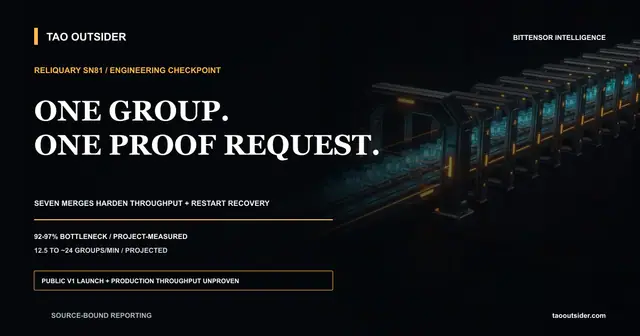

Reliquary SN81 went live this week with a subnet mechanism that deserves attention because it is specific.
The public claim is specific. Miners can compete to find useful prompts at a model’s learning frontier, submit rollouts, and have those rollouts verified before they influence the next checkpoint.
That design is more interesting than generic distributed training language.
On its site, Reliquary describes itself as a GRPO reinforcement learning training market on Bittensor Subnet 81. The core idea is that miners hunt for prompts where the model can still learn, while GRAIL verifies rollouts cryptographically. The project’s protocol paper describes a proof carrying inference setup, a nine stage verifier and stake weighted mesh consensus.
The GitHub repository also frames Reliquary as a coordination protocol that turns independent GPU operators into a distributed RLHF pipeline. Miners generate cryptographically proven rollouts. The validator aggregates accepted work into a GRPO training batch, updates a live checkpoint and publishes the result to Hugging Face.
Useful learning pressure
The bullish part is the filtering mechanism.
Reliquary is trying to make training contribution more selective. A miner is not simply rewarded for producing more rollouts. The miner has to predict which prompts sit in the useful training band. Bad picks can waste compute. Good picks can earn weight because they give the trainer better material.
In plain English:
the subnet is trying to pay for useful learning pressure.
Decentralized training has a measurement problem. It is easy to claim that many machines are contributing. It is harder to show that their outputs are useful, verified and incorporated into a model in a way that improves it.
Reliquary is attacking that exact gap.
The early caveat
The project also deserves a cautious read. It is early. The site shows live protocol language, dashboards and current windows, but the market still needs time to prove consistency. The protocol paper is marked as a preprint. The security model includes real limitations, including validator stake assumptions and hardware determinism checks.
That honesty helps. A subnet that names its limits is easier to study than one pretending the system is finished.
The best version of the SN81 story is simple:
miners find training prompts, rollouts carry proof, validators filter them, the model checkpoint absorbs the useful work.
If that loop holds up in production, Reliquary becomes a useful example of how Bittensor can move from “who has compute” to “who produced training signal that changed the model.”
I would keep SN81 on the watchlist for its design.
It is worth following because it has a concrete mechanism, a public source trail and a problem that matters outside crypto.
Sources
Reliquary launch post: SN81 is live
Const quote post: Signal and intelligence markets
Reliquary site: reliqua.ai
Reliquary research page: Research
Reliquary protocol paper: Paper
Reliquary GitHub: reliquadotai/reliquary
Was this article useful?
One tap feedback helps us improve each post.