
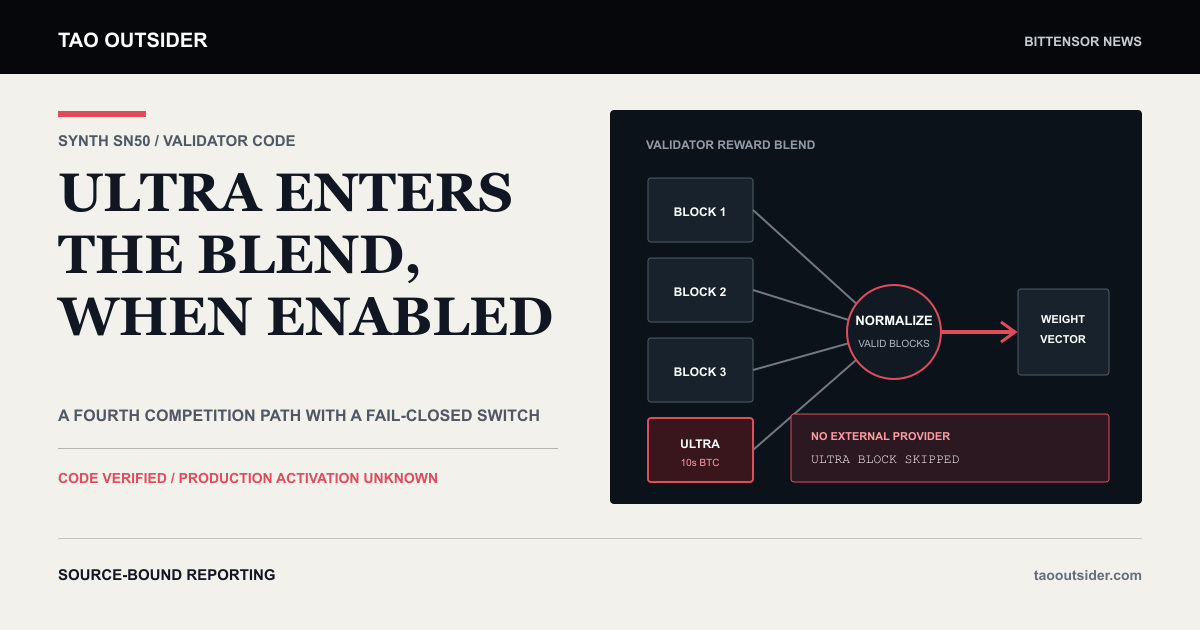
Synth SN50 has added code that can blend scores from its Ultra forecasting track into a validator’s reward calculation as a fourth competition.
The integration landed on August 31. It covers the project’s 10-second Bitcoin microprice track and pulls scores from an external provider before mapping them to registered subnet miners.
The operative word is “can.” The path is disabled when the validator has no VHFT_SCORES_URL configured. Code inspection confirms an optional implementation path. It does not confirm that validators on mainnet have enabled it or that Synth Ultra currently receives a fixed share of subnet emissions.
How the fourth block enters the blend
Synth’s existing validator code calculates reward weights across three forecasting competitions. The new path fetches an external set of Ultra scores, shapes those scores with a lower-is-better softmax and adds the result to the same moving-average data used by the other competitions.
Each valid competition contributes the same configured coefficient before the final weight vector is normalized. When all four blocks are present and valid, their totals enter that local calculation equally. Under that specific condition, each block represents one quarter of the pre-distribution blend.
This is the source of the 25% interpretation. It is a property of the code path under four valid inputs, not a guaranteed 25% of network emissions. The Ultra block can be absent, a validator can leave the provider disabled, other competition data can vary and on-chain rewards reflect the weight-setting behavior of participating validators.
The code deliberately keeps Ultra outside the inline CRPS competition list. Its scores arrive through a separate HTTP provider that has already assembled the scoring window.
The path fails closed when the input looks wrong
The external provider is optional by construction. If the environment variable is missing, the validator does not create the provider. If the request fails or the response contains no usable rows, the cycle continues with the other competitions.
Several checks narrow what counts as a usable Ultra field. Rows need a positive supplied weight. Null or negative mean CRPS values are dropped. A valid zero score is retained because field-relative scoring can assign zero to the best participant.
An all-identical field is rejected as a degraded or placeholder snapshot. The code also maps subnet UIDs to the validator’s current miner identities before applying a participant guard. Fewer than three mapped participants or more than 64 causes the Ultra block to be skipped for that cycle.
That ordering is important. Nine returned UIDs do not create a valid field if only two map to registered miner records. The guard counts the participants that could receive weights.
These checks reduce obvious concentration and malformed-input risks. They do not independently verify the external scorer, the forecasting data or the identity of the systems producing the scores.
Lower CRPS receives more of the Ultra block
Synth’s configuration uses a negative softmax beta for Ultra, so a lower mean CRPS receives a higher reward weight. The beta is steeper than those listed for the other competitions because the code comments describe the Ultra field as tightly grouped.
The score level is relative. Shifting every participant by the same amount does not change softmax ordering. What matters is the spread between participants. A wider spread concentrates more reward at the same beta.
The integration commit also includes a separate cap for extreme CRPS responses in another scoring path. That work is presented as protection against an absurd response distorting the fill used for missed responses. It should not be read as evidence of an exploit or attack. The repository shows defensive scoring changes, not a public incident report.
Forecasting code is not a profitability record
Synth announced Ultra on August 26 as an ultra-low-latency forecasting product for high-frequency systems. The August 31 commit gives validators a route for incorporating its scores. Neither artifact provides an independently reproduced latency measurement, trading record or forecasting advantage.
CRPS can tell a validator how a probabilistic forecast performed against an observed outcome under the project’s scoring setup. It cannot establish that a trader could capture the result after fees, slippage, execution delay and market impact.
A TaoSwap snapshot on September 2 showed 238 active miners on Synth SN50 and an emission_value of 0.001021014. That is subnet-wide context. It does not identify how many miners participate in Ultra or whether the optional provider is enabled by any validator.
The code change is still worth following because it connects a newly announced product track to the mechanism that produces validator weights. The next proof should be operational: enabled-validator evidence, reproducible score snapshots and on-chain weights that show the fourth block appearing without breaking the other three.
Sources
Synth commit adding Ultra as a conditional fourth competition
Synth Ultra product announcement
Was this article useful?
One tap feedback helps us improve each post.