This Bittensor price prediction 2030 framework is scenario analysis, not investment advice.
My base case for TAO in 2030 is US$2,500 to US$3,600, with US$2,800 as the midpoint I would use for discussion. That outcome requires Bittensor to grow beyond crypto AI attention and become a real market for machine work across inference, compute, model improvement, data, routing, agents and scientific search.
The core test is simple. TAO needs evidence that subnets can create demand outside the internal loop of emissions, APY and capital rotation. If that demand appears, TAO can be valued as a scarce asset inside an open AI market. If it does not, the serious 2030 range should be far lower.
This article started from a Tao Outsider 2030 model, with market desk review by Lena Hayes. It was updated on July 4, 2026 with fresh CoinGecko market data.
Bittensor price prediction 2030: the short answer
My base Bittensor price prediction for 2030 puts TAO between US$2,500 and US$3,600, with US$2,800 as the midpoint.
The calculation starts with market cap and supply:
| 2030 scenario | TAO market cap | Price at 15.8M TAO | Price at 17.0M TAO | Price at 21.0M TAO |
|---|---|---|---|---|
| Bear | US$5B to US$12B | US$316 to US$759 | US$294 to US$706 | US$238 to US$571 |
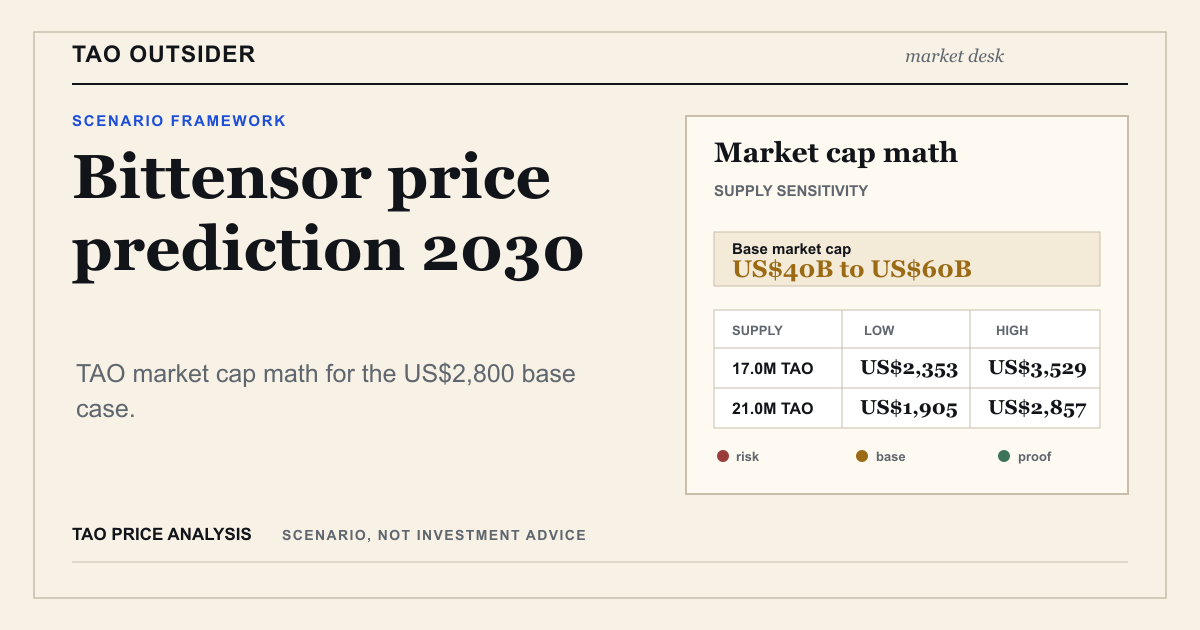
| Base | US$40B to US$60B | US$2,532 to US$3,797 | US$2,353 to US$3,529 | US$1,905 to US$2,857 |
| Bull | US$120B to US$200B | US$7,595 to US$12,658 | US$7,059 to US$11,765 | US$5,714 to US$9,524 |
| Extreme | US$300B | US$18,987 | US$17,647 | US$14,286 |
Read this as a market cap model rather than a promise about price.
If TAO reaches a US$40B to US$60B market cap by 2030, and the economically relevant supply is around 15.8M to 17.0M TAO, the math lands near US$2,500 to US$3,600.
Using the full 21M max supply gives the conservative FDV sensitivity. The same market cap would imply about US$1,900 to US$2,850.
Supply is the part most TAO prediction pages skip. A price target without supply math is closer to a slogan than a model.
The market snapshot
Data checked at 20.19 UTC on July 4, 2026 showed TAO near US$217.61 on CoinGecko.
CoinGecko showed TAO market cap near US$2.09B, fully diluted valuation near US$4.57B, circulating supply of 9,597,491 TAO, max supply of 21M TAO and 24 hour volume near US$92.1M.
The same CoinGecko API snapshot showed the artificial intelligence token category near US$21.67B in market cap.
That starting point matters. Bittensor is already visible inside AI crypto, while the valuation remains small compared with the global AI market.
Grand View Research projects the global AI market moving from US$539.5B in 2026 to US$3.49T in 2033. McKinsey estimated that generative AI could add US$2.6T to US$4.4T annually in economic value across use cases.
Those numbers do not belong to TAO by default. They define the field size. Bittensor still has to earn value capture.
Why Bittensor can justify a 2030 model
Bittensor deserves a 2030 model because it is built as a network of markets.
Each subnet defines a task, miners compete to perform that task, validators score the work and Yuma Consensus turns validator judgment into emissions. Dynamic TAO adds subnet alpha tokens and market pricing around each subnet economy.
That design gives TAO a reason to matter beyond branding.
TAO sits inside a system where machine intelligence, compute, model work, inference and scientific search can become competitive markets. The idea is ambitious. The execution risk is high. The structure is unusual enough to deserve a 2030 framework.
The useful question is whether Bittensor can capture a small, durable slice of AI demand through subnets that produce outputs people want to use.
The supply assumption
The 15.8M to 17.0M supply range is my scenario assumption for economically relevant TAO supply by 2030. Opentensor has not published that range as an official forecast.
Current CoinGecko circulating supply is 9,597,491 TAO. The maximum supply is 21M TAO.
For 2030, I look at three views:
-
15.8M TAO: lower economic supply sensitivity.
-
17.0M TAO: higher economic supply sensitivity.
-
21.0M TAO: full max supply sensitivity.
The third view is important because it prevents the model from hiding dilution risk. If the thesis only works under a low supply assumption, it is weaker than it looks.
The US$2,800 case belongs inside a scenario. It should never sit alone as a standalone prediction.
What demand would need to look like
The model needs proof outside the Bittensor capital loop.
The strongest subnet stories today are useful because they give readers something to inspect.
Chutes SN64 has product access, TEE based inference claims, model listings, a Parallax training narrative and a reported revenue metric tied to tokens served. Tao Outsider has not audited the revenue figure. The important category is usage connected to money.
Quasar SN24 has a public Hugging Face checkpoint, an 18B class MoE architecture, a 2B active parameter path and a public long context training object. Readers can inspect a model card instead of only seeing a subnet name.
Targon SN4 gives the market a physical compute story through Tower Pro, confidential GPUs, supplier onboarding and reported revenue linked to SN4 alpha buybacks.
The June 27 dTAO board showed the same pattern from another angle. The market is starting to care more about visible products, liquid markets, subnet mechanisms and evidence paths.
This does not prove a US$2,800 TAO case. It shows what the evidence would need to become: more product paths, more external usage, more revenue clarity, more public mechanisms, more code and more user behavior outside Bittensor Twitter.
The protocol side
The 2030 thesis also depends on Bittensor becoming more selective.
Recent emission changes and cleanup debates point in that direction. The price EMA emissions article covered the shift toward market signal inside subnet emissions and the pressure on weak mechanisms.
This direction is healthy if it forces subnets to prove work.
It can also increase reflexivity. Strong liquid subnets may attract more attention and capital, while weak subnets may fade faster. The board becomes easier to read and easier to chase.
For long term TAO value, the protocol needs three things at once. Market pressure should punish weak mechanisms. Stability should help teams trust the rules. Transparency should help investors and users understand why emissions move.
What could break the model
The biggest risk is reflexivity.
TAO can trade higher during an AI cycle without proving durable demand. That would make the chart exciting and the 2030 thesis weaker.
The second risk is subnet quality.
Some teams will build. Some will fail. Some will look strong while liquidity is favorable and weak when judged by output. Bittensor needs better ways to reward useful work and starve weak mechanisms.
The third risk is liquidity.
dTAO can make subnets legible, while thin alpha markets can exaggerate both upside and downside. A subnet price can move sharply because demand is real, or because the pool cannot absorb size.
The fourth risk is centralized AI speed.
OpenAI, Google, Anthropic, Meta, xAI and cloud providers will keep improving. Bittensor needs a reason for developers and users to choose open incentive markets when centralized services are easier to buy.
The fifth risk is regulation and market access.
TAO sits at the intersection of crypto markets, AI infrastructure, open models, token incentives and global capital. Any 2030 framework has to include exchange, jurisdiction and institutional access risk.
What would make me raise or lower the model
I would raise the model if more subnets show external revenue, real API usage, repeat customers, public code, clear miner scoring, transparent validator behavior and deeper liquidity.
I would also raise it if Bittensor becomes easier for non crypto builders to use. The best version of the network lets products use Bittensor underneath while users choose them because the output is good.
I would lower the model if the market stays dominated by emissions farming, vague subnet launches, thin liquidity, weak code availability, opaque mechanisms and APY first marketing.
The price of TAO can still move in that world. The 2030 case would be much weaker.
What market cap would TAO need for US$2,800?
At 15.8M TAO, a US$2,800 price implies roughly US$44.2B market cap.
At 17.0M TAO, it implies roughly US$47.6B market cap.
At full 21M supply, it implies roughly US$58.8B fully diluted valuation.
The US$2,800 midpoint sits inside the US$40B to US$60B base scenario because the calculation is market cap divided by supply.
FAQ
What is the Bittensor price prediction for 2030?
My base scenario is US$2,500 to US$3,600 per TAO, with US$2,800 as the midpoint. That depends on Bittensor reaching roughly US$40B to US$60B in market cap and having about 15.8M to 17.0M economically relevant TAO supply.
Could TAO reach US$10,000 by 2030?
TAO can reach US$10,000 only in a bull case where Bittensor becomes a major open market for AI work. At 17.0M TAO, a US$10,000 price would imply about US$170B market cap. At full 21M supply, it would imply US$210B fully diluted value.
What market cap does TAO need for US$2,800?
TAO needs about US$44.2B market cap at 15.8M supply, US$47.6B at 17.0M supply and US$58.8B at full 21M supply.
What would make this TAO prediction wrong?
The model breaks if Bittensor remains driven mainly by emissions farming, weak subnet mechanisms, thin liquidity, vague AI narratives and no repeat external demand.
Is this a TAO buy recommendation?
Use this page as market cap math and scenario analysis for readers researching Bittensor, TAO price and decentralized AI. It is not financial advice.
Bottom line
The Bittensor price prediction 2030 case is attractive because Bittensor combines scarce token supply, open AI incentives, subnet level markets, Yuma based work evaluation and a growing field of products trying to turn machine work into something measurable.
The risk is familiar. The market can still get distracted by price, APY, rotation and narrative.
My base scenario remains US$2,500 to US$3,600, with US$2,800 as the midpoint I would use in a serious discussion.
That view changes if the evidence changes.
The next four years are about proving that Bittensor can capture demand from a market everyone already knows is large.
Sources
CoinGecko: Bittensor TAO market data
CoinGecko: Artificial intelligence token category
Grand View Research: Artificial intelligence market size and outlook
McKinsey: The economic potential of generative AI
Bittensor docs: Understanding subnets
Bittensor docs: Yuma Consensus
Bittensor docs: Emissions
Was this article useful?
One tap feedback helps us improve each post.