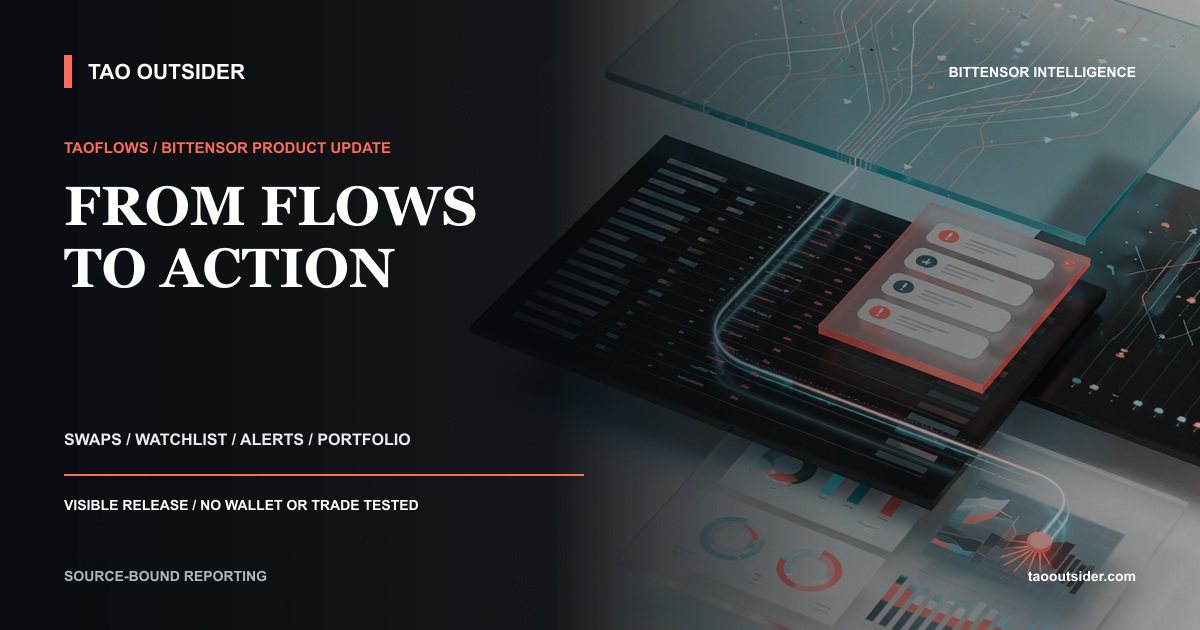
TaoFlows has expanded from watching Bittensor subnet activity to acting on it.
The September 2 product release adds subnet-token swaps, a watchlist, on-chain-event alerts and a portfolio dashboard to the existing flow terminal. TaoFlows says users can keep browsing without connecting a wallet. That preserves the read-only path while placing transaction tools beside the market data.
Tao Outsider inspected the public surface without connecting a wallet or executing a trade. The release is visible. Its execution quality, security and transaction costs were not independently tested.
What changed in TaoFlows
The update puts four jobs in one interface:
- the watchlist narrows the subnet board to assets a reader chooses to follow;
- alerts surface selected on-chain events;
- the portfolio view groups positions and project-reported holding APY fields;
- swaps let a connected user move between subnet tokens.
The first two features reduce the cost of monitoring a crowded market. The portfolio adds account context. The swap closes the distance between seeing a flow and initiating a transaction.
Together, those additions change the role of the interface. TaoFlows is no longer only a tape for interpreting dTAO activity.
Wallet connection remains optional
Optional connection is an important interface decision for a public market terminal.
A reader can inspect flows and subnet pages without handing an application an account context. A connected user can access portfolio and execution features. Keeping those modes separate makes the research surface useful to people who do not want to transact from the same session.
It is not a security audit. Optional connection does not establish how every wallet request is handled, whether a swap is suitable for a user or whether the interface eliminates transaction risk.
No wallet was connected during this review, and this article is not an installation or trading guide.
Zero platform fee is not zero transaction cost
TaoFlows describes the swap feature as zero-fee. That should be read narrowly.
An application can charge no platform fee while an on-chain transaction still faces execution effects. Network fees, pool depth, price movement and slippage can affect what a user receives. The announcement does not turn every route into a costless trade.
The distinction matters in Bittensor because subnet-token liquidity is uneven. A polished swap button cannot make a shallow pool deep.
The interface should therefore be evaluated on the route and transaction details it shows before confirmation, not on the word “zero” alone. Tao Outsider did not run that transaction-level test.
Alerts turn the chain into an editorial filter
Founder Alex Drocks says the initial alerts cover volume spikes and subnet identity changes.
Those are different signals. A volume spike can point to abrupt market activity but says nothing by itself about the reason or direction. An identity change can alter how a subnet appears to users, yet it does not establish a change in ownership, code quality or product status without additional records.
Alerts become useful when they send a reader to evidence. They become dangerous when their label is mistaken for an explanation.
TaoFlows can shorten the time between an on-chain event and investigation. It cannot determine the story on its own.
The founder says one swap now uses one extrinsic
Drocks also says he filed a Bittensor issue and that a newly shipped on-chain call can move between subnets with one extrinsic instead of three.
That is a specific implementation claim with an important boundary. Tao Outsider has not matched the statement to a public code change and has not compared transaction traces. The article therefore attributes the one-extrinsic description to the founder rather than presenting it as independently reproduced.
If confirmed in public code and live calls, fewer extrinsics would simplify the path and reduce the number of separately submitted actions. It would not guarantee execution quality, safety or a favorable price.
A Bittensor terminal is becoming a workspace
The more important direction is how TaoFlows connects market observation with selection, notification and action.
Subnet explorers often answer one question at a time. What moved? What does this subnet do? How much liquidity is visible? TaoFlows is arranging those questions around a persistent user view that retains watched names, notable events, positions and an available route.
That creates a more complete product. It also creates more responsibility. Portfolio calculations need transparent definitions. Alerts need timestamps and source fields. Swaps need clear route, price-impact and confirmation information. Market data needs a freshness signal.
The September 2 release shows the pieces together. The next test is whether users can move among them without losing the distinction between a signal, an account estimate and an executable transaction.
Sources
TaoFlows September 2 product release
Founder description of the interface, alerts and one-extrinsic path
Related Tao Outsider guide: How to evaluate Bittensor platforms
Was this article useful?
One tap feedback helps us improve each post.