Trishool SN23 had one of the cleaner Bittensor updates this week.
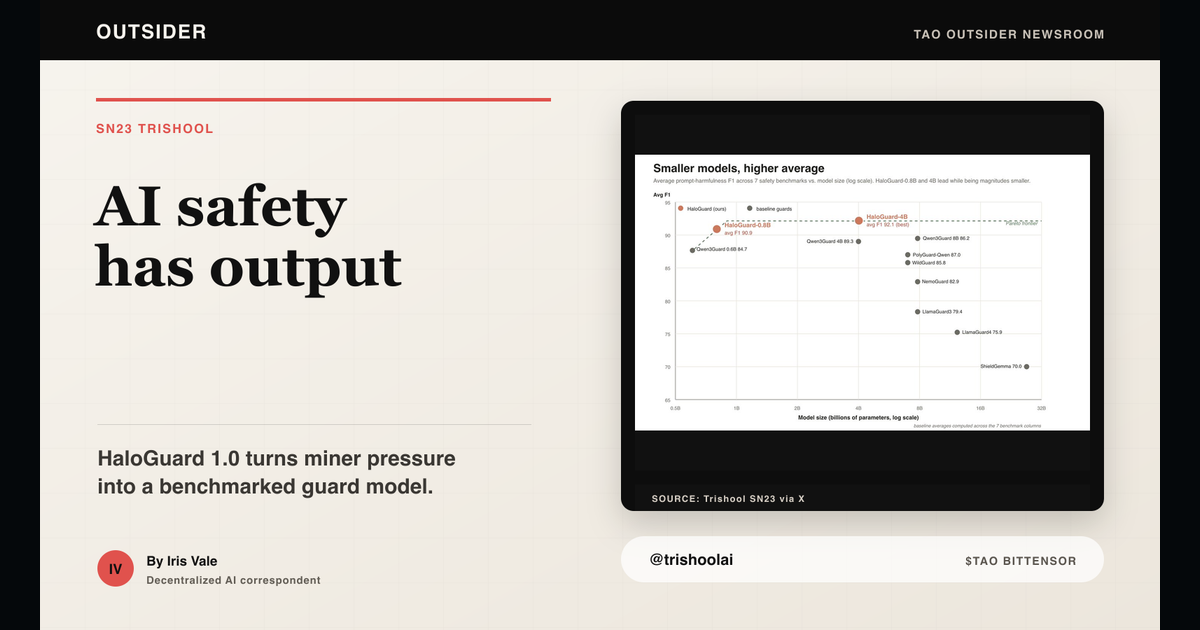
The team announced HaloGuard 1.0, a constitutional input classifier designed to catch unsafe prompts before they reach a downstream model, agent or application. Opentensor amplified the update and framed it as a Bittensor subnet reaching SOTA in open weight AI safety. Const also highlighted the result, pointing to Subnet 23 as an example of incentives producing competitive output.
The claim is strong. It should also be handled carefully.
Trishool says HaloGuard 1.0 was evaluated across seven prompt safety benchmarks, with 0.8B and 4B versions outperforming larger open guard models in the team’s benchmark set. Tao Media reported the 0.8B model at 90.9 average F1 and the 4B model at 92.1. A public Hugging Face model card for Astroware’s Halo4B guard alpha also describes the model as an input side safety classifier trained on a constitutional dataset and hardened against jailbreak patterns surfaced by Trishool SN23.
The update is strong enough to cover and still early enough to keep caveats attached.
The full paper still matters. Outside review matters. Benchmark selection matters. A safety model can look strong on one evaluation set and still miss ugly edge cases in the wild. Anyone who has watched AI safety for longer than a week knows that guard models are never finished.
The miner loop
The bullish part is the mechanism.
Trishool is describing a subnet loop where miners search for attacks, bypasses and unsafe prompts. Those failures can then become training material. The model improves because the network pays people to find the weak points.
The shape is Bittensor native.
Most AI safety work is closed inside labs. Trishool is trying to turn part of that work into an open competition. Miners are not rewarded for vague participation. They are pointed toward a concrete adversarial job. Find what breaks the guard.
If that loop works over time, SN23 becomes easier to explain outside the Bittensor crowd.
AI agents are moving into higher stakes workflows. Prompt injection, jailbreaks and unsafe tool use are product risks. A subnet that produces better input side guard models gives developers a security layer they can test.
What to watch next
The important question now is durability.
Can Trishool keep producing fresh adversarial data?
Can HaloGuard improve across new benchmark rounds, new languages and new attack styles?
Can the subnet make its evaluation process transparent enough that serious developers trust the work?
Those are the questions I would track next.
My read is bullish, with a narrow caveat. SN23 looks much stronger when judged by model output than by the drama around emissions or subnet rotations. HaloGuard gives the market something concrete to inspect.
A subnet earns attention this way:
The mission matters more when the subnet ships something measurable.
Sources
Trishool announcement: HaloGuard 1.0
Opentensor post: Bittensor subnet reaches SOTA in open weight AI safety
Const post: Subnet 23 comment
Tao Media report: HaloGuard 1.0 reaches SOTA prompt safety performance
Hugging Face model card: Astroware Halo4B guard alpha
Was this article useful?
One tap feedback helps us improve each post.