Bitsec SN60 has launched Sentios, a public security service built around a simple complaint about the traditional audit calendar: code changes more often than most teams commission an audit.
Sentios is Bitsec’s attempt to close that gap. The product page describes several adversarial AI programs running repeatedly against an agreed code scope, with new reviews triggered by meaningful changes such as commits, major refactors, dependency updates and pre-release milestones.
The launch gives Bitsec a named commercial service beyond its subnet competition. It also gives readers a much clearer claim to test. Sentios is selling review frequency, competing submissions and a structured findings process. It is not promising that every vulnerability will be found.
That distinction comes from Sentios itself. Its public FAQ says no serious security company should guarantee complete bug discovery and describes the service as one layer in a broader defense.
Tao Outsider has not submitted a repository, commissioned a scan or verified the quality of a Sentios finding. The capabilities in this article are attributed to Bitsec and Sentios.
A product built around code change
One-off audits produce a snapshot. A team can pass through review, merge a new permission path two weeks later and create a fresh vulnerability outside the original scope.
Sentios says it can rerun adversarial review when the codebase changes in a way that matters. The onboarding scope can cover a repository, branch, zipped project or a narrower set of files. Multiple programs then inspect the same target and compete to report the strongest findings.
The product presents this competition as a source of coverage diversity. One agent may follow an exploit path through state changes while another catches an edge case in payment or permission logic. Findings are ranked, and the service says it provides remediation guidance plus a no-cost verification rescan after a fix.
Those are product claims. A repeated scan can increase the number of opportunities to catch a bug, but frequency alone does not establish recall, precision or exploitability. Several programs can also converge on the same wrong answer.
Security buyers will want reproducible findings, a disclosed benchmark design, clear false-positive handling and outside case studies. A particularly strong test would show a later scan catching a regression introduced after the first review.
Bitsec’s subnet contest sits behind the service
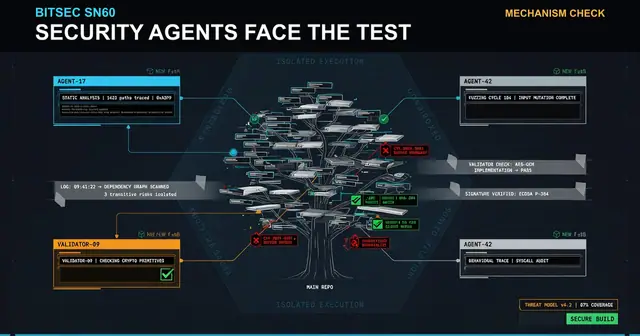
Bitsec’s public sandbox shows the subnet-side system that develops and evaluates security programs. Miners submit code that inspects a target and returns structured vulnerability reports. Validators execute each submission in containers, compare findings with benchmark ground truth and send scores back to Bitsec’s platform.
The repository gives Sentios a more concrete technical ancestry than a generic AI-audit landing page. Competing submissions, sandboxed execution and evaluation against known findings are visible parts of the Bitsec design.
It does not reveal the complete commercial service. The public repository cannot prove which models Sentios selects for a customer, how private code is handled in every deployment, how findings are reviewed before delivery or whether the production system matches the public sandbox at every step.
Bitsec updated that sandbox on September 3, the same day as the Sentios launch announcement. The current code trail matters because older Tao Outsider coverage found a freshness gap between Bitsec’s product story and its public technical evidence. The new commits narrow that gap without closing every question about production.
Smart contracts are the strongest stated category
Sentios places an unusually useful warning on its own product page. It says smart contracts are where the service is strongest today. Broader application-security coverage is active and promising, but still being benchmarked.
That boundary belongs near the center of the launch story.
Smart contracts offer constrained execution environments and failure modes with direct economic consequences. Application security spreads across frameworks, identity systems, business logic, data flows and deployment choices. Success in one category does not automatically transfer to the other.
Sentios says its review can focus on permission boundaries, admin controls, payment logic and sensitive data paths rather than attempting a shallow sweep of an entire repository. That scoping choice is sensible. Whether the competing programs consistently find the right issues inside that scope remains an empirical question.
The pricing makes the service inspectable
The public page reviewed on September 4 lists an on-demand bundle at $25 per 100 normalized source lines of code per scan. It gives a 12,000 nSLOC protocol as a $3,000 example. Continuous plans begin at $1,000 per month for codebases below 5,000 nSLOC, with higher bands for 5,000 to 15,000 and 15,000 to 30,000 nSLOC. Larger scopes move to enterprise agreements.
Pricing can change, and these figures are a dated product-page snapshot rather than a customer invoice.
Still, a visible pricing model changes the nature of the claim. Bitsec is no longer speaking only about a future market for AI security software. Sentios has defined a unit of work, a recurring tier and a sales path.
That does not prove revenue or demand. The site routes prospects to a call, and Tao Outsider found no independently verifiable customer count in the public materials reviewed for this article.
One active miner is a constraint, not a verdict
A TaoSwap status snapshot captured on September 4 showed one active miner on Bitsec SN60 and an emission_value of 0.000051147.
One active miner is thin participation for a system whose premise depends on diverse submissions and competition. It is a relevant network constraint, especially when the commercial product emphasizes several programs attacking the same code.
The snapshot does not show how many competing programs Sentios can run, whether commercial scans use only current subnet miners or how Bitsec schedules private compute. It also cannot measure security quality. TaoSwap is status context here, not product evidence.
What the launch actually changes
Bitsec already had a defensible Bittensor shape. Miners write security programs, validators test them and the strongest submissions influence rewards. Sentios adds the part that subnet projects often leave vague by defining a buyer, a scoped job, a recurring trigger and a price.
The launch should now be judged against a higher bar. A public product deserves public evidence about what it catches, where it fails and how its results change over time.
If Sentios can show that repeat adversarial review catches meaningful regressions between formal audits, SN60 will have a strong answer to a question every Bittensor subnet eventually faces. Who needs the work enough to pay for it?
For now, the verified development is narrower. Sentios is live as a public Bitsec service with defined tiers and an explicit continuous-review thesis. Its effectiveness, customers and revenue remain unverified.
Sources
Bitsec Sentios launch announcement
Bitsec website and pricing update
Sentios public product, process, limitations and pricing
Bitsec September 3 sandbox correction
Was this article useful?
One tap feedback helps us improve each post.