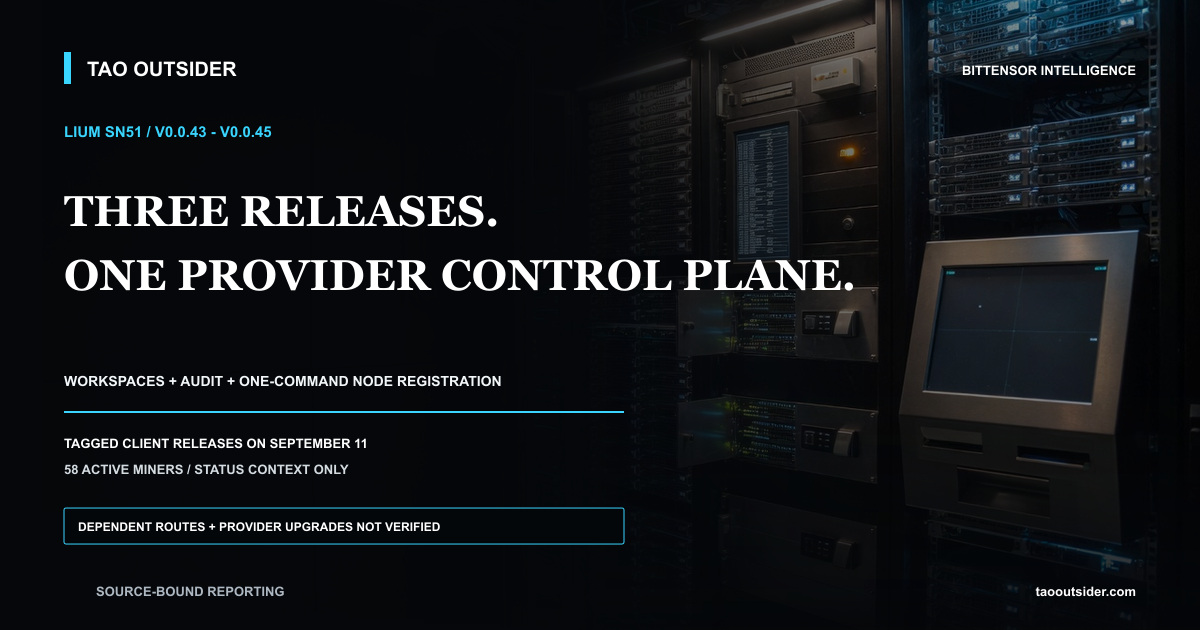
Lium released three versions of its command-line client in less than three hours on September 11. Taken separately, they look like a list of operator conveniences. Taken together, they describe a more consequential change. The Bittensor GPU marketplace is building a provider control plane alongside its rental interface for buyers.
Version 0.0.43 added workspace-aware accounts and a clearer view of provider-node status. Version 0.0.44 exposed account audit records. Version 0.0.45 added a one-command path that can install, register and watch a node from a bare GPU host.
Two more changes landed on the main branch after those releases. They add resumable pod-to-pod transfers and template labels for Hopper and Blackwell compatibility. Neither was part of a newer tag observed during this review, so they belong in a different evidence bucket.
That distinction matters. A merged feature, a tagged client and a deployed server dependency are three different states. Lium reached the second state for the core provider tools. The public sources do not prove every dependent route is live everywhere or that providers have upgraded.
The provider side was carrying too much manual work
GPU marketplaces often market the cleanest side of the transaction. A buyer chooses a machine, starts a pod and runs a workload. The provider side is less forgiving. A host has to report the correct GPU model, public address, port and price. It has to enter the marketplace under the right account, pass validation and remain observable when something fails.
Lium’s pull request for v0.0.45 says the previous account-to-first-node flow took a median of 34 minutes and required providers to type machine details into the portal. Hand-entered values were one source of invalid executor identifiers.
The new lium mine --register <token> path moves those facts onto the host. It reads the GPU through nvidia-smi, resolves the public IPv4 address, takes the configured executor port and obtains a default price from Lium’s public configuration. It then posts the node to the portal and polls its status every 15 seconds.
The command has three meaningful outcomes. Exit zero means the node is listed. Exit one means a named failure or remediation is available. Exit two means registration succeeded while listing remained unconfirmed inside the wait window.
That is not a small UX detail. An automation agent can distinguish “fix this host” from “the marketplace is still processing it” without scraping terminal prose or assuming that a submitted node is already rentable.
The staged GPU test stopped before listing
Lium reports a staged run on an AWS L4 host in which the command moved from a bare server to a registered portal record in three minutes and 18 seconds. The validator reached the node later. Listing failed because its NVIDIA driver was absent from the validator’s allow-list.
The failure is part of the useful evidence, not an embarrassment to hide. It shows that the registration path completed while the market’s hardware validation still rejected the machine. A one-command installer cannot make an unsupported driver acceptable.
The same pull request says an earlier host with insufficient storage was rejected before registration. A separate A10G run also stopped because the reported GPU name did not match the supported model table.
These are project-reported tests. Tao Outsider did not reproduce them. They do not establish time-to-listing, reliability across providers or production adoption.
Workspaces change who can operate an account
Version 0.0.43 adds lium workspaces, workspace-bound keys and a global --workspace selector. The client can list members, create and select workspaces, invite users and transfer billing ownership. Existing pod and provider commands display which workspace is active.
This is the least visually dramatic release and possibly the most important for teams. A personal API key and a shared billing account are tolerable in a one-person experiment. They become an operational liability when several people rent machines, manage providers or automate workloads.
The implementation also checks whether a server advertises workspace support. According to the pull request, a server without the capability keeps the previous output rather than receiving invented workspace behavior. Writes require a user session, while API keys remain suitable for scoped machine operations.
The client-side controls do not prove that access policy is flawless. They do show Lium separating identity, workspace and billing concerns that were previously compressed into one account surface.
Node status and audit records make failures legible
The same release changes provider-node inspection. lium provider node list/get now includes the portal’s computed status and last error. A new watch command follows verification progress, while default queries are scoped to the active provider identity instead of listing every provider’s nodes and billing data.
Version 0.0.44 adds lium audit --account, with filters for action, source client, API key and resource. The proposed output records the actor, action, client and IP behind each event.
There is a hard caveat. At merge time, the pull request described the corresponding account-audit API route as not released and told operators to merge only after the server path was deployed. The GitHub release proves the client package exists. It does not prove that every Lium server currently answers the route.
Audit logs are also evidence of recorded events, not an independent security audit. They can improve traceability without proving that credentials, sessions or workspace permissions are secure under every failure mode.
Two useful tools are merged but not yet in the observed release line
After v0.0.45, Lium merged a pod-to-pod copy command and richer rsync controls. The transfer path uses a temporary key on the source, authorizes it on the destination, pins the destination host key and revokes access after the copy. Resume is enabled by default.
Another merge adds a Runs on field to template listings. It derives CUDA and architecture compatibility from image names and tags, labeling known templates for Hopper, Blackwell or older generations. Unknown metadata stays unknown rather than being guessed.
Both changes address expensive mistakes. One avoids routing large checkpoint transfers through a laptop. The other warns when a CUDA image lacks declared support for a GPU generation. Neither was present in a newer GitHub tag at 13:09 UTC on September 11. They should stay outside the v0.0.45 release claim.
The on-chain context is active, but it cannot prove product use
At TaoSwap block 9,044,495, Lium SN51 showed 58 active miners and 13.43916% of subnet emission, with zero miner burn in the snapshot. That confirms an active Bittensor subnet at one point in time.
It does not reveal how many operators installed the new CLI, how many nodes were registered through the token flow, how many workspace accounts exist or whether audit records are being consumed by customers. It also says nothing about uptime, rental revenue or GPU quality.
The stronger conclusion is narrower. Lium’s provider product now has releases for identity separation, operational visibility and host registration. That is the machinery a decentralized GPU market needs before it can scale beyond manual operator knowledge.
The next proof has to come from observable use. Providers would upgrade, nodes would reach listed status, teams would separate access through workspaces and the marketplace would publish service-level evidence across the process.
Sources
One-command provider registration pull request
Workspace support pull request
Provider node status pull request
GPU template compatibility pull request
Was this article useful?
One tap feedback helps us improve each post.