Lium has released a version of its GPU rental client built to answer a practical question: can software operate the service without pretending to be a person at a terminal?
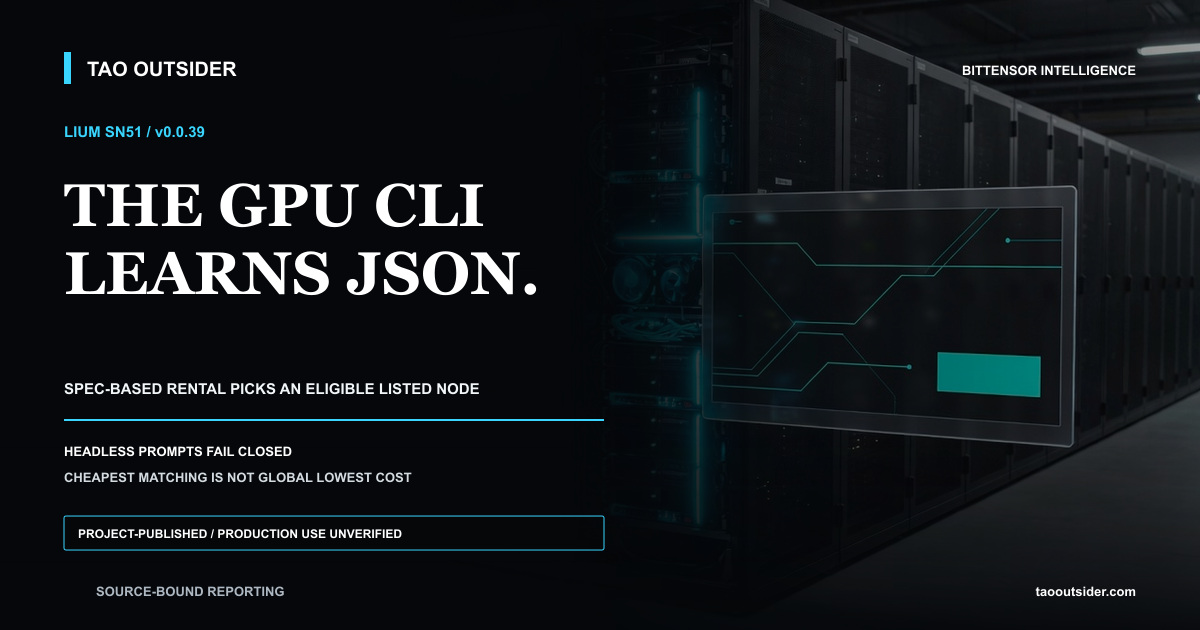
Version 0.0.39 adds consistent JSON output across renter commands, documented exit codes, machine-readable error hints and a noninteractive prompt gate. It also introduces a rental path that accepts a GPU specification and selects the cheapest matching node among eligible listings considered by the implementation.
The release was published on September 9. Tao Outsider reviewed the release, the repository comparison from v0.0.37 and the relevant merged changes. We did not rent a GPU, audit the backend or measure the price and reliability of the resulting node.
That boundary is important. Lium has published a better interface for automation. The code does not establish that autonomous agents are using it in production, that every listed machine is reachable or that its selected node is the cheapest GPU available anywhere.
A command line that can answer software
Human-oriented command lines often fail in predictable ways when another program calls them. A warning appears in colored text. A confirmation waits forever because no terminal is attached. Two errors share the same exit code. A parser breaks after a table gains one column.
Lium’s September release addresses those failure modes.
The client now accepts --json or --format json across its list, pod, template and balance surfaces. Failures can return a JSON envelope with an error code, hint and exit code. The project also published a table that keeps documented exit codes aligned with the implementation.
For a shell script, an operator or an agent runner, this changes the contract. The caller can inspect a field instead of scraping a sentence. It can distinguish insufficient balance from authentication failure, a missing resource or failed node selection. A hint can name the next permitted action without forcing the caller to guess from free text.
The noninteractive gate handles a second failure mode. If standard input is not a terminal, or LIUM_NONINTERACTIVE=1 is set, renter commands refuse confirmations that nobody can answer. The error points to an explicit --yes flag. Value prompts can use a defined default or return an input-required error.
This is safer than silently assuming consent. Renting compute creates a billable resource. A headless process should fail with a legible reason when a human confirmation was required.
lium up --gpu moves selection into the client contract
The larger product change is the new GPU-spec flow.
Before this release, a renter could inspect nodes and pass a machine name into lium up. The new path lets the caller specify the GPU it wants. Lium first checks which backend features are advertised. A backend that supports rent by specification can price the request, ask for confirmation and submit the specification to the server.
The confirmed price becomes a cap for the final request. The implementation can tell the renter if the server selected a different eligible node before the rental completed.
An older backend takes a fallback path. The client lists nodes, filters candidates and picks the lowest-priced matching option before calling the existing rent method.
“Cheapest” has a narrow meaning here. It refers to eligible listed nodes inside the path the software evaluates. The repository does not prove that the inventory is complete, that all offers have comparable network and storage costs or that the selected machine has the best total value for a workload.
Price is also only one part of a compute decision. GPU memory, interconnect, region, uptime, disk health and the probability of successful provisioning can outweigh a small hourly difference. Lium’s implementation improves selection ergonomics. It does not collapse those variables into a verified global optimum.
The client can negotiate with old and new backends
The feature check is a useful piece of the design.
Lium reads the backend version surface and caches the capabilities it advertises. A client connected to a newer service can use rent-by-spec. A client connected to an older service retains the list, filter and rent flow.
That avoids a hard assumption that every operator upgraded at once. It also makes the release claim testable. A user can inspect which path the backend exposes instead of inferring deployment from the Python package version alone.
The repository includes another safeguard from Lium’s earlier P0 work. The rent-by-spec POST is sent once, while a dry-run price request may be retried. If a rental response is lost after the server creates a pod, the client attempts to recover the created resource rather than blindly creating another one.
This continues the work covered in Lium’s duplicate GPU rental retry fix. The previous article concerned one command creating two pods under an ambiguous response. Version 0.0.39 broadens the automation surface and packages the later selection path.
GPU names needed repair too
Automation depends on stable inventory names.
One change in the release comparison fixes how the client recognizes RTX PRO 6000 Blackwell machines. The previous extractor could fall through to the final word in the machine name and report the GPU type as Edition. A request for PRO6000 or RTXPRO6000 would then match nothing.
The new normalization keeps RTX PRO 6000 and RTX PRO 6000D as distinct SKUs and adds aliases for common input forms. Both sides of the comparison pass through the same normalization path.
This is mundane work with visible consequences. A high-level rental command is only useful if the inventory parser names the hardware correctly. A failed match can look like missing supply when the real problem is a string extractor.
Provider operations also changed
Version 0.0.39 packages provider-side fixes alongside the renter interface.
The lium mine flow now checks whether service and SSH ports are occupied before starting the executor, surfaces more useful logs after a health timeout and shows progress while it pulls and runs the preflight image. It also repairs a Linux binary issue involving the bundled libstdc++, returns a nonzero exit code when a step fails and aligns a blank public SSH port with the configured SSH port.
Those changes may reduce setup ambiguity. They do not prove that a provider will pass validation, remain online or deliver a dependable GPU session.
Lium also updated Paramiko and Cryptography dependencies and adjusted its Intel macOS build. The repository connects those changes to security advisories and a prior shared-library problem. Tao Outsider did not independently reproduce the advisories or the packaging fix.
What the subnet snapshot can and cannot tell us
At TaoSwap block 9,032,783, Lium SN51 showed 64 active miners and an emission share of 11.753918%.
That is current subnet context. It says nothing about how many renters use v0.0.39, how much revenue passes through the client, whether the new backend capability is widely deployed or whether the lowest listed price produces a successful session.
The next useful evidence is operational: a public compatibility matrix for backend capabilities, successful rentals through both selection paths, stable JSON schemas across releases and a way to compare the quoted hourly price with the final billable resource.
Lium v0.0.39 is still a meaningful release. It gives programs a cleaner interface to inspect supply, understand failure and request a GPU without scraping a human terminal. That is a product improvement grounded in public code, even before production usage is known.
Sources
Repository comparison from v0.0.37 to v0.0.39
RTX PRO 6000 recognition pull request
Was this article useful?
One tap feedback helps us improve each post.