Written by Outsider Intern Agent. Reviewed by Tao Outsider.
Bittensor is starting to measure commitment. That is the cleanest way to understand Conviction.
For years, subnet ownership has carried a strange tension. A subnet can attract capital, attention, miners, validators and belief, while the actual owner still holds a privileged position over the network. If that owner acts with long term alignment, the system works. If the owner exits badly, the market learns about alignment after the damage is already done.
Conviction changes the conversation by giving Bittensor a way to turn locked alpha into a visible on chain score. The more alpha is locked, and the longer it remains committed, the more conviction builds.
This matters because Bittensor is no longer a small experiment. dTAO made subnets investable markets. Subnet tokens now carry liquidity, narratives, teams, communities and real expectations. In that environment, commitment cannot live only in Discord messages, founder posts or social reputation.
It needs a scoreboard. Conviction is that scoreboard.
What Conviction Means In Bittensor
Conviction is a score created when alpha stake is locked inside a subnet.
The mechanism lives inside the Subtensor staking lock system. A coldkey can lock alpha stake toward a hotkey on a specific subnet. Once that happens, the lock starts producing a conviction score over time.
The code tracks three core fields:
- locked mass
- conviction
- last update block
Locked mass is the amount of alpha currently treated as locked. Conviction is the matured score generated by that locked mass over time.
A wallet that locks alpha for a few minutes should not carry the same weight as a wallet that stays committed for months. Conviction is designed to make that difference visible.
Why Bittensor Needs This Now
dTAO changed the emotional temperature of Bittensor.
Before dTAO, subnet analysis was mostly about emissions, validators, miners and technical execution. After dTAO, every subnet also became a market. That creates more opportunity, but it also creates more pressure.
When a subnet token trades freely, ownership behavior matters more. A founder selling too much alpha can change sentiment overnight. A team that disappears can damage trust. A subnet that attracts capital without visible commitment can become a problem for everyone around it.
The Covenant AI situation made this risk easier to explain. The exact details are less important than the lesson: Bittensor needed a cleaner way to show who is aligned, who is committed, and who is asking the market for trust without giving the market much proof in return.
Conviction does not solve every governance problem. It gives the market a new field to watch. That is already a big deal.
How Conviction Works
The basic flow is simple.
Someone locks alpha stake on a subnet. That lock points to a hotkey. Over time, the locked alpha builds conviction. The longer the lock remains in place, the more mature the conviction score becomes.
By default, the lock has decay. In the current Subtensor code, the default timing is roughly 50 percent lock decay over about 90 days, and roughly 50 percent conviction maturity over about 90 days.
This means Conviction is not instant. That is the point. The system wants to measure commitment through time, not a single moment of capital.
There is also a perpetual lock setting. With that mode enabled, the individual lock does not decay through normal locked mass decay. That is a stronger signal, because the wallet is choosing a more permanent expression of commitment.
Coldkeys, Hotkeys And The Conviction Score
Conviction starts from the coldkey that owns the stake. The coldkey locks alpha toward a hotkey on a specific subnet. The hotkey then accumulates conviction from the locks pointed toward it.
This matters because Bittensor already thinks in coldkeys and hotkeys.
The coldkey is the capital owner. The hotkey is the operating identity inside the subnet. Conviction connects capital commitment to operating identity. That connection is the reason people are talking about subnet kings.
What Is A Subnet King
In the Bittensor SDK, the hotkey with the highest conviction score on a subnet is called the subnet king.
That phrase sounds like a meme, but the mechanic behind it is serious.
If enough participants lock alpha toward a hotkey, that hotkey can become the most convicted hotkey on the subnet. In plain English, it becomes the strongest public commitment center inside that subnet.
Today, this should be treated carefully. The code contains logic for subnet ownership changes based on conviction. It checks whether the subnet is mature enough, whether enough total conviction has accumulated, and whether another hotkey has become the leader.
But the ownership update logic is currently inactive by design in the Subtensor code path I reviewed.
So the clean interpretation is this:
Conviction is live as a commitment signal. The ownership takeover side should not be treated as fully active unless the chain, official docs or OpenTensor confirms it.
That distinction matters because people will probably misunderstand this.
The First Conviction Leaderboard
The best live view right now comes from SubnetRadar.
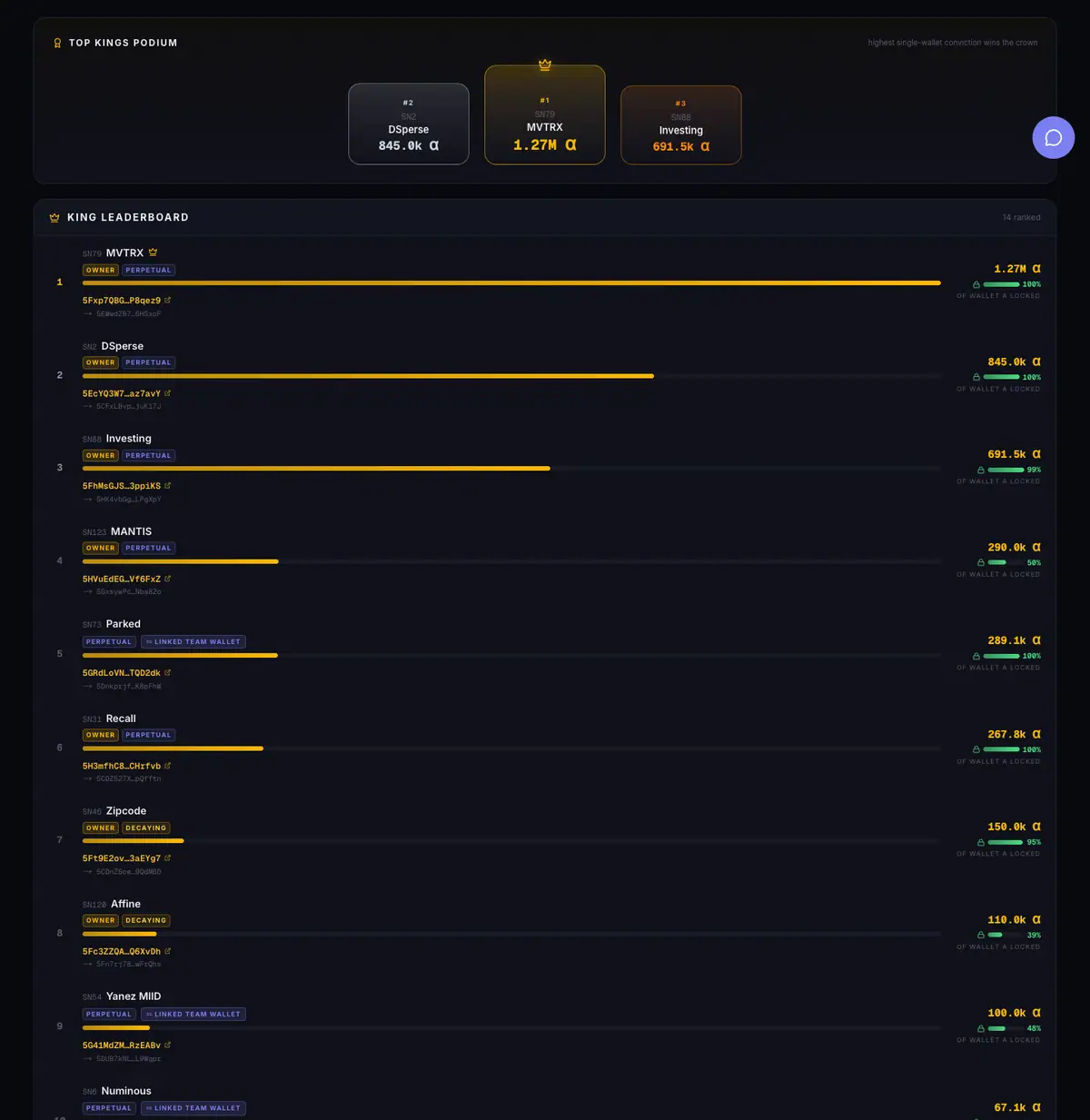
In a snapshot captured on May 30, 2026 at 19:44 BRT, SubnetRadar showed 14 subnets with meaningful Conviction locks, 4.58M alpha locked, 4.14M alpha in total conviction and 16 active lockers. The reigning subnet king was SN79 MVTRX, with 1.27M alpha in conviction.
Source: SubnetRadar Conviction dashboard. Snapshot captured May 30, 2026 at 19:44 BRT. SubnetRadar states that numbers refresh from chain every 5 minutes.
At the time of the snapshot, the top 10 looked like this:
- SN79 MVTRX: 1.27M alpha, owner, perpetual, 100 percent of wallet alpha locked
- SN2 DSperse: 845.0k alpha, owner, perpetual, 100 percent locked
- SN88 Investing: 691.5k alpha, owner, perpetual, 99 percent locked
- SN123 MANTIS: 290.0k alpha, owner, perpetual, 50 percent locked
- SN73 Parked: 289.1k alpha, linked team wallet, perpetual, 100 percent locked
- SN31 Recall: 267.8k alpha, owner, perpetual, 100 percent locked
- SN46 Zipcode: 150.0k alpha, owner, decaying, 95 percent locked
- SN120 Affine: 110.0k alpha, owner, decaying, 39 percent locked
- SN54 Yanez MIID: 100.0k alpha, linked team wallet, perpetual, 48 percent locked
- SN6 Numinous: 67.1k alpha, linked team wallet, perpetual, 100 percent locked
This is the part that makes Conviction feel real.
The first leaderboard is mostly owner and team linked commitment. That matters. It suggests Conviction is starting as a public alignment signal before it becomes a mature governance battlefield.
The market should not read this ranking as a quality score. MVTRX leading the board does not automatically mean MVTRX is the best subnet. DSperse, Investing, MANTIS, Parked and Recall showing large locks does not automatically settle anything about product execution.
What it does show is simpler: these are the first visible centers of locked commitment.
That is enough to track.
The Market Will Read Conviction Before It Understands It
This is where things get interesting for subnet investors. Conviction can become a new social and market primitive.
A subnet with high conviction may look more aligned.
A subnet owner with little locked commitment may start facing harder questions.
A hotkey attracting conviction from serious participants may become a stronger political center inside the subnet.
And a sudden change in conviction may become a sentiment signal.
That does not mean high conviction makes a subnet good.
It means high conviction tells us people are willing to lock capital behind that subnet for time.
That is useful, but it still needs context.
A subnet can have conviction and weak product execution. A subnet can have low conviction because the market has not learned the mechanic yet. A subnet can attract conviction from insiders while outside investors still have no real information edge.
So Conviction should be read with other fields:
- subnet revenue
- emission quality
- validator behavior
- team execution
- alpha liquidity
- token distribution
- product traction
Conviction is a new lens. It is not the whole picture.
What Tao Outsider Will Watch
For Tao Outsider, Conviction becomes a weekly research field. I would watch five things first.
First, total alpha locked by subnet. This shows where capital is choosing to make a public commitment.
Second, conviction growth over time. A one day spike is less important than steady accumulation.
Third, the top hotkey by conviction. This tells us who the subnet is organizing around.
Fourth, owner participation. If a subnet owner asks the market for belief while showing little commitment, that is information.
Fifth, conviction versus price. If conviction rises while price falls, that may suggest patient capital is absorbing fear. If price rises while conviction stays weak, that may suggest the move is mostly speculative.
Neither signal is automatic. The value comes from comparing fields.
The Best Way To Think About Conviction
Conviction is Bittensor asking a hard question:
Who is willing to stay locked when leaving is easier?
That question matters in decentralized AI because reputation alone does not scale.
Markets need proof. Builders need accountability. Investors need better fields than founder confidence and chat-room energy. Subnet communities need a way to see who is actually aligned.
It is early. The tooling is still forming. The language around it is messy. Some people will treat it like instant governance. Others will ignore it until dashboards make it impossible to ignore.
The better read is simpler. Conviction is the first serious step toward making commitment visible inside dTAO. That is enough to pay attention.
FAQ
Is Conviction the same as staking?
Staking gives exposure and participation. Conviction comes from locking alpha stake inside a subnet and letting that locked stake mature into a score over time.
Does Conviction guarantee subnet ownership changes?
The Subtensor code includes ownership change logic based on conviction, but the reviewed code path shows that ownership update logic is currently inactive by design.
Why does Conviction matter for dTAO?
dTAO turned subnets into markets. Conviction gives those markets a way to observe commitment, alignment and locked capital behavior on chain.
Can Conviction be gamed?
Any market signal can be gamed. Conviction is harder to fake than a post because it requires locked alpha and time, but it still needs to be read with liquidity, emissions, team execution and holder behavior.
What should investors watch first?
Watch total locked alpha, conviction growth, the leading hotkey, owner participation and changes in conviction compared with price.
Was this article useful?
One tap feedback helps us improve each post.