Gravity Payments made headlines in 2015 by announcing a $70,000 minimum salary for every employee.
The company raised a floor. Bittensor is doing something that points in the opposite direction.
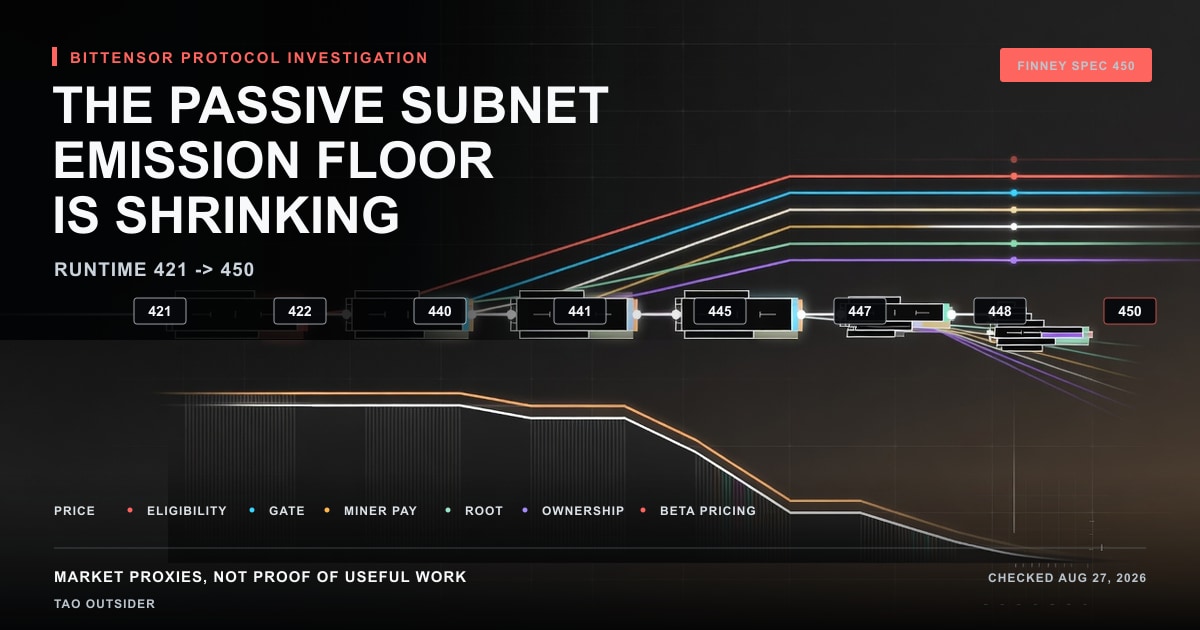
Across a fast sequence of runtime changes in 2026, Bittensor has been reducing the economic comfort of owning a subnet that merely occupies a registered slot. The protocol moved cross-subnet emission toward price demand, made new subnets start with pool-side emission disabled, introduced a smooth gate that compresses the weak tail, restored a penalty for withholding miner incentives, rebuilt Root dividends and made subnet ownership contestable through matured conviction.
The Gravity comparison is only the opening. An employee salary and a blockchain emission are not the same thing. Gravity’s policy was about compensation for people. Bittensor’s rules allocate scarce protocol issuance among competing markets.
The useful parallel is the floor.
Gravity raised one so nobody earned too little. Bittensor is compressing the floor that allowed a subnet to earn something simply because it existed.
That sounds bullish for useful subnets. It is also more complicated than the slogan. Bittensor still cannot inspect a product and know whether it has customers, revenue or useful output. Its on-chain proxies include price demand, miner incentives, eligibility, stake locks and conviction. Those signals can reward real demand. They can also reward attention, financial reflexivity and capital concentration.
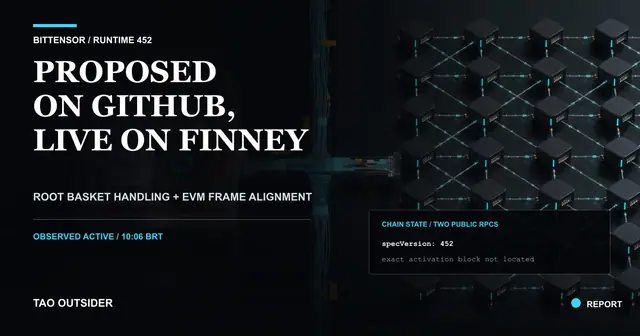
This investigation prioritizes the code and Finney over the release calendar. On August 27, 2026, Finney moved from specVersion 448 to specVersion 450 at block 8,938,465. The v450 release page still described the package as proposed and awaiting signatures after the chain had begun executing it. Runtime 430 and 431 never appeared as active Finney specs in the archive sequence examined for this article. Their economic changes arrived on-chain inside Runtime 432. Runtime 444 and 449 did not appear either.
Here is what actually changed.
Before Runtime 421: emissions could reward motion around the market
Bittensor emissions have two layers that are easy to mix together.
First, the chain divides each block’s TAO emission among eligible subnets. That cross-subnet share determines the TAO and alpha injected into each pool.
Second, each subnet distributes its participant-side alpha_out at epoch. Under the current runtime, that alpha is split 18% to the subnet owner, 41% to miners and 41% to validators and their stakers.
The recent changes touched both layers, but in different ways.
Before Runtime 421, the cross-subnet calculation used a flow-based signal. Capital movement around subnet pools could influence allocation. The network was trying to discover demand, but flow is not the same thing as enduring demand. A burst of movement can be temporary, strategic or circular.
The release train that began with Runtime 421 changed the question from “where is capital moving?” to “where is the moving price saying demand exists?” It also started attaching costs to behavior the protocol wanted to discourage.
That was the beginning of the current regime.
The runtime map
| Runtime | Finney status | Material change for this thesis | Why it matters |
|---|---|---|---|
| 421 | Active from block 8,466,530 | Replaced flow-based cross-subnet allocation with EMA price shares and added MinerBurned scaling | Demand price became the starting signal; withholding miner incentives reduced a subnet’s share |
| 422 | Active from block 8,472,455 | New subnets defaulted to pool-side emission disabled | Registration stopped guaranteeing immediate access to TAO-side injection |
| 423 | Active from block 8,486,593 | Consolidated the 421 and 422 changes into the main release train | Important operationally, but not a separate new economic rule |
| 424 | Active from block 8,513,820 | Balancer and locked-alpha fixes | Checked, but excluded from the main economic map because it did not create a new cross-subnet allocation rule |
| 430 and 431 | Proposed, never observed active | Packaged Conviction ownership enforcement and removed root_proportion from cross-subnet shares | Their code entered later ancestry; Finney skipped these spec numbers |
| 432 | Active from block 8,636,190 | Carried the 430 and 431 economic package on-chain | This is where price-only cross-subnet weighting and original Conviction enforcement became live in the observed chain history |
| 437 | Active from block 8,679,056 | Added miner registration collateral and key lineage | Raised the cost of disposable miner identities and made earning the path to collateral release |
| 438 | Active from block 8,686,925 | Required exact mechanism-emission vectors | Prevented short custom vectors from silently starving trailing mechanisms |
| 439 | Active from block 8,713,025 | Exposed Conviction and owner-cut auto-lock controls through EVM | Expanded the ownership and lock interface without changing the base owner cut |
| 440 | Active from block 8,713,793 | Added the smooth emission gate | Compressed weak adjusted demand and redistributed more emission toward the head |
| 441 | Active from block 8,765,683 | Root Reborn | Replaced mechanical Root dividend selling with validator-specific basket accounting |
| 442 | Active from block 8,770,559 | Fixed ineligible Root stake diverting dividends into alpha | Closed a yield distortion created around Root eligibility |
| 443 | Active from block 8,772,666 | Gated basket weight setting | Kept Root Reborn on a null strategy while state-growth and curation risks were reviewed |
| 445 | Active from block 8,831,003 | Restored MinerBurned scaling before the gate | Made miner treatment part of the live cross-subnet allocation again |
| 446 | Active from block 8,843,319 | Changed Conviction denominator to eligible alpha | Corrected accounting but made ownership takeovers cheaper than intended |
| 447 | Active from block 8,844,992 | Required one hotkey to exceed 18% of eligible alpha as matured Conviction | Repriced ownership contests around the 18% owner cut |
| 448 | Active from block 8,894,682 | Hardened Root claims and staking operations | Wrapped the earlier emission, Root and ownership rules without adding a new cross-subnet curve |
| 449 | Not observed active | Unshipped packaging stage for curated Root weights | Its changes were superseded by Runtime 450 |
| 450 | Active from block 8,938,465 and current at review | Added canonical beta-basket pricing, a flow-neutral market index, total-return accounting and chain-first Root APIs | Makes Root basket reporting more legible without proving investment skill or useful subnet output |
The table is intentionally stricter than a release index. A tag proves code was packaged. A proposed release proves it was offered. Finney activation proves the network began executing it.
Runtime 421: price demand replaces flow, with a miner-burn penalty
Runtime 421 was the first major break in this sequence.
The old rule used flow-based shares. Runtime 421 changed get_shares so each eligible subnet’s EMA price became the base cross-subnet weight. The same release multiplied that weight by 1 - MinerBurned, then normalized the result.
In plain English, a subnet with stronger smoothed price demand received more of the network emission. A subnet that directed miner incentive to owner-controlled or otherwise immune hotkeys gave up part of that share.
The release also changed the alpha injection cap. root_proportion continued to limit how much alpha could be injected into a subnet pool, while excess TAO could move toward chain buys. This protected the relationship between TAO injection and the alpha owed to Root stakers.
Who gained? Subnets with sustained demand, a cleaner miner-incentive path and enough age for their moving price to respond.
Who lost? Subnets relying on transient flow and subnet owners redirecting miner rewards to themselves.
The intended behavior was clear. Attract durable market demand and pay the miners doing the work.
The limitation was equally clear. EMA price is a market signal, not a customer invoice. A well-marketed subnet can attract price demand before it proves utility. An excellent product can remain underpriced.
Runtime 422: registration no longer opens the full emission valve
Runtime 422 made a quieter change with large consequences for new subnet economics.
Newly registered subnets began with SubnetEmissionEnabled = false.
While that flag is false, the subnet receives no TAO-side network share. The chain injects no tao_in or alpha_in into its pool and performs no excess-TAO chain buys for it. The share it would have received is redistributed among enabled subnets.
Participant-side alpha_out is different. It continues to accrue and can be distributed through the normal owner, miner and validator split.
That distinction prevents a common misunderstanding. An emission-disabled subnet is not necessarily inert. It can register participants, run epochs and build a market. What it does not have is an open pool-side TAO emission valve.
The owner can start the subnet. Root controls enablement. Registration, operation and full eligibility are separate states.
The intended incentive is to make a new subnet establish itself before drawing from the shared TAO stream. The possible side effect is a harder cold start. A young team may need miners and validators before it receives the pool support that makes participation attractive.
Runtime 423 consolidated this direction. Runtime 424 repaired adjacent Balancer and locked-alpha behavior, but it did not add a separate headline allocation rule, so it belongs in the audit trail rather than the main thesis.
Runtimes 430 to 432: price-only cross-subnet allocation and ownership enforcement
The release history gets deceptive here.
Runtime 430 code enabled Conviction-based subnet ownership enforcement. Runtime 431 documentation described a monorepo release with two important economic changes. It removed root_proportion from the cross-subnet split and enforced a Conviction ownership rule for older subnets.
But the archive sequence examined for this article did not show either spec running on Finney. The active chain moved from Runtime 424 to Runtime 432 at block 8,636,190.
The changes survived in the ancestry of Runtime 432. Specs 430 and 431 were proposal and packaging stages. Runtime 432 carried the package into active execution.
The cross-subnet formula then became price multiplied by 1 - MinerBurned, without root_proportion deciding how the network share was divided among subnets.
root_proportion did not vanish. It remained important inside each subnet. It still limits pool injection and determines the part of validator dividends reserved for Root TAO stakers when the Root dividend gate is open.
This separation matters. Price demand decides the competition between subnets. Root proportion handles part of the accounting within a subnet.
The original Conviction rule was also narrower than product performance. For subnets old enough to be contestable, a sufficiently convicted hotkey could take ownership. That mechanism dealt with control of the 18% owner position. It did not score the subnet’s product.
Runtime 437: miners put collateral behind registration
Runtime 437 did not change the cross-subnet curve. It changed the economics of joining and surviving inside a subnet.
The release introduced miner collateral. A registration price could be divided between a burn and locked collateral staked to the registering hotkey. Each tempo, earned miner incentive and validator dividends release a configured multiple of collateral back into withdrawable stake.
Earning is the exit route.
That makes disposable registrations more expensive. A miner that registers, fails to contribute and is pruned can leave capital locked. The lock can survive deregistration, and a blacklisted or unscored miner may not have an easy path to release the remainder.
The intended behavior is persistence. A miner should have something at risk after registration and throughout the period needed to earn the collateral back.
The possible side effect is higher working-capital pressure for small miners. A bad validator, weak task market or broken scoring system can trap honest participants along with low-quality ones.
Runtime 438 tightened mechanism-level distribution. A custom mechanism emission split must now contain one entry for every active mechanism and sum to 65,535. Before the fix, a short vector could be padded with zeroes and silently starve trailing mechanisms. The change operates inside a subnet and materially affects how a multi-mechanism subnet distributes what it receives.
Runtime 439 then exposed stake locks, miner Conviction and owner-cut auto-lock controls to EVM clients. Owners could opt to compound new owner-cut emission into locks. The interface made the ownership contest easier to operate and observe. It did not change the 18% owner cut or prove that locked owners were good builders.
Runtime 440: the emission gate compresses idle carry
Runtime 440 made the visual shape of Bittensor emission more selective.
Price demand remained the base input. The runtime added a smooth gate before final normalization.
Under the gate implementation inherited by Runtime 450, the chain starts with each eligible subnet’s EMA price share. It scales that share by 1 - MinerBurned and renormalizes. It then finds a midpoint called theta, normally the 32nd-highest positive adjusted share. That midpoint is recalculated every 360 blocks by default.
The gate follows this formula.
gate_i = 1 / (1 + (theta / adjusted_share_i)^h)The default exponent h is 3.
A subnet at the midpoint passes half of its adjusted weight. A subnet well above the midpoint passes almost all of it. A subnet far below passes much less. Final shares are normalized again.
Rank 32 does not act as a universal guillotine. A subnet below that rank can still receive a nonzero gated value. The curve is gradual, ties are possible and a tiny result can round to zero. The runtime also includes fallbacks so an all-zero calculation does not strand the block emission.
The original V440 release described a quantile-based bar. Code merged immediately afterward moved the mechanism toward a rank-pinned bar, and the current V448 documentation and code set the default at rank 32. That is a useful example of why the latest active code outranks a release-day explainer.
The practical effect is still harsh. A weak tail no longer carries the same economic floor. More emission moves toward subnets already above the demand bar.
That rewards focus and can lower the value of a parked slot. It can also create a feedback loop. Emission deepens liquidity, liquidity can attract more demand and demand earns more emission. If the market is wrong, the gate can concentrate the error.
Runtime 441: Root Reborn changes what Root does with its share
Root Reborn is adjacent to the idle-subnet thesis, but it should not be described as another version of the emission gate.
The cross-subnet allocation still determines how much each subnet receives. Inside a subnet, part of validator dividends can belong to Root stakers through root_proportion when the Root dividend gate is open.
Before Runtime 441, that alpha was mechanically sold back into TAO. Root stakers received a passive TAO path, and every subnet absorbed price-insensitive selling of the alpha owed to Root.
Root Reborn replaced that path with one escrowed basket per Root validator. Under the launch default, without a custom vector, each dividend accumulates in its originating subnet alpha. Once curation is enabled, a validator can publish weights, sell the arriving dividend once and redeploy the TAO across chosen destinations.
The holdings remain in chain-controlled escrow. Root stakers accrue a proportional entitlement to the fund and realize it through a claim.
The intended behavior is to turn Root validators from passive pipes into visible allocators. Good allocation can compete for delegation. Mechanical sell pressure disappears under the null strategy, and active strategies can express a view across subnets.
The risks move rather than vanish. Root validators can concentrate baskets, copy each other or chase performance. A public weight vector can become a market signal before it becomes evidence of product quality. Curation also adds operational and state complexity.
Runtime 442 closed a specific distortion. Ineligible Root stake held by a hotkey without a Root UID had been able to enlarge the split denominator and then divert too much of a validator’s dividend to alpha. The fix kept the weighted Root amount in the denominator but denied the Root-basket credit to an ineligible hotkey. The unclaimed Root portion is redistributed among eligible Root validators or recycled when none qualify.
Runtime 443 then gated stake_into_basket and related weight-setting behavior while state growth and rollout safety were reviewed. That restraint belongs in the story. Root Reborn was not a single switch from passive yield to fully open curation. It launched with parts of the allocation controls deliberately disabled.
Runtime 445: MinerBurned returns before the gate
The code history between Runtime 443 and 445 contains a commit removing miner-burn scaling, followed by a release that restores it.
The important chain fact is that no Runtime 444 activation was observed. Finney moved from 443 directly to 445 at block 8,831,003.
Runtime 445 therefore arrived with MinerBurned active in the live formula.
The current sequence runs as follows.
demand share = subnet EMA price / total EMA price
burn-adjusted share = demand share * (1 - MinerBurned)
gated share = burn-adjusted share * smooth gate
final share = gated share / total gated shares
MinerBurned is the previous tempo’s proportion of miner incentive withheld because it was directed to subnet-owner hotkeys. The amount counts whether the subnet later recycles or burns it. Changing the recycle setting cannot avoid the network-share penalty.
Who gains? Subnets with real miner competition and low owner capture.
Who loses? Owners using miner slots as a route to redirect the miner allocation back to themselves.
What behavior does it encourage? Pay miners through the protocol instead of presenting an active subnet while the owner captures the miner side.
What does it miss? Almost everything off-chain. MinerBurned cannot detect a private rebate, an unfair task, hidden whitelisting, delayed payment or a validator that scores badly. It is a precise measure of one on-chain behavior, not a fairness oracle.
There is also a safety fallback. If every subnet’s adjusted weight becomes zero, the runtime restores the unadjusted price shares so emission is not stranded.
Runtimes 446 and 447: Conviction is normalized around the 18% owner cut
Conviction deals with ownership, not emission performance.
Runtime 446 changed the takeover denominator from outstanding alpha to eligible alpha:
eligible alpha = SubnetAlphaOut - SubnetProtocolAlpha - AlphaBurnedThat accounting correction removed protocol-owned and burned balances from the contest. It also lowered the effective amount a challenger needed. The release team’s own analysis concluded that takeover cost had fallen farther than intended.
Runtime 447 responded with a stricter rule.
For a subnet at least one year old, one challenger hotkey must hold more than 18% of eligible alpha as matured Conviction. That same hotkey must also exceed the current owner’s Conviction. Conviction spread across several challenger hotkeys does not satisfy the single-hotkey gate.
The 18% number mirrors the owner cut. Under the current participant-side split, the subnet owner receives 18% of alpha_out. A challenger now has to put more than that fraction of eligible alpha behind one matured claim before taking the owner position.
Owner locks mature immediately for defensive purposes. Challenger locks mature over time. The official release describes the current challenger timescale around 43 days, but that timing is a parameterized mechanism rather than a permanent law.
This makes a takeover visible and expensive. It can discourage abrupt owner exits and abandoned slots. It can also favor capital-rich challengers over better operators with less balance-sheet capacity.
The protocol still does not ask whether the challenger has a product, team or plan. It asks whether one hotkey has enough matured economic commitment to take control.
Runtime 448 wrapped that rule with improved Root claim envelopes, staking indexes, stake-move limits and linked orders. It did not introduce another cross-subnet emission curve or replace the 18% Conviction threshold.
Runtime 450: Root basket performance gets a chain-first accounting layer
Runtime 450 does not rewrite the subnet emission curve. It changes how Root Reborn baskets, beta positions and staker returns are recorded and displayed.
The release sequence is another warning against reading labels as live state. RaoFoundation published v450 on August 27 as a proposed prerelease awaiting a second multisig signature. Historical Finney RPC evidence shows Runtime 448 at block 8,938,464 and Runtime 450 at block 8,938,465. The chain had already resolved the deployment question.
The deployed package superseded an unshipped Runtime 449 stage. It carried curated Root weights under the existing cap and added four accounting records.
First, BetaBaseline records a display baseline when a fund first mints shares. The runtime stamps the baseline using realizable quotes bounded by the pool’s TAO reserves. That choice is intended to stop a thin pool’s temporary spot price from poisoning a permanent baseline.
Second, BetaIndexSnapshot creates a chained, NAV-weighted market index. The project says deposits and redemptions are excluded from index movement, so the series should move with fund performance rather than cash flow.
Third, BasketTwr compounds a per-fund total-return accumulator when dividends are minted. A staker return over a window becomes the ratio between two samples. The separate staker_yield field remains a mark of pending entitlement, not a historical return series.
Fourth, version 3 beta runtime APIs expose pricing, index, position and portfolio views. Pagination and portfolio size are capped so a public RPC does not become an unbounded scan of global state. The SDK and btcli are meant to prefer these on-chain values when connected to Runtime 450, while older frozen tables remain a pre-upgrade fallback.
The same release brings set_root_weights into the transaction-pool rate-limit guard. Rate-limited calls should be rejected before they land as free failing extrinsics.
Who gains? Root validators and stakers gain a canonical chain record for comparing baskets. Interfaces no longer need to reconstruct every displayed number from local tables. A validator with a consistent allocation record has a clearer object to show.
Who loses? Interfaces built around incompatible local calculations lose room to define their own numbers. A basket that benefited from deposit timing or unclear return labels may look less flattering under a flow-neutral index and time-weighted return accumulator.
What behavior does the protocol encourage? Publish weights within the rules, let the chain record a comparable history and compete for delegation with more legible accounts.
The boundary remains severe. Tao Outsider did not independently recompute the migration baselines, index levels, basket returns or portfolio API outputs. The project’s claims of flow neutrality, migration continuity and 1,482 passing tests are implementation evidence, not an external audit. Canonical accounting can make a strategy easier to inspect. It cannot prove the strategy is intelligent, the underlying subnets are useful or future returns will be positive.
What builders and analysts said on X, and where the code disagrees
The public argument began before the final code landed.
On March 31, Investing88 warned that many subnets were withholding miner emissions and proposed the exact shape later used by the runtime. The post wrote, “Subnet_Emission = Raw_Emission * (1 - Burn_Rate).” It treated miner burn as a threat to Bittensor’s proof-of-useful-work ambition. Runtime 421 implemented the same high-level penalty, and Runtime 445 restored it in the live gated formula.
On April 3, Andy wrote that emissions “follow net TAO flows” and argued that sustained inflows were harder to fake than price. That described the flow-centered debate of the moment. Runtime 421 then moved the active formula in the other direction, back to EMA price. The post remains useful as market interpretation, but it is not a description of Runtime 450.
On April 10, Bittensor founder Jacob Steeves wrote that ownership would be determined by a team’s “long term economic commitment to the project.” The statement followed a contentious subnet-owner exit and set the direction for lock-based ownership. The code that followed is narrower than the phrase. Runtime 447 measures matured Conviction on one hotkey against eligible alpha. It does not measure team continuity, governance quality or commitment in the ordinary human sense.
The gap between language and mechanism reveals the boundary. Public narratives describe intentions. Code defines the proxy the chain can actually execute.
Who is likely to gain
Subnets with sustained TAO demand are best positioned under price-based allocation and the gate.
Teams that pay miners through the intended incentive path avoid the MinerBurned haircut.
Established products with real users may benefit if use eventually produces market demand. The protocol cannot create that link automatically. A commercial loop can reinforce it.
Root validators with strong allocation judgment can compete on visible basket outcomes once curation is enabled.
Root interfaces that read Runtime 450 directly can present a more consistent account of prices, positions and time-weighted returns.
Owners willing to lock a defensible share of alpha gain protection against opportunistic takeovers.
Miners that can earn consistently have a path to release collateral and build a durable position.
Who is likely to lose
Idle subnet owners lose the passive carry that came from sitting in the weak tail.
Owners who redirect miner incentives to their own hotkeys lose cross-subnet share through MinerBurned.
New subnet teams face a steeper cold start because registration does not open pool-side TAO emission.
Small miners can face more capital pressure under collateral rules.
Root incumbents can lose delegation if allocation performance becomes legible and challengers outperform them.
Root strategies that relied on ambiguous local return calculations can lose narrative flexibility under canonical chain-first reporting.
Under-capitalized but capable operators can lose ownership contests to better-funded challengers, even when the latter have no stronger product.
What the protocol still cannot measure
The chain cannot see a signed customer contract.
It cannot verify recurring revenue, retention, model accuracy, scientific validity, inference quality or customer satisfaction merely from subnet price.
It cannot know whether a miner task creates useful work or elaborate waste.
It cannot tell whether a Root validator’s profitable basket came from insight, momentum or luck.
It cannot turn a canonical beta index or time-weighted return series into proof of future performance.
It cannot turn an 18% Conviction position into evidence of competent ownership.
The chain sees narrower signals.
| Signal | What it measures | What it does not prove |
|---|---|---|
| EMA price demand | Smoothed market demand for subnet alpha | Revenue, adoption or useful output |
| Emission gate | Relative position against a moving demand bar | A universal quality threshold |
| MinerBurned | Miner incentive withheld through owner hotkeys | Fair off-chain work or payment conditions |
| Emission enablement | Whether Root opened pool-side TAO flow | Commercial readiness |
| Miner collateral | Capital still locked behind participation | Honest or high-quality work |
| Root basket weights | A validator’s allocation choice | Predictive skill or product quality |
| Beta index and BasketTwr | Standardized basket price and historical return accounting | Audited returns, future performance or underlying utility |
| Conviction | Matured alpha commitment behind a hotkey | Team quality, governance or execution |
The bullish case needs discipline.
Bittensor does not prove useful work at the network-allocation layer. It makes several forms of passive or extractive behavior more expensive. The improvement is meaningful without serving as proof of productivity.
Verified, interpretation and unknown
VERIFIED
- Finney moved from Runtime 448 to Runtime 450 at block 8,938,465 on August 27, 2026.
- Runtime 421 switched cross-subnet allocation from flow-based to EMA price shares and added MinerBurned scaling.
- Runtime 422 made new subnets start with pool-side emission disabled.
- Finney moved from Runtime 424 to 432; 430 and 431 were not observed as active specs.
- Runtime 440 introduced a smooth emission gate. The current default midpoint is the 32nd-highest positive adjusted share, with exponent 3.
- Runtime 441 activated Root Reborn, with weight setting gated at launch.
- Finney moved from Runtime 443 to 445; Runtime 445 restored MinerBurned scaling in the active formula.
- Runtime 447 requires one challenger hotkey to exceed 18% of eligible alpha as matured Conviction and exceed the owner’s Conviction.
- Runtime 450 adds chain-first beta pricing, index, position, portfolio and total-return accounting for Root baskets.
- The v450 release artifact remained labeled proposed after Finney had activated the runtime.
INTERPRETATION
- Compressing the weak tail should make a parked subnet slot less valuable.
- The combined rules should favor teams that can sell, retain miners and attract durable demand.
- A more concentrated emission curve can accelerate strong subnet growth, but it can also amplify market mistakes.
- Conviction makes ownership harder to abandon or seize casually, but it can privilege capital over operating skill.
- Runtime 450 should make Root basket comparisons more consistent, but consistent accounting is not the same thing as investment skill.
UNKNOWN
- Whether demand will reliably follow real product usage and revenue.
- Whether the gate will improve average subnet quality or mainly concentrate issuance.
- Whether MinerBurned will change owner behavior rather than move extraction off-chain.
- Whether Root basket competition will produce better allocation or coordinated momentum trading.
- Whether Runtime 450’s canonical beta metrics will improve delegation decisions or mainly standardize presentation.
- Whether higher miner capital requirements will improve participation more than they restrict it.
The Tao Outsider read
Gravity created a floor so nobody earned too little.
Bittensor is compressing the passive floor, so existence alone carries less economic value.
The protocol has moved from flow to price, from price to gated price, from unqualified registration to disabled emission, from miner withholding without a network penalty to MinerBurned scaling, from passive Root selling to basket accounting, from static ownership to an 18% Conviction contest and now from interface-defined beta math to chain-first basket reporting.
None of that lets the chain see useful work directly.
It does make inactivity, owner capture and weak demand harder to carry indefinitely.
For subnet owners, the job is getting brutally simple. Build something people want, attract TAO demand, pay your miners and defend your slot.
Tao Outsider has argued that $TAO subnets needed to get better at sales. Now the chain is saying it too.
Sources
Gravity Payments
Rao Foundation and Bittensor
- Runtime 421 release
- Runtime 422 release
- Runtime 423 release
- Runtime 424 release
- Runtime 431 economic explainer
- Runtime 432 release
- Runtime 437 collateral explainer
- Runtime 438 release explainer
- Runtime 439 release
- Runtime 440 emission gate
- Runtime 441 Root Reborn
- Runtime 442 release
- Runtime 443 release
- Runtime 445 release
- Runtime 446 release
- Runtime 447 Conviction Normalization
- Runtime 448 release
- Runtime 448 emissions documentation
- Runtime 448 Conviction documentation
- Runtime 450 release
- Runtime 450 deployed commit
- Runtime 450 beta-token documentation
- Runtime 450 Root Reborn documentation
- PR 3117 implementation history
X reaction sources
- Investing88: Miner-burn criticism and proposed scaling
- Andy: Flow-based market interpretation
- Jacob Steeves: Lock-based subnet ownership direction
Was this article useful?
One tap feedback helps us improve each post.