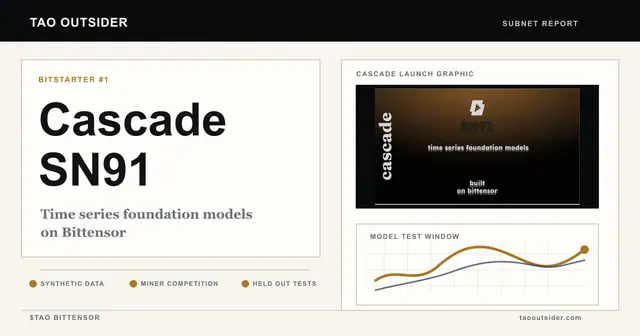

There is something satisfying about watching a subnet become a product you can explore. In our earlier coverage, we explored Cascade’s ambition to build time series models on Bittensor. Now SN91 has something new to put in front of developers: Ephemeris, a forecasting API offering access to six models through one interface.
Think about a business anticipating next week’s orders, an operator planning computing capacity, or a team working with energy demand. Different problems, same starting point: a history of measurements and a decision about what happens next. That is the territory Cascade is building for.
Six models, one way in
Ephemeris lists Chronos2, Flowstate-r1, PatchTST-FM-r1, TimesFM25, TiRex2 and Toto2-313m. Developers can select a model, use automatic routing or request an ensemble that combines compatible models.
That last option caught my attention. Choosing a forecasting model is a task in itself. A common API gives developers a way to explore several approaches without assembling a separate integration for each one.
The API supports quantile forecasts, giving applications a range of outcomes to work with. For someone planning stock, staffing or infrastructure, the spread around a forecast can matter as much as the middle.
The Bittensor story underneath
Cascade’s miners compete by creating synthetic time series data generators. The model and training conditions are controlled, allowing the competition to focus on which data produces a better forecaster. Validators evaluate the resulting checkpoints against held-out real-world data.
The question behind that competition is compelling: which patterns should a model learn before it encounters a customer’s data? Cascade makes that a recurring research task, with public code and model checkpoints available to inspect.
The subnet’s training work and Ephemeris’s six-model catalogue are distinct parts of the project. Their connection is the opportunity: a forecasting service gives the team a route to put research into developers’ workflows.
A route into agents
Cascade describes a wider stack spanning training, evaluation through Weir, hosted forecasts through Ephemeris and agent tools through Gnomon.
An agent handling an operational question could use a forecasting tool to examine a numerical series and bring the result into its response. Sales planning and infrastructure monitoring offer concrete reasons for developers outside crypto to explore what this Bittensor team is building.
Why I am paying attention
When we first covered Cascade, much of the story concerned the subnet’s design and what would come next. Alongside its public repository and downloadable checkpoint, Cascade now presents a forecasting service with documented integration options.
Builders can contribute to training, work with a checkpoint or develop an application around the API. A developer can arrive because they need a forecast and discover the subnet behind the product afterward.
That is the next chapter I want to follow: what people build with it.
Sources
- Ephemeris
- API documentation
- Cascade’s product stack
- Official repository
- Public checkpoint
- Our earlier Cascade coverage
Was this article useful?
One tap feedback helps us improve each post.