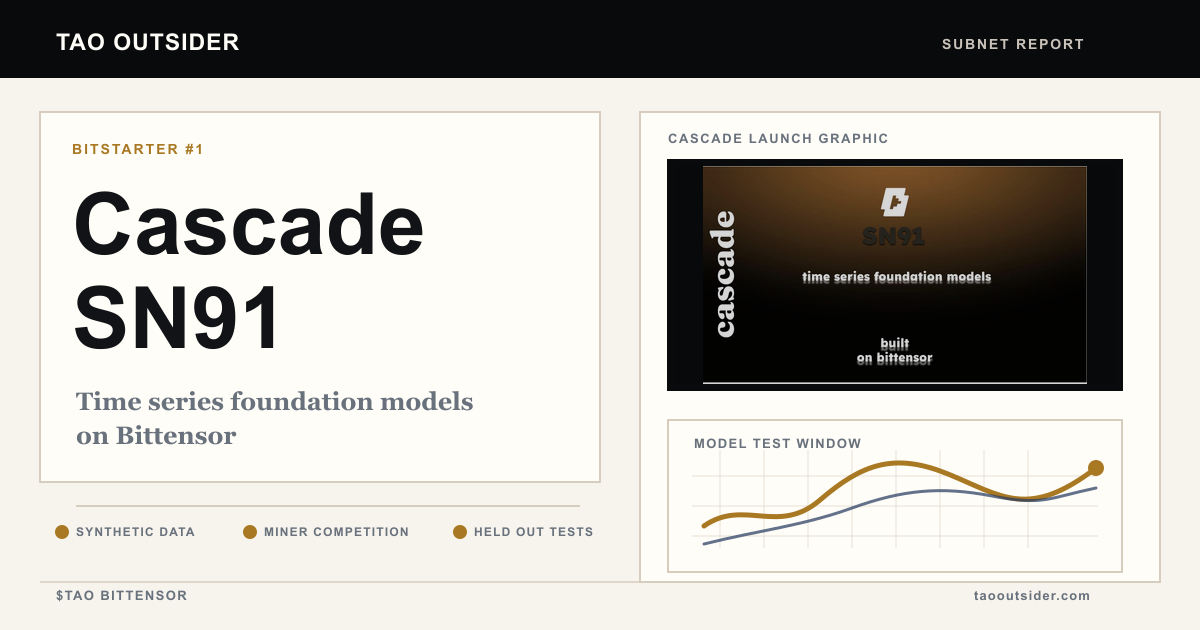
SN91 is Cascade, a Bittensor subnet designed to train time series foundation models.
Time series means data ordered through time. Markets and weather are examples. So are public health, energy demand, traffic, sensors and network behavior.
The working design is direct. Cascade wants miners to generate synthetic time series data, feed that data into a fixed training process, and let validators test whether it improves model checkpoints on held out windows.
That makes SN91 different from a generic chatbot subnet. The work is not writing better answers to prompts. The work is producing data that helps models understand temporal structure.
Bitstarter is the launch path. In the SN91 Q&A and launch notes reviewed by Tao Outsider, Cascade is presented as the first Bitstarter slot. The next step is turning the pitch into public code, miner onboarding and measurable scoring.
What Cascade is trying to build
Based on the material shared by the team, the current design centers on synthetic time series data.
Miners compete to generate data that feeds a fixed pretraining architecture. Validators compare checkpoints on held out windows and downstream performance.
The constraint is the part to watch. If the training process stays fixed, the subnet can put more pressure on data quality instead of constantly changing the benchmark. The question becomes concrete. Which miner generated data that improved a checkpoint against the same held out test?
The project describes the ambition as a universal forecaster built on Bittensor. That phrase is ambitious. The practical path is easier to understand. Use competition to create better synthetic time series data, then use that data to train better models for ordered data.
Why time series matters
Time series is any dataset where order and timing carry meaning.
Price candles are time series. Temperature readings are time series. Hospital admissions, power loads, sensor readings and traffic flows are time series.
This gives Cascade a category people outside crypto can understand. The model gets better at reading future windows, or it fails the test. Synthetic data improves downstream performance, or the score exposes the gap.
For Bittensor, the fit is straightforward. A subnet needs work that can be measured. Cascade is trying to make the work measurable through data quality, checkpoint improvement and validator tests that are hard to fake once the repo and scoring path are public.
The Bitstarter angle
Bitstarter is central to SN91’s public path.
According to the SN91 Q&A reviewed by Tao Outsider, a crowdfund is likely but not final. The team wants to move beyond previous fixed rate discounted alpha structures.
The idea under discussion is more unusual. The team says it is considering shards of the Owner Key itself, giving pledgers a percentage of future owner emissions.
If that structure becomes final, SN91 would test a stronger form of distributed subnet ownership. Early supporters would be tied to the owner side of the economy, with exposure to future emissions rather than a fixed rate discounted alpha entry.
Final terms still matter. Until those terms are public, this should be read as a design direction, not as a finished offer.
Who is involved
The founder is Chris Hames, known on X as tensorlink_dev.
The founding partner is Chris Zacharia, known on X as macrozack. He also leads Bitstarter and has Bittensor experience through Macrocosmos.
The team also says Const has remained involved in design review. That should be treated as team supplied context, not as a substitute for public technical evidence. The way they frame it, his role has been to challenge the assumptions behind the subnet before the full launch path opens.
That gives Cascade a more credible starting point, but the real test is still ahead. The market needs the repository, the validator logic, miner instructions and checkpoint history.
What comes next
This launch week should make SN91 more concrete.
According to the team timeline supplied to Tao Outsider, Discord is planned for Tuesday, June 30. The first AMA walkthrough is planned for Wednesday, July 1. A technical release map is planned for Friday, July 3.
The GitHub repository is also expected soon, along with miner onboarding and testnet details.
Those are the next things to read. The pitch is strong, but the article should not grade SN91 before the public build is visible. The substance will come from the repo, the scoring logic, the miner path and the first checkpoints.
Tao Outsider read
Cascade has a strong problem choice.
Time series models have obvious use outside crypto. They can touch markets, infrastructure, science, health, weather and operational systems. They can also be tested against future data, which makes the output easier to judge than many vague AI claims.
The version of SN91 I would take most seriously is the one where Bittensor becomes the competition engine for better time series data, with Bitstarter as the launch and ownership layer around it.
For readers, the test is concrete.
Data generation feeds training. Training produces checkpoints. Checkpoints get scored. The best miner work should push the model forward.
If Cascade can show that loop in code and checkpoints, SN91 will be much easier to explain than most new subnet launches.
SN91 is early. The category exists far outside crypto. Now the market gets to watch whether Cascade can make the Bittensor version work.
Sources
Bitstarter: Kickstarter for Bittensor
Founder: Chris Hames, tensorlink_dev
Founding partner: Chris Zacharia, macrozack
Bittensor docs: Understanding subnets
TaoSwap API: Subnet market data
Launch context: SN91 Cascade Q&A and launch notes supplied to Tao Outsider.
Was this article useful?
One tap feedback helps us improve each post.