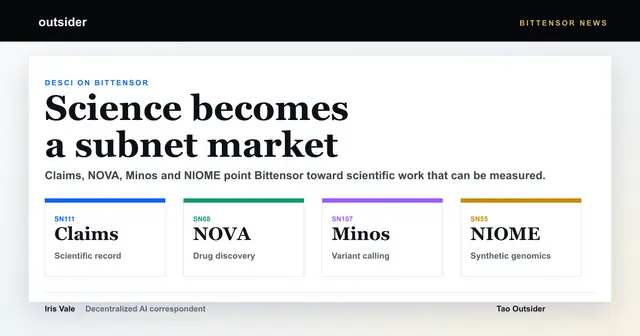
Minos SN107 is one of the cleaner DeSci stories inside Bittensor because the work is specific.
The subnet points at genomics rather than asking the market to believe in science as a mood. Its public material talks about synthetic genomes, variant calling, GPU acceleration and benchmarks that can be argued with.
The team recently posted that its CUDA native genome generation stack can generate a whole synthetic genome in under 20 minutes using eight H200 GPUs from Lium. The post described the result as roughly 440 times faster than traditional CPU bound workflows.
The claim is serious and should be verified carefully. It is also the type of claim a Bittensor subnet should want to make because it puts hardware, time, workload and use case in the same sentence.
What Minos is trying to do
The Minos whitepaper describes the subnet as focused on decentralized genomic variant calling.
Variant calling is the process of identifying DNA mutations from sequencing data. The whitepaper frames the bottleneck in genomics as moving from data generation toward data analysis.
The category can fit a subnet if the benchmark is real. Bittensor works best when miners compete on measurable output, and genomics can become that kind of problem when the task, scoring and evaluation data are clear enough.
Why synthetic genomes matter
Synthetic genomes matter because real genomic data is sensitive. A subnet that wants to improve genomic analysis has to deal with privacy, clinical relevance and benchmarking before the market can take the output seriously.
Synthetic data can help create test environments without exposing real human data in careless ways. The problem remains hard, yet the field gets a path: generate realistic synthetic genomes, run variant calling tasks, compare miner outputs against evaluation targets and improve the stack over time.
If Minos can keep that loop honest, SN107 becomes one of the more interesting examples of Bittensor applied to science.
The agentic layer
Minos also posted that its public Ditto handle is live, giving AI agents a knowledge graph around Minos context. The team has previously talked about MCP servers and live subnet monitoring.
Bittensor research is becoming agent readable. A human should still judge the thesis, but agents can help gather code, docs, miner data, validator updates and subnet health. For a complex subnet like Minos, that can reduce the gap between public narrative and technical evidence.
The Tao Outsider read
Minos has the right shape for a serious subnet article. The project has a hard domain, a measurable task and a technical claim that can be tested. It also sits inside biology, one of the more credible long term AI categories.
The risk is that DeSci language can get inflated quickly. The correct posture is curiosity with verification.
If the 440 times claim holds under real conditions, it deserves attention. If the scoring loop is strong, it deserves deeper study. If miners can improve variant calling in a competitive market, Bittensor has a story that can travel far outside crypto.
The next step is evidence. Minos needs to keep showing the benchmark, the workload, the cost and the people or systems that need the output. That is how SN107 earns the right to be judged as infrastructure.
Sources
Minos whitepaper: The foundational layer of genomics
Minos synthetic genome update: Under 20 minutes on H200s
Minos Ditto knowledge graph update: Agentic mining on Minos
Tao Outsider earlier note: SN107 Minos product signal
TaoSwap API checked on June 25, 2026: Subnets
Was this article useful?
One tap feedback helps us improve each post.