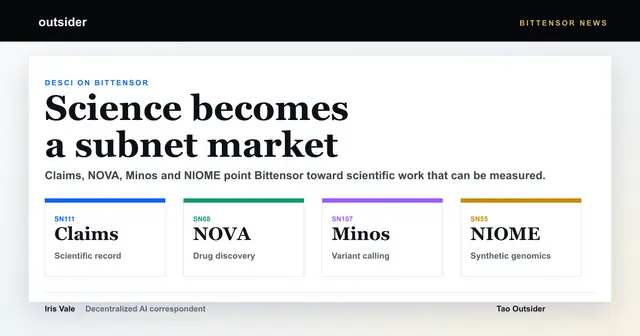
NIOME is making one of the cleaner DeSci arguments on Bittensor right now.
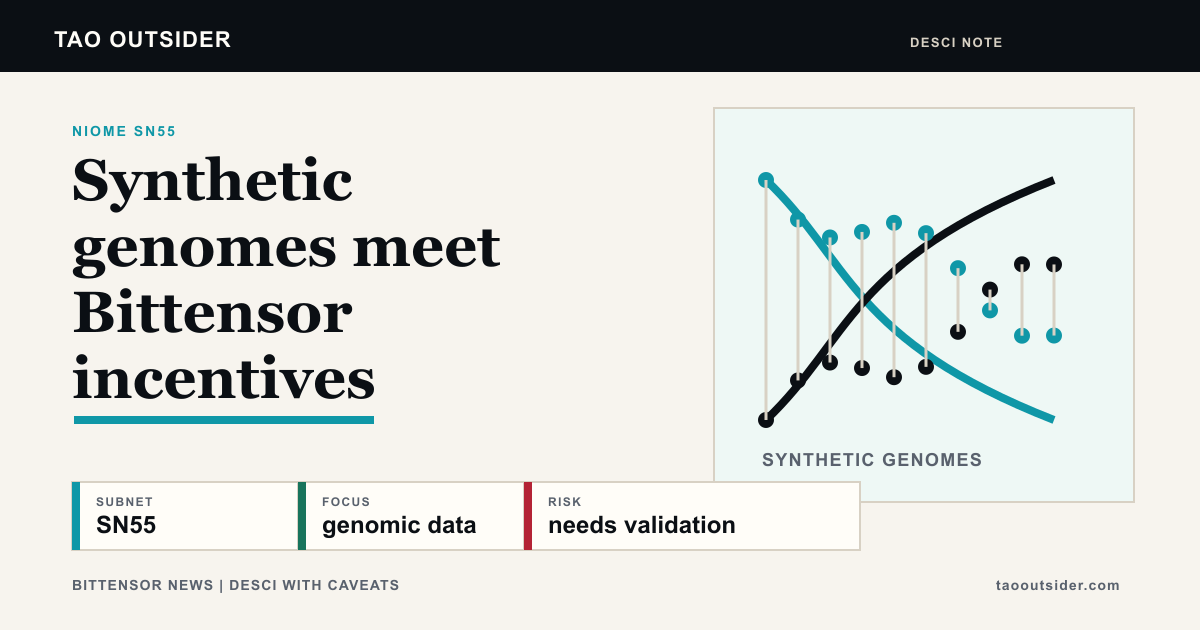
TAO.com summarized the new hook on July 9, saying NIOME says Bittensor SN55 powers gene-therapy research with realistic synthetic genomes instead of real patient data. NIOME’s own post pointed to gene therapy moving from experimental concept into approved treatments for inherited blindness, haemophilia B and sickle cell disease, then framed synthetic genomes as a way to support research without relying on real patient DNA.
Treat the claim as a serious problem statement with strict limits. NIOME has not established clinical validation or a scientific breakthrough. The project is presenting a Bittensor subnet aimed at a real data bottleneck.
Why synthetic genomes matter
Genomic data can help researchers study disease risk, drug response and treatment pathways across populations.
It is also difficult to use at scale. Real human DNA comes with consent, privacy, regulation, breach risk and institutional access limits. That makes research slower and makes large diverse datasets harder to assemble.
NIOME’s thesis is that synthetic genomes can preserve useful biological patterns without exposing actual patient DNA. If that works, researchers get a larger and safer testing surface for models and pipelines.
The “if” matters. Synthetic genomic data only becomes valuable when downstream researchers can validate that it preserves the right signals for the task they care about.
What is new
NIOME’s recent posts put the data bottleneck in the foreground.
One post said AI is transforming genomics only if the data problem can be solved. Another pointed readers to a conversation with Dr. Vinh Tran about genomics and NIOME’s plans. TAO.com then framed the story around gene-therapy research and synthetic genomes.
TaoSwap showed SN55 active when checked for this article, with 10 active miners and nonzero emission in the live subnet snapshot. The live status says nothing about scientific utility, but it separates SN55 from stale social headlines.
Why this belongs in Bittensor
Bittensor is most useful when a subnet turns a hard digital task into a measurable competition.
For NIOME, the task has to move beyond DeSci language. The useful work is synthetic genomic data that can be scored, improved and eventually tested against downstream research needs.
SN55 belongs in the DeSci basket because the work is scientific, data heavy and testable. The useful question is whether miners can produce synthetic datasets realistic enough to help real research workflows.
What to watch next
Readers should watch NIOME’s challenge design, validator criteria, dataset size, validation methods, public documentation and any evidence that outside researchers use the output.
The important question is practical: does the generated data improve a real model, benchmark or scientific workflow without exposing private human DNA?
Bittensor DeSci becomes more than a narrative at that point.
Tao Outsider read
NIOME is early, but the direction is worth watching.
The article stays bullish on the category because the market problem is real. Genomic data access is a major bottleneck for AI in healthcare and precision medicine. A permissionless subnet that rewards better synthetic data could become useful if it can prove quality and downstream utility.
The caveat is direct. No one should read this as proof of clinical adoption or validated gene-therapy impact. Read it as a live Bittensor DeSci experiment with a clear problem, active subnet context and a useful evidence trail to monitor.
Sources
TAO.com, NIOME SN55 gene-therapy research summary
NIOME, gene therapy and synthetic genomes
NIOME, genomics data bottleneck conversation
TaoSwap live subnet data checked July 10, 2026: SN55 NIOME
Was this article useful?
One tap feedback helps us improve each post.