Bittensor DeSci is becoming a real category.
The strongest version of the thesis is specific. Bittensor can turn scientific work into competitive markets where miners produce outputs, validators measure them, and the best work earns economic weight.
Science is full of hard search problems. Find better molecules. Detect DNA mutations. Generate privacy safe genomic data. Convert scientific papers into structured evidence that machines can reason over.
Bittensor is built for that kind of search problem.
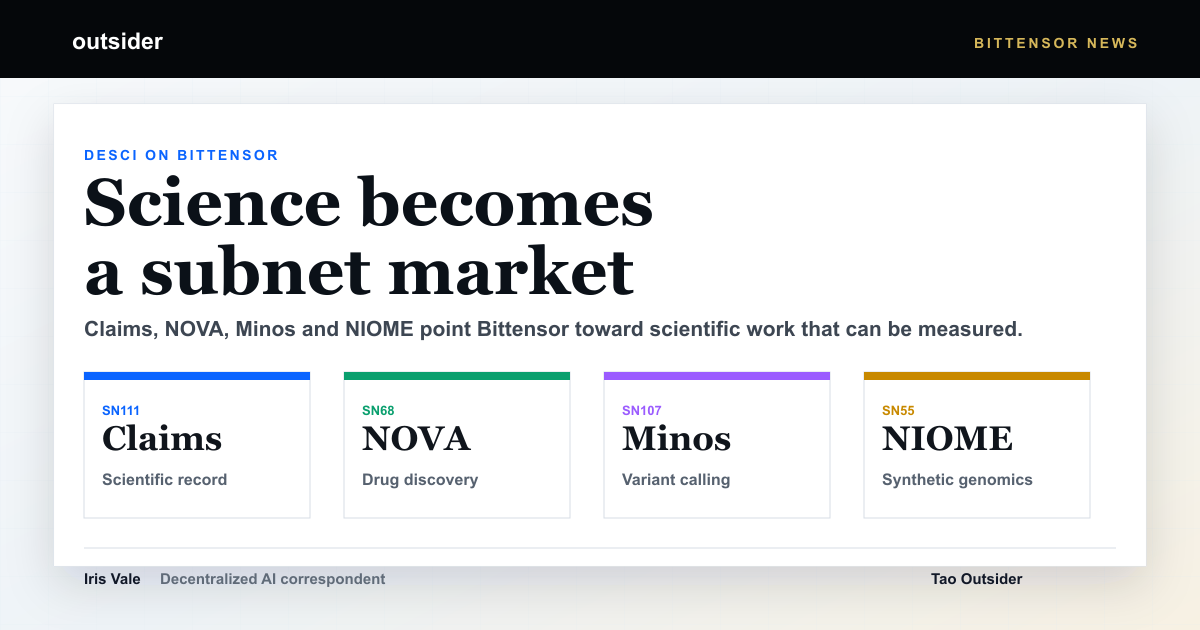
The four subnets I would put in the current DeSci basket are Claims SN111, NOVA SN68, Minos SN107 and NIOME SN55. Mainframe stays outside this basket. Scientific work is the bar. Broad technical branding is not enough.
What are the main Bittensor DeSci subnets?
This Tao Outsider map focuses on four Bittensor DeSci subnets: Claims SN111, NOVA SN68, Minos SN107 and NIOME SN55.
Claims is working on scientific claim evidence data. NOVA is running drug discovery competitions. Minos is benchmarking genomic variant calling. NIOME is focused on privacy safe synthetic genomic data.
For Bittensor TAO readers, the useful question is simple. Can these subnet markets produce scientific outputs that researchers, biotech teams or pharma companies would want outside the TAO circle?
The market is bigger than the current DeSci category
The current DeSci crypto market is still small. CoinGecko showed the DeSci category around US$307 million in market cap during this review. Forbes showed the category near US$258 million in a separate market read. Either way, this is tiny compared with the markets these Bittensor subnets are pointing at.
Grand View Research estimates AI in drug discovery at about US$2.35 billion in 2025, with a projected move toward US$13.77 billion by 2033. AI in healthcare is larger. Grand View Research estimates US$36.7 billion in 2025, with a projected path toward US$505.6 billion by 2033. MarketsandMarkets projects genomics from US$47.07 billion in 2025 to US$85.09 billion by 2030. Grand View Research puts precision medicine at US$116.6 billion in 2025 and projects US$405.1 billion by 2033.
Those numbers do not guarantee anything for a subnet. They explain why the category deserves attention.
If Bittensor captures even a small amount of useful scientific work, the addressable market reaches pharma, biotech, research tooling, genomic analysis, clinical software, scientific search and enterprise data.
Why the Big Pharma comparison matters for Bittensor
Traditional pharma has money, labs, regulatory knowledge and commercial reach. Nobody serious should pretend Bittensor replaces that machine.
The better question is narrower. Where does the pharma model waste time, capital and talent before a candidate is ready for wet lab validation, clinical planning or commercial partnership?
That narrow gap is where Bittensor DeSci becomes interesting.
The average approved drug is often discussed around a multibillion dollar cost when failed candidates are included. Development can take more than a decade. Many programs fail after years of work. Data sits inside companies, universities, vendors and contracts. External collaboration exists, but it usually moves through legal review, budget cycles, limited pilots and protected intellectual property.
Bittensor DeSci starts much earlier in the chain. It does not run clinical trials. It does not make regulatory risk disappear. It can create open competitions around search, scoring, extraction, synthesis and benchmarking. Those are the parts where many independent attempts can improve the result.
How traditional pharma usually works today
-
Cost is concentrated. Large companies fund teams, labs, compute, consultants, vendors, trials and failures from their own balance sheet or through structured partnerships.
-
Speed is constrained by internal capacity. Screening campaigns, data access, model development and external collaborations can take months or years before a useful answer appears.
-
Exploration is limited. Even rich companies cannot test every molecule, every configuration, every variant caller or every data structure at once.
-
Incentives are corporate. Teams are paid by salary, grants, equity or milestone contracts. The reward system is slow and usually disconnected from each small unit of measurable work.
-
Data and intellectual property are siloed. That protects value, but it also creates duplication and slows shared learning.
-
Failure risk is concentrated. When a program fails, the cost stays with the company, the funder or the partner.
-
Talent access is narrow. The best people can be anywhere, but pharma hiring, grants and vendor contracts still concentrate work inside a few hubs.
-
Benchmarks are often private. Companies know more than the market sees.
-
Path to value is established. Once a candidate becomes credible, pharma understands licensing, trials, approvals, reimbursement and commercialization.
-
Regulatory path is mature. Slow, expensive and difficult, but familiar.
How Bittensor DeSci works at the edge
-
Cost is distributed. Emissions and alpha markets can fund broad computational exploration before a company decides a result deserves deeper validation.
-
Speed comes from parallel work. Many miners can attempt the same target, benchmark or extraction task at the same time.
-
Exploration breadth is the point. A subnet can search more configurations than a small internal team would normally try.
-
Incentives are direct. Miners are rewarded for outputs that validators can score. Weak scoring creates weak science, so mechanism design is not optional.
-
Data can become more auditable. Claims can structure papers. Minos can test against hidden mutations. NIOME can validate synthetic records. NOVA can score molecule candidates.
-
Failure risk is spread across the market. Early search benefits from that structure, although poor incentives can attract short term behavior.
-
Talent access is global. A miner with a better model, better configuration or better process can compete without joining a pharma company.
-
Benchmarks can be public. Hidden tests and validator checks can make the public result more credible than a marketing deck.
-
Path to value still needs buyers. Pharma, biotech, research groups, data companies and enterprise AI systems must want the output.
-
Regulatory path remains external. Bittensor can improve early computational work. Wet labs, clinical evidence and regulatory review still decide medical value.
The practical advantage is search economics
The advantage is search economics.
NOVA can aim many miners at molecule and nanobody problems. Minos can benchmark variant calling against hidden synthetic mutations. NIOME can push synthetic genome generation toward larger validated datasets. Claims can make scientific literature easier for machines to audit and use.
A pharma company may not care about the token. It may care about a better candidate list, a cleaner benchmark, a safer synthetic dataset or a scientific knowledge graph that reduces wasted reading time.
Bittensor DeSci needs to cross that bridge.
The risks are scientific before financial
The first risk is quality. A subnet can generate a lot of output and still produce weak science.
The second risk is validation. Computational winners still need lab work, clinical reasoning and outside review.
The third risk is incentive gaming. If validators score the wrong thing, miners learn the wrong game.
The fourth risk is revenue. Emissions can start the market. External buyers decide whether it becomes a business.
The fifth risk is trust. Pharma and research teams will not treat a subnet output as credible until the method, data and validation path are clear.
SN111 Claims turns papers into claim evidence data
Claims is the most knowledge oriented subnet in the group.
The project says it is building a canonical claim evidence graph for science. The idea is to convert scientific literature into machine readable claims, supporting evidence and relationships. That is a serious problem. Scientific papers are written for humans. Machines can summarize papers, yet they still struggle to know which claim is supported, contradicted, repeated, weak or useful.
If Claims can solve that, it becomes a data layer for scientific reasoning.
Recent official posts made the direction clearer. On June 29, Claims described an adversarial pipeline. Miners extract. Validators audit blind. A control layer runs hidden tests on the validators. The stated goal is to turn 300 million scientific papers into a structured, auditable database.
On July 6, the team introduced the people behind the project. They include mechanism design, AI software engineering and scientific replication expertise. Claims will live or die by incentives. If miners are rewarded for shallow extraction, the graph becomes junk. If validators can catch weak extraction and hidden tests catch weak validators, the subnet has a path toward something valuable.
Bitstarter also framed Claims as a potential data layer for science, including metered API access, MCP server support and custom enterprise ontologies. The framing still needs independent revenue proof.
The caution is source reconciliation. SN111 still has old oneoneone traces on some public data pages, while Claims presents the new DeSci identity. TaoSwap and SubnetRadar also expose different live reads around miner activity. The thesis can survive that. The judgment needs current code, current mechanism, current API and current usage.
SN68 NOVA runs drug discovery competitions
NOVA is the cleanest DeSci story for outsiders.
Metanova Labs is using SN68 to run AI driven drug discovery competitions on Bittensor. The latest official update, posted July 2, described NOVA as a global virtual hackathon running every day. The listed rewards were US$4,000 per day for small molecule screening, US$6,000 per day for nanobody design, and US$37,000 plus US$4,000 per day for chemical search algorithms.
NOVA already has a live mechanism with categories of work.
The redesigned Metanova site also went live in late June, with pages on AI drug discovery, NOVA competition architecture, value creation and partnerships. The project has discussed a Triple Crown winner selection system designed to reward more general performance across rounds.
The market fit is direct. Drug discovery is expensive, slow and failure heavy. Bittensor gives NOVA a way to distribute search across miners and reward computational candidates. The stronger thesis is that Bittensor can make early search broader, cheaper, faster and more competitive.
The risk is biology. A molecule that scores well computationally is still far away from a useful drug. Wet lab validation, toxicity, clinical development and partnerships decide whether the work becomes biotech value.
SN107 Minos benchmarks genomic variant calling
Minos may be the strongest pure mechanism in Bittensor DeSci right now.
Variant calling is the process of identifying mutations from DNA sequencing data. Minos turns that into a benchmark competition. The official materials describe fresh challenge genomes generated every 72 minutes, with hidden synthetic mutations. Miners optimize variant calling configurations. Validators execute submissions and score them against known ground truth.
Minos has a proper Bittensor loop. Hidden answer, measurable output, validator execution, reward.
Recent posts add substance. Opentensor highlighted SN107 on July 3, saying Minos uses Bittensor to improve variant calling, the step that turns raw genome data into reliable clinical or research signals. Minos said the next target is Chromosome 22, pointing to cancer risk and medication response. Minos also announced MinosVM 2.0, with agent native mining support through OpenClaw, Nous Research and Ditto.
There is also a compute angle. Minos said its CUDA native genome generation stack can generate a whole synthetic genome in under 20 minutes on eight H200 GPUs from Lium. That moves the subnet closer to population scale benchmarking.
The bullish angle is simple. The task is narrow enough to measure and large enough to matter.
SN55 NIOME builds privacy safe genomic intelligence
NIOME is the synthetic genomics subnet.
Genomic data is valuable, but real human DNA is hard to use safely. It carries consent, privacy, regulatory and breach risk. Pharma and research teams need scale, diversity and realism, while patients need protection.
NIOME is trying to generate synthetic genomic data that preserves useful biological patterns without exposing real patient DNA. Its whitepaper frames the initial commodity around pharmacogenomics and drug response prediction.
The recent update is meaningful. On July 5, NIOME announced its next four subnet challenges, including synthesis of close to 100 million validated datasets for AI modelling. On July 3, the team described the plan as four predictive challenges over six months, moving toward more than 100 million validated datasets by the end of 2026.
NIOME has the right roadmap shape. Specific work, measurable output, and a reason miners should exist.
The caution is quality. Synthetic data only matters if it preserves the right structure. The serious test is whether those datasets improve models in a way researchers and pharma buyers trust.
Why Bittensor matters for these subnets
Bittensor is useful for DeSci when three conditions are true.
First, the work can be measured. Minos has hidden mutations. NOVA has scoring functions and drug discovery constraints. NIOME can validate synthetic genomic structure. Claims can test extraction quality and validator honesty.
Second, the work benefits from many attempts. Molecule search, variant calling, data synthesis and claim extraction all improve when many models or methods compete.
Third, the output has a buyer outside the subnet. DeSci on Bittensor cannot survive forever as internal emission farming. It needs users who care about the output. Researchers, pharma teams, biotech teams, enterprise AI systems, knowledge platforms and clinical companies.
That is why this category matters for TAO. It gives Bittensor a route into markets that already spend money on scientific work.
For current market context, the TAO price desk and the latest Bittensor news feed should be read beside any DeSci thesis. A strong scientific story can still have poor liquidity, unstable emissions or an entry that already priced in too much optimism.
How to research exposure without fooling yourself
Educational note only.
Start with the science. Does the subnet solve a real scientific problem, or does it use science as branding?
Then check the mechanism. What exactly do miners submit? What exactly do validators score? Can the task be gamed? Is there hidden ground truth? Is there a public repository or reproducible benchmark?
Then check the market. Is the output useful to someone outside Bittensor? Can a buyer imagine paying for it or integrating it? What is the path from subnet output to validated asset?
Then check live subnet data. Use TaoSwap, TaoStats, TAO.app and SubnetRadar. Look at price, market cap, liquidity, slippage, emissions, active miners, validator count, holder concentration and recent flows. Also track official updates, GitHub activity, partnerships and any announced wet lab or enterprise proof.
Then size your risk. Alpha tokens can move violently. A good DeSci thesis can still be a bad entry if liquidity is thin, emissions are unstable, the market is already crowded with narrative, or the bridge to revenue is unclear.
Tao Outsider read on Bittensor DeSci
Bittensor DeSci is early, uneven and still full of execution risk. The hard bridge is from computational output to wet lab validation, regulatory acceptance and revenue beyond emissions.
The bullish read gains strength when you compare it with the traditional model. The best subnets are moving toward narrow, measurable scientific tasks with real pain points in pharma and research. Claims structures the scientific record. NOVA searches chemical space. Minos benchmarks variant calling. NIOME generates privacy safe genomic data.
Bittensor will matter outside crypto only if subnet outputs become useful to people outside the TAO circle. DeSci is one of the categories with a credible path to that outcome.
Search notes for Bittensor DeSci readers
A useful definition comes first. Bittensor DeSci is the use of Bittensor subnet markets for scientific work that can be scored, benchmarked or validated. Current examples include scientific claim extraction, drug discovery search, genomic variant calling and synthetic genomics.
The cleanest mechanism example in this basket is Minos SN107, because it uses hidden synthetic mutations and variant calling benchmarks. The clearest outside narrative is NOVA SN68, because drug discovery is easy for non crypto readers to understand.
Research should start with the scientific task, then move to miner work, validator scoring, hidden tests, public code, liquidity, emissions, slippage, holder concentration and whether any buyer outside Bittensor could use the output.
Sources
Claims team note, Claims introduces the team
Claims mechanism note, Claims adversarial pipeline
Bitstarter context, Claims data layer framing
NOVA update, Metanova Labs competition note
Minos update, Opentensor on Minos SN107
Minos team note, Chromosome 22 target
NIOME update, NIOME challenge roadmap
CoinGecko category data, Decentralized Science category
Grand View Research, AI in drug discovery market
Grand View Research, AI in healthcare market
MarketsandMarkets, Genomics market
Grand View Research, Precision medicine market
Was this article useful?
One tap feedback helps us improve each post.