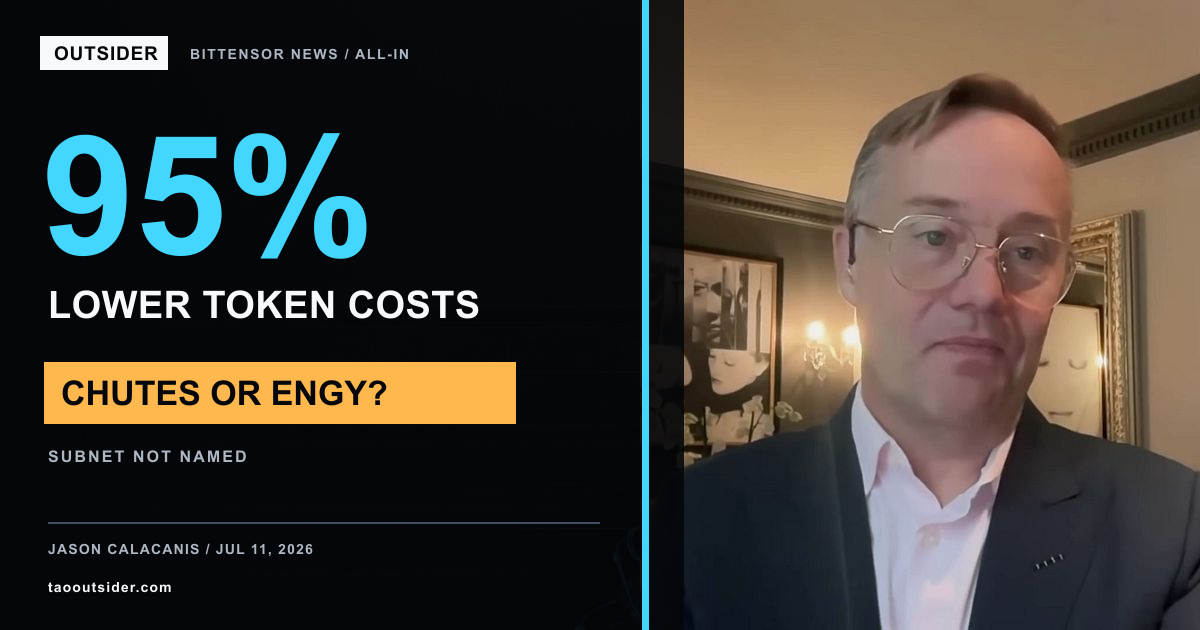
Jason Calacanis put a concrete Bittensor usage story on the All-In Podcast on July 11.
While discussing inference costs, Calacanis said an unnamed Bittensor subnet gave him an API key for GLM 5.2 and other models. He reported that his token costs fell by 95%. The lower bill changed how he used Hermes, moving recurring work from daily runs to hourly runs and splitting one task across several processes.
He never named the subnet.
I checked the full video segment and its transcript. Calacanis says Bittensor, TAO, GLM 5.2, an API key and the 95% figure. He does not say Chutes, SN64, Engy, SN53 or any other subnet name.
That leaves the important question open: which Bittensor subnet was he using?
Chutes SN64 fits several visible clues because it offers GLM 5.2 through an OpenAI compatible API, authenticates with API keys, serves other models from the same account and publishes low per token pricing. Engy SN53 is now also relevant because there are rumors and unofficial ecosystem information pointing in that direction, its builder has shown GLM 5.2 work, and the project is repositioning around inference.
The only defensible answer today is that Calacanis described a Bittensor inference subnet without naming it. There are good reasons to keep both Chutes and Engy in the discussion. Neither is confirmed.
What Jason Calacanis actually said about Bittensor
The relevant section begins around 25 minutes and 19 seconds into the July 11 All-In Podcast episode.
Calacanis first explains that he had been testing the Hermes agent from Nous Research. He then describes receiving access to “a subnet that is putting GLM 5.2 and other models available at really cheap prices.”
His summary of the result was direct. “Having my token cost go down 95%.”
The cost change affected behavior. Calacanis said he began running jobs hourly instead of daily. He also broke one task into three parallel jobs. The episode gives Bittensor a practical use case that people outside the subnet market can understand. Cheaper inference made more work economically reasonable.
Hermes is the agent software in this story. It is not the name Calacanis gives to the inference subnet. He gives the subnet no name at all.
The subnet question: Chutes SN64 or Engy SN53?
Chutes remains a strong public candidate from the available clues.
The official Chutes GLM 5.2 page lists an OpenAI compatible endpoint, API key authentication and published pricing of $1.40 per million input tokens and $4.40 per million output tokens at the time of this review.
Those details line up with the All-In description:
| Clue from the podcast | Public Chutes evidence | Honest conclusion |
|---|---|---|
| GLM 5.2 access | GLM 5.2 is live on Chutes | Strong product match |
| API key | Chutes documents bearer API keys | Strong API match |
| Other models on the same service | Chutes exposes a broader model catalog | Strong platform match |
| Much lower token cost | Chutes publishes low usage pricing | Plausible cost match, unverified for Calacanis |
Chutes also said in its July 7 update that it was putting an advertising push behind GLM 5.2 for developers outside crypto. Calacanis discussed his access four days later. The timing helps the Chutes case. It still does not prove it.
Engy SN53 now has to stay in the frame too.
Calacanis refers to someone creating a subnet, language that could point to a newer operation. Engy SN53 is active under its new identity, and its developer has published GLM 5.2 work on consumer GPUs and amplified Calacanis’s Bittensor posts. Sources in the ecosystem also told Outsider that SN53 could be the subnet in question.
Those are rumors and unofficial signals, not confirmation. They are strong enough to keep SN53 in the story and weak enough that we should not name it as fact.
No API endpoint, dashboard, invoice, provider name or subnet number appears in the clip. Chutes has not publicly claimed the usage example. Engy has not publicly confirmed it. Calacanis has not publicly identified the provider.
The evidence supports a question, not a verdict: was this Chutes, Engy or another Bittensor inference subnet?
Why this is important Bittensor news
The 95% claim comes from one user describing his own experience. Outsider did not inspect the bill or reproduce the comparison. It should not be treated as an independent benchmark.
The behavior change is still useful evidence.
Inference cost determines how often software can run, how many branches it can test and whether an experiment becomes routine. A cheaper call can produce more demand instead of only saving money. Calacanis described exactly that response. Daily jobs became hourly jobs. One agent became three.
This is the part of the Bittensor TAO story that deserves attention. Subnets become easier to value when someone uses their output and can explain what changed. The discussion moves from emissions and token narratives toward API access, model choice and workload economics.
Readers tracking Bittensor price should keep the boundary clear. A high profile usage anecdote is not a TAO price signal, audited revenue, durable demand or proof that one subnet has won the inference market.
For more product context, read how Chutes SN64 is becoming easier to test.
What would confirm the subnet identity
Confirmation needs one missing fact. The provider identity.
That could come from Calacanis naming the subnet, the operator claiming the case with evidence, or a visible endpoint tied to the API key he used. A reproducible price comparison would also strengthen the 95% figure.
Until then, the safest Bittensor news headline belongs to the network. Chutes and Engy both get a question mark.
Sources
All-In Podcast, OpenAI vs Anthropic IPOs and the Bittensor inference discussion
Jason Calacanis, direct post about using an unlimited GLM 5.2 Bittensor subnet
Mark Jeffrey, link to the exact All-In segment
Chutes, GLM 5.2 model and API page
Chutes, API key authentication documentation
Chutes, July 7 update covering its GLM 5.2 developer push
Nous Research, Hermes Agent repository
Engy builder, GLM 5.2 work on consumer GPUs
Engy developer, amplification of Calacanis’s GLM 5.2 Bittensor post
Chutes, official documentation identifying the platform as Bittensor Subnet 64
Was this article useful?
One tap feedback helps us improve each post.