Chutes keeps giving Bittensor something the market can understand without a glossary. A user opens a tool, selects a model, adds a key and reaches inference without needing to understand subnet culture first.
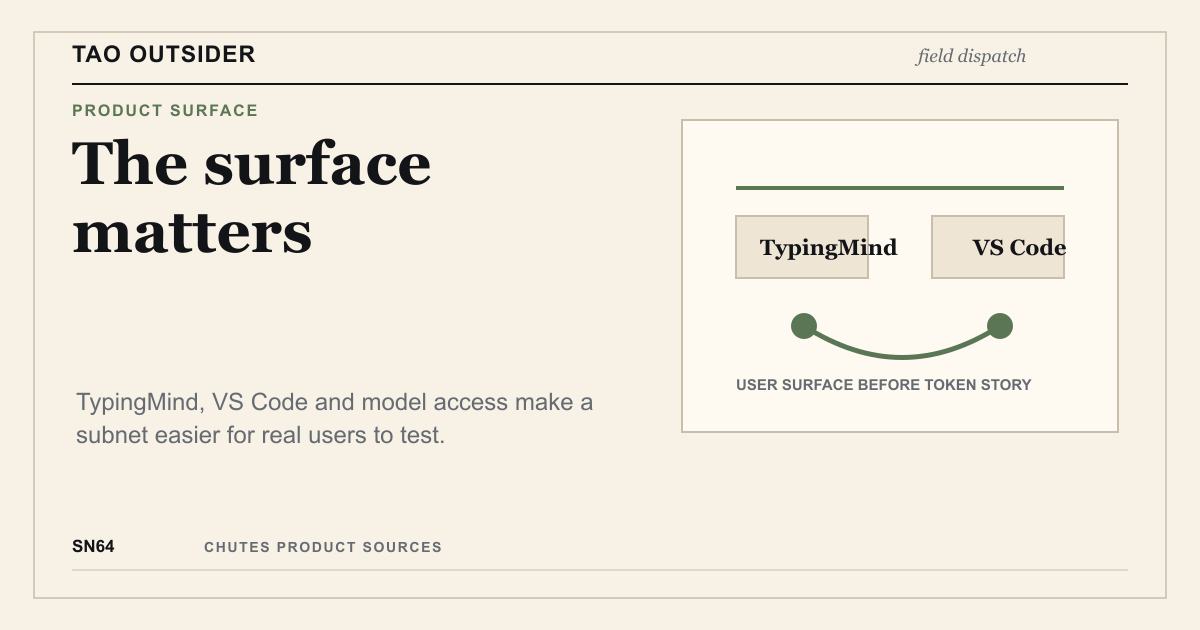
That is the real story behind the latest Chutes updates. The team posted that Chutes is now a built in provider in TypingMind, one of the better known interfaces for people who want to bring their own AI keys. Chutes also highlighted a community built VS Code extension that lets users run models like DeepSeek, Qwen, Kimi and GLM as coding agents inside the editor.
The point is simple. Chutes is moving part of the SN64 conversation away from emissions, APY and charts and toward tools people can test.
The TypingMind angle
TypingMind is a practical front end for AI users. It lets users connect providers and keep control over how they access models.
Chutes being available there means the subnet can sit next to more familiar AI providers inside a user workflow.
That is stronger than a claim about decentralized inference in abstract terms. The reader can run a simple test: open the product, add the key, use the model and compare the experience.
If that works, the subnet has crossed a line that many crypto AI projects never reach.
The VS Code angle
The VS Code extension may be even more interesting for builders.
Chutes says the extension pulls the model catalog automatically, supports agent mode and exposes models through the editor. That turns the subnet into part of a developer workflow.
The Bittensor story gets better when the user does not need to know Bittensor first. A developer wants a coding assistant, model choice, cost control and open model access. If Chutes can serve that demand, SN64 becomes easier to explain to people who do not care about subnet culture.
Most crypto AI projects struggle to reach that kind of distribution.
Many projects can publish a benchmark. Fewer can appear inside a tool where a user already works. The difference is friction. A developer inside VS Code is not asking for a new thesis. The developer is asking whether the model helps with the task in front of them.
That test is more honest than a token thread.
What still needs checking
Product access is not the same thing as economic proof.
For a complete read, the market still needs usage, revenue quality, cost structure, miner economics, latency, reliability and retention.
The Chutes story is strong because the product is visible. That does not remove the need to check the machine underneath it.
Open TaoSwap. Check liquidity, market cap, flow and slippage.
Open Chutes. Check which models are live.
Open the extension or provider page. Check whether the workflow works for a real user.
Then compare that evidence with emission changes.
The next useful Chutes article should test the integrations directly. Open TypingMind. Add a Chutes key. Run the same prompt across two providers. Open VS Code. Try the extension on a small coding task. Track latency, model choice, failure handling and cost.
That turns a subnet story into product research.
The Tao Outsider read
Chutes is one of the easiest subnets to explain right now because it has an external narrative. Inference is a known market, developers already use model front ends, coding agents already have demand and open models are getting stronger.
Centralized AI keeps exposing cost, access and control problems. That does not make SN64 risk free. It makes SN64 legible.
In Bittensor, legibility is becoming a competitive advantage.
Sources
Chutes TypingMind update: Chutes as built in provider
Chutes VS Code update: Chutes models in VS Code
TypingMind Chutes guide: Use Chutes with TypingMind
Chutes model page: GLM 5.2 on Chutes
TaoSwap API checked on June 25, 2026: Subnets
Was this article useful?
One tap feedback helps us improve each post.