
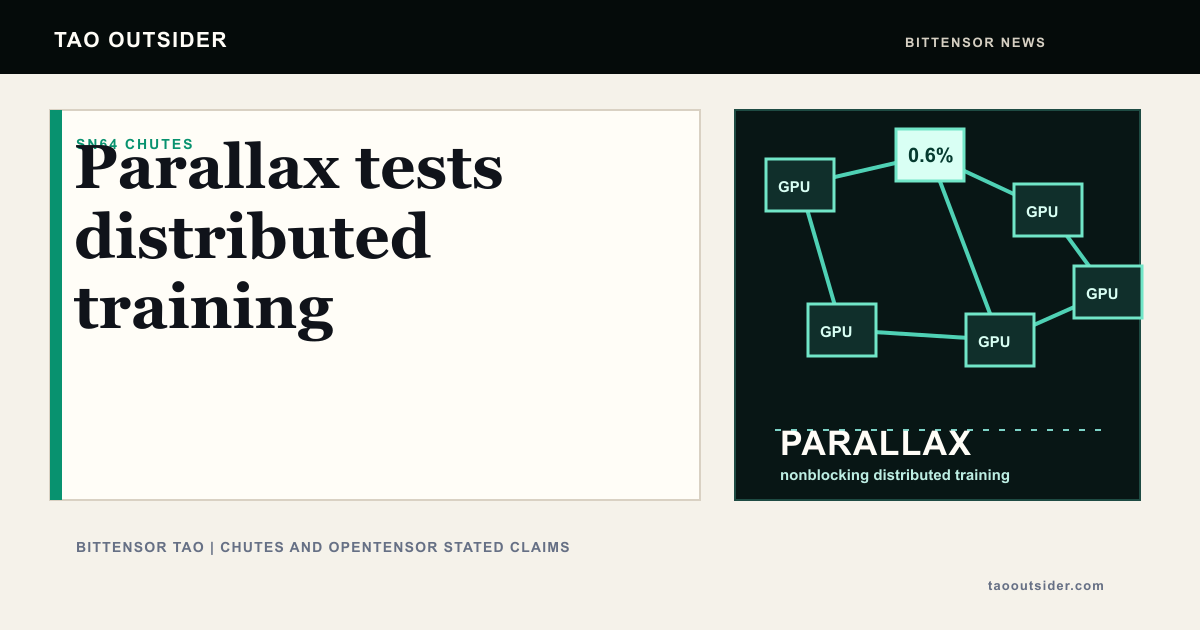
Chutes says Parallax has crossed a harder test than another model listing. On July 8, Chutes said it trained a recurrent model across distributed GPUs in a fully nonblocking setup, with a stated 0.6 percent quality gap versus centralized training. Opentensor highlighted the same update and framed it as a concrete milestone for decentralized AI training on Bittensor.
Tao Outsider is treating the numbers as Chutes and Opentensor stated claims. We have not independently benchmarked Parallax. This belongs in the Bittensor news queue because Chutes is moving from inference product updates into training architecture claims, and Parallax is the technical thread connecting those claims.
What Chutes said
The Chutes post made three concrete claims. The training setup was fully nonblocking, meaning GPUs could keep training without waiting through a normal synchronization pause. The test used a recurrent model, a harder case because each step depends on the prior step. Chutes also said the result stayed within a 0.6 percent quality gap versus centralized training.
The claim set is narrow enough to track. Nonblocking distributed training, a recurrent model and a small stated quality gap.
Why this is stronger than a generic subnet update
Most subnet updates ask the reader to believe a broad direction. This one gives the market a narrower claim to track. If Parallax works beyond this test case, it could help explain how distributed GPU capacity becomes useful for training workloads that usually prefer tight, centralized infrastructure.
The Bittensor angle is limited and useful. One post does not settle decentralized training. SN64 still keeps producing specific product and infrastructure surfaces, including inference routing, TEE based model serving, model throughput claims, Kraken visibility and now a Parallax training result. That stack is easier to evaluate than a subnet with only a name, APY and a promise.
What still needs proof
The next checks are practical. Chutes still needs to show whether the method works across more architectures, larger runs and enough outside inspection for developers to understand what was measured. The result also needs a path toward usefulness for model builders outside the Bittensor community.
Those checks should carry more weight than the first headline. For now, the update is still meaningful. It gives SN64 a fresh technical story that is separate from its earlier dFlash and revenue narratives.
Tao Outsider read
Chutes remains one of the easier Bittensor subnets to explain to outsiders because its updates keep touching the same real problems: compute cost, model serving, privacy, throughput and training coordination. Parallax adds another piece to that map.
The right read is bullish with a boundary. Chutes has made a specific claim about decentralized training, Opentensor amplified it, and the market now has something to verify over time.
If the next Parallax updates show repeatable results, SN64 becomes more than an inference subnet with good distribution. It becomes a stronger test case for whether Bittensor can coordinate useful AI infrastructure outside centralized data centers.
Sources
Chutes post: Parallax recurrent model training update
Chutes follow up: Read more link from Chutes
Opentensor post: Chutes Parallax decentralized training milestone
TaoSwap live subnet data checked July 9, 2026: Chutes SN64
Was this article useful?
One tap feedback helps us improve each post.