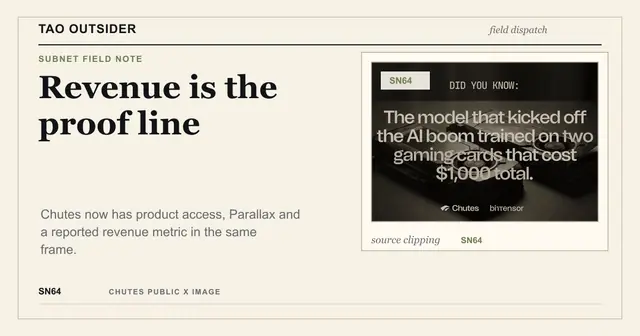
Chutes SN64 has been one of the easier Bittensor subnets to explain because it already has a product surface.
Developers can open Chutes, browse models, see pricing, call APIs and understand what the subnet is trying to sell. Serverless AI compute for open models, powered by Bittensor.
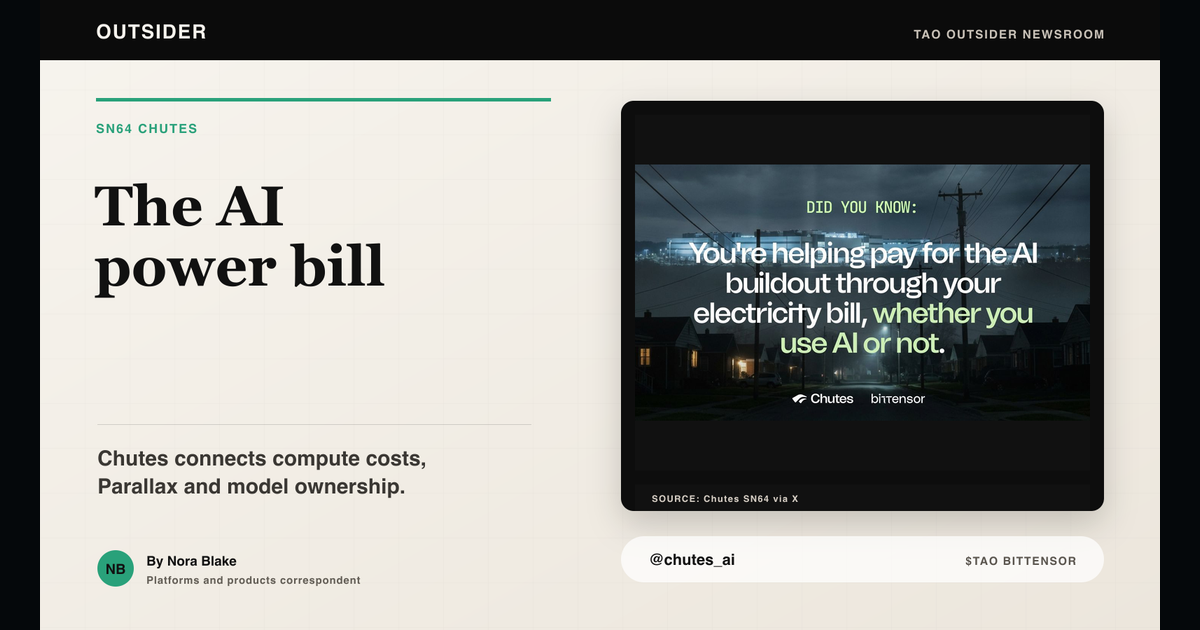
The latest Chutes post adds a broader frame. It turns the AI infrastructure debate into a power bill story.
Chutes pointed to US electricity rates rising close to 40 percent since 2021, utilities planning major grid investment through 2030 and data centers as a major driver of future spending. Renewable Energy World also reported PowerLines analysis showing utility bills up approximately 40 percent since 2021, with investor owned utilities planning about US$1.4 trillion in capital expenditure through 2030.
The Chutes read is sharper than a normal compute post:
if centralized AI needs massive grid expansion, households and businesses may help carry the cost through higher rates, while the resulting models remain privately owned by a small group of companies.
That framing is bullish for Bittensor because it moves the discussion out of crypto vocabulary.
The problem expands beyond token emissions or subnet APY. Who owns the compute layer? Who pays for the infrastructure? Who captures the value of trained models?
Where Parallax fits
Parallax is where Chutes connects the narrative back to its technical roadmap.
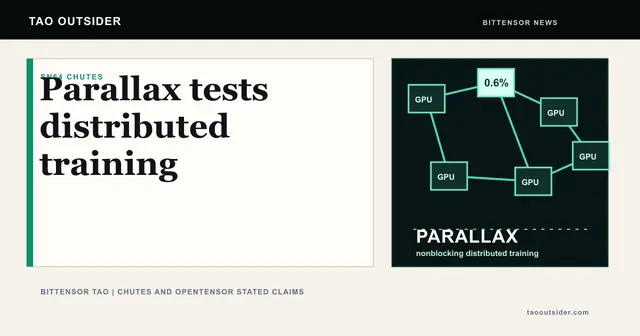
The Parallax report, written by Jon Durbin in June 2026, describes a training decomposition for sparse Mixture of Experts models running on heterogeneous GPUs that are not colocated. The report says Parallax removes expert all to all communication from the local step path, uses local surrogates for non owned experts and synchronizes shared state through tiered cadences.
That sounds technical because it is technical.
The clean version is this:
ordinary large scale training usually assumes a tightly connected cluster. Parallax explores whether model training can be decomposed so distributed machines can carry useful parts of the work without behaving like one perfect data center.
The caveat matters. The report says it gives point estimates from completed 20B runs and does not report replicated equivalence tests or measured wall clock speedups. So the right read is not “Parallax solved decentralized training.”
The right read is more grounded:
Chutes is building a product business around inference while researching a harder training path for fragmented compute.
That combination is strong.
Why it travels
One side is already legible to developers. Chutes describes itself as a serverless compute platform for AI code, with APIs, model exploration, private compute and pricing. The other side is the long term systems bet. Can Bittensor style incentives help organize useful compute outside centralized clusters?
For $TAO Bittensor, this story can travel outside the usual subnet crowd.
Energy costs are real. Data center pressure is real. Model ownership is real. If Chutes can keep converting those facts into working products and credible research, SN64 stays one of the strongest external narratives in the subnet market.
The next proof points are simple:
more developer usage, more visible revenue, better public Parallax results, and clearer evidence that decentralized compute can compete where centralized infrastructure is becoming expensive and politically heavy.
The bullish case is practical:
A better cost, ownership and access story for AI infrastructure.
Sources
Chutes post: The AI power bill
Chutes site: chutes.ai
Chutes docs: docs.chutes.ai
Parallax technical report: Parallax draft technical report
Renewable Energy World and PowerLines utility capex coverage: Investor owned utilities capex through 2030
Tao Media Chutes context: Inside Chutes’ next phase
Was this article useful?
One tap feedback helps us improve each post.