Chutes SN64 has another concrete model update on the Bittensor board.
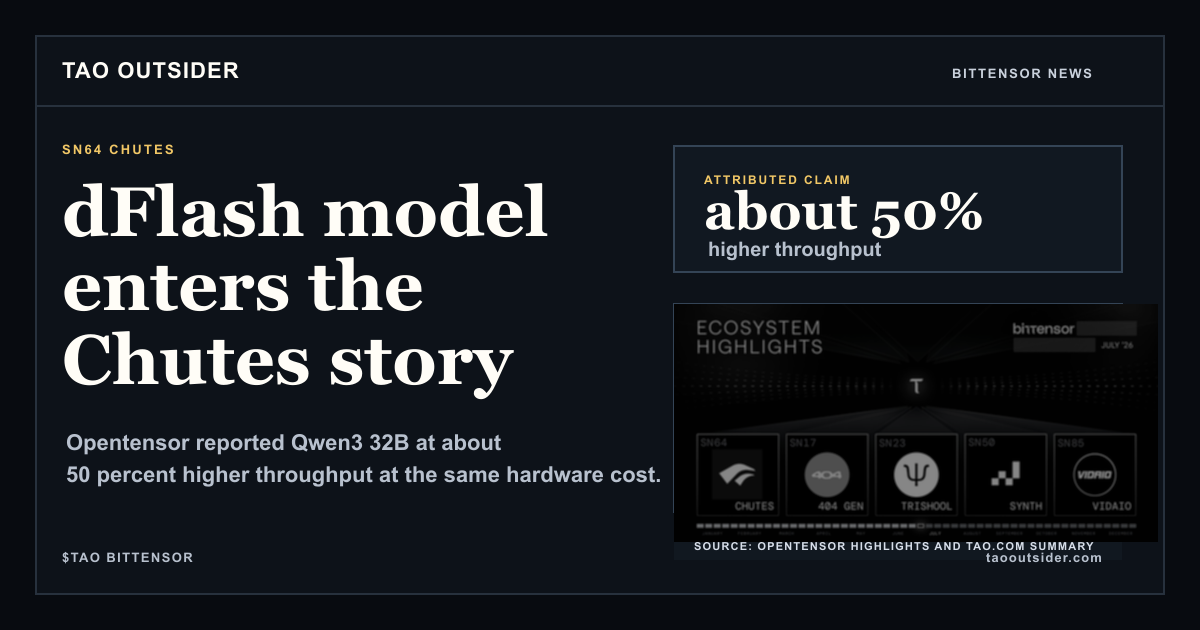
In its July 5 ecosystem highlights post, Opentensor said Chutes’ first in house dFlash model is live, with Qwen3 32B delivering about 50 percent higher throughput at the same hardware cost. TAO.com repeated the update on July 6.
Tao Outsider is treating the throughput number as an attributed claim from Opentensor and TAO.com, not as an independent benchmark from this publication.
Even with that caveat, the update is newsworthy.
Chutes already has one of the clearest product stories in Bittensor. AI inference is served through a product that developers can actually open, route to and pay attention to. A reported model level throughput improvement belongs in that same frame.
What changed
The public claim is specific.
Chutes’ first in house dFlash model is live. The model named in the update is Qwen3 32B. The reported improvement is about 50 percent higher throughput at the same hardware cost.
Readers can track a statement like that over time.
It points to cost, serving efficiency and model availability instead of a vague statement about decentralized AI. If the performance claim holds across more visible product surfaces, it would strengthen the case that Chutes is improving the economics of inference rather than simply adding more model names to a catalog.
SN64 keeps returning to the Tao Outsider desk for that reason.
Chutes is building in a category that outsiders understand. Developers already know inference cost, latency, privacy, model availability and routing pain. The Bittensor question is whether a subnet can make those tradeoffs better through competitive infrastructure.
Why throughput matters
Throughput is not a cosmetic metric for inference.
If a model can serve more work at the same hardware cost, the product has more room to compete on price, reliability or margin. A subnet does not become stronger from one number alone. The market still gets a practical metric to check.
The follow up work is more important than the headline number. Readers should look for product visibility, real developer routing, pricing changes and reliability under actual load.
The Bittensor read
For Bittensor, the useful story is that a subnet is pushing toward measurable AI infrastructure.
The market has too many vague subnet claims. Chutes is more interesting when it gives readers specific surfaces: models, app changes, provider integrations, privacy claims, TEE deployment, search integrations and now a reported throughput improvement.
Verification still matters.
The update still needs public usage, product visibility and repeated performance evidence. It should not be treated as a finished case for SN64 by itself.
The bullish read is narrower and stronger.
Chutes is building where Bittensor can be understood by people outside the ecosystem. It is serving models, reducing inference friction and making decentralized AI feel like a product rather than a slogan.
If that path keeps producing measurable updates, SN64 remains one of the subnets worth watching closely.
Sources
Opentensor ecosystem highlights, Bittensor Ecosystem Highlights, June 29 to July 5
TAO.com summary, Chutes dFlash model on Bittensor SN64
Chutes website, Serverless AI compute
Tao Outsider DeSearch archive: July 6, 2026 source pull for Chutes SN64 dFlash.
Was this article useful?
One tap feedback helps us improve each post.