Babelbit says its next product direction is paraphrasing.
The July 6 update reframes SN59 as a language transformation stack, with real time interpretation as the first application. The next layer is same language speech adaptation across English to English, accent adaptation, simpler phrasing, pacing changes and clearer word choice.
Babelbit is giving the market a more precise story than generic translation.
Babelbit is trying to work closer to speech itself. The product idea is that a spoken sentence can be transformed for the listener without changing the speaker’s intent. Slower or faster. More formal or more direct. Easier to understand. Better matched to a local accent or a specific audience.
Read this as product roadmap news. Do not read it as proof of revenue or broad usage.
What Babelbit announced
The team wrote that Babelbit is known today for real time interpretation, but its broader vision is language transformation.
The next product named in the post is Paraphrasing. Babelbit described it as a Grammarly for speech in any language, starting with English to English adaptation.
The examples were concrete enough to cover:
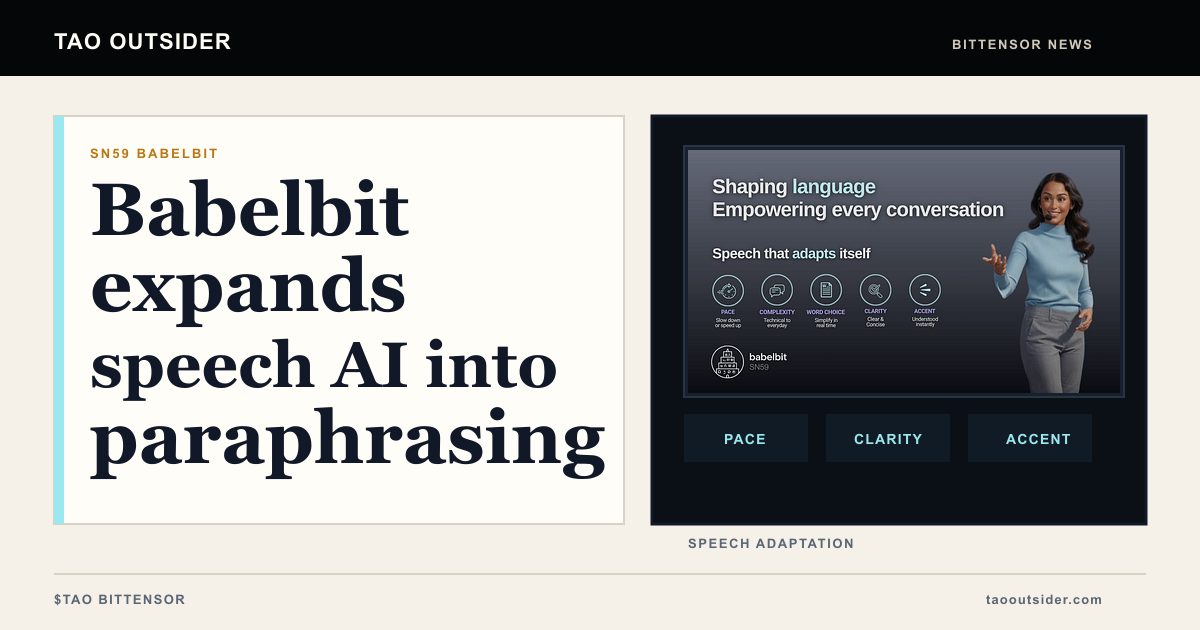
Pace. Speech can slow down or speed up.
Complexity. Technical language can move closer to everyday language.
Word choice. The same idea can be rephrased in real time.
Clarity. A spoken answer can become more concise.
Accent. Speech can become easier for a listener to understand.
The list changes how SN59 should be read. Babelbit is still a Bittensor speech subnet. The roadmap now reaches beyond translation between languages and moves toward modifying speech for context.
Why this is a Bittensor story
Speech is a difficult AI market because the output is judged by humans immediately.
A model can look good in a demo and still fail when latency, accent, pacing, emotional tone and listener comprehension collide. Babelbit’s subnet thesis becomes stronger if miners can be pushed toward those hard edges through measurable competition.
The useful Bittensor question is what exactly the subnet rewards.
For interpretation, the target is low latency speech translation. For paraphrasing, the scoring problem gets more subtle. The system has to preserve meaning while changing delivery. It has to improve clarity without flattening the speaker. It has to adapt speech without making the result feel synthetic or wrong.
Benchmarking that is harder than checking a simple text conversion.
It is also more interesting.
Product roadmap, not adoption proof
The Engine caveat matters here.
This roadmap update should not be treated as market validation.
Babelbit also recently announced a reseller partnership with Line21 and said a commercial prototype is underway for a Spanish to English voice dubbing solution for a Spanish news channel. The partnership gives SN59 commercial context. It does not prove that Paraphrasing is already adopted at scale.
The right read is narrower.
Babelbit is giving the market a clearer map of where SN59 may go next. The product is moving from interpretation into speech adaptation. Future demos, repos, customer pilots and subnet mechanism updates can now be checked against that map.
What to watch next
The next proof should be visible.
Readers should watch for demos that show same language speech adaptation under real conversation pressure. The demo should make it easy to compare input and output. Did the meaning survive? Did the accent adaptation help? Did the simpler phrasing keep the speaker’s intent? Did latency stay low enough for conversation?
The mechanism also matters.
If paraphrasing becomes part of SN59, miners need a scoring path that rewards useful speech transformation instead of bland rewriting. Helpful paraphrasing and generic smoothing can look close on paper. In live speech, the gap is huge.
Bittensor can make the story stronger only if that gap becomes measurable.
A subnet can turn a product claim into a competition only when the task can be measured. Babelbit now has a more ambitious language target. The next stage is proving that the target can be evaluated, rewarded and turned into a product people use.
Tao Outsider read
Babelbit is becoming easier to explain.
SN59 is no longer only a real time translation story. The better current frame is language transformation. Interpretation comes first, paraphrasing comes next, and speech adaptation becomes the larger product direction.
The roadmap gives Babelbit more surface area than a narrow translator.
The caveat stays in place. Roadmap is not adoption. A strong graphic is not a working market. A product name is not revenue.
Still, the direction is useful for Bittensor.
Speech is one of the few AI categories where normal people understand the problem instantly. If Babelbit can turn paraphrasing, accent adaptation and clarity into measurable subnet work, SN59 becomes a more interesting product story inside decentralized AI.
Sources
Babelbit, Paraphrasing as the next product in the language transformation stack
TAO.com, Babelbit SN59 paraphrasing summary
Babelbit, Line21 reseller partnership and commercial prototype context
Tao Outsider DeSearch archive: July 7, 2026 source pull for Babelbit SN59.
Was this article useful?
One tap feedback helps us improve each post.