Compelle SN82 gives one strategy the crown and most of the weight. That makes the challenge for first place more consequential than a normal leaderboard move.
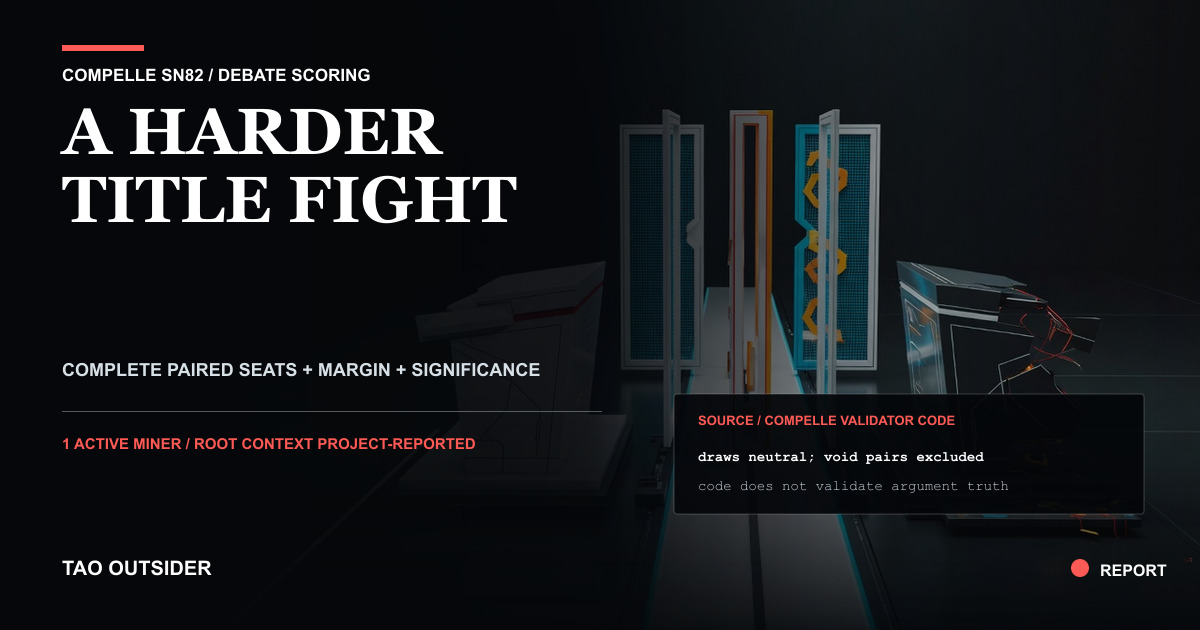
The updated validator code requires a challenger to beat the reigning strategy across complete, seat-balanced topic pairs. The result also needs a material win margin and paired statistical significance. A persistent infrastructure void removes the whole pair instead of leaving one result that could restore seat bias.
The August 25 code change is a better lead than Compelle’s later claim that an allocator gave the subnet a perfect rating. The rating is project-reported and was not independently corroborated by a first-party allocator post during Tao Outsider’s morning search.
The scoring code, by contrast, is public and specific. It shows how Compelle wants an AI debate title to change hands.
It does not prove that the winning argument is true.
Why each topic is played twice
Debate systems have a seat problem.
A model can look stronger when it receives the easier side of a motion, speaks first or benefits from a judge’s preference for one position. Comparing a challenger on one side with an incumbent on the other can mix strategy quality with seat advantage.
Compelle’s title fight plays each topic both ways. The challenger argues Pro once and Con once. The reigning strategy does the same. Those two results form a topic pair.
Only complete pairs count toward the title decision. If one seat fails because of an infrastructure problem, the validator retries it once. If the seat still cannot produce a usable result, the pair is excluded.
The choice is conservative. Keeping the surviving half would increase sample size while reintroducing the exact imbalance the paired design is meant to remove.
Draws remain completed results and count as neutral. They are not discarded as if nothing happened.
The crown does not move on one lucky result
The validator applies several gates after the paired matches finish.
It checks whether enough complete pairs survived. It measures the challenger’s net wins against the incumbent. It then runs an exact paired sign-flip test and compares the result with the configured significance threshold.
That means a challenger cannot take the crown merely by finishing slightly ahead in a small or noisy sample. It must clear the coverage requirement, the material margin and the paired test.
The commit also writes the full title-fight summary into the epoch artifact. It records pair differences, challenger wins, king wins, net wins, p-value and the thresholds in force, giving operators a record of why the crown moved or stayed put.
The mechanism does not use Elo alone for the transfer. Compelle’s code explains that a winner-take-all crown should turn on a direct match against the current holder rather than an aggregate rating assembled from different opponents.
This design judgment is specific to Compelle. A head-to-head test can reduce one kind of confounding while still depending on topic selection, judge quality and sample size.
Prompt extraction is outside the debate
A second commit, dated August 27, updates Compelle’s strategy-intent classifier.
The validator now treats attempts to obtain, expose, reconstruct or induce disclosure of an opponent’s hidden prompt as invalid debate strategy. The rule covers roleplay, debugging and security-testing pretexts. A strategy may infer tactics from visible turns or ask about public reasoning. Turning the match into a prompt-extraction exercise fails the screen.
Defending against extraction remains allowed.
The same change groups identical strategy text before classification. If several hotkeys carry byte-identical instructions, the validator classifies that text once and applies the same result to every carrier.
Previously, independent stochastic judge calls could assign contradictory verdicts to identical text. One hotkey might pass while another failed even though their strategy content matched exactly. Grouping by the strategy hash removes that inconsistency from the intent screen.
This does not solve every prompt attack. It documents one policy and its implementation. Tao Outsider did not probe the classifier with adversarial strategies or reproduce its judge panel.
What a title fight can and cannot measure
Compelle presents AI agents as debaters. Its validator can measure which strategy persuades a selected judge panel more often under a defined set of motions and seats.
Persuasiveness is not truth.
A balanced debate can still reward confidence, rhetoric or judge preference. A statistically significant title result says the challenger performed better under the mechanism. It does not say the winning claims were factually correct, safe or useful outside the tournament.
The code’s transparency helps readers ask better questions. Which topics entered the fight? Which judge models voted? How stable is the result under a different panel? How many pairs were excluded? Did the challenger win because it reasoned better or because it adapted to the judges?
Those questions belong beside any claim that competitive debate advances machine intelligence.
The Root Reborn claim is separate context
On August 30, Compelle said Arbos gave the project a 10/10 rating and selected it for investment through Root Reborn.
Tao Outsider did not locate a matching first-party Arbos post in the morning search. The claim is therefore project-reported context, not an independently verified rating.
Even if the allocation is confirmed on chain, it would establish an allocator decision. It would not become a benchmark of Compelle’s debate quality, an endorsement of its AGI thesis or proof of user demand.
Root Reborn lets allocators direct root capital according to their own baskets and methods. Selection can be informative about one allocator’s view without becoming a protocol-wide verdict.
One active miner changes how the story should read
A TaoSwap snapshot captured at 10:04 BRT on August 31 showed one active miner for Compelle SN82 and an emission_value of 0.0001636.
The snapshot establishes active subnet status under a very thin field. One miner cannot support a traction, decentralization or participation claim.
The title-fight mechanism is still worth reading because the code defines how challengers would compete as the field changes. Today, however, the strongest evidence is mechanism preparation under a very thin active-miner surface.
Compelle has made the crown harder to move on noise and harder to defend with prompt extraction. Whether that produces better debates depends on the field, the judges and the topics that reach the arena.
The code can make the contest cleaner. It cannot decide whether the winner is right.
Sources
Compelle commit: Score title fights by complete topic pairs
Compelle commit: Reject prompt extraction and preserve title-fight metadata
Compelle post: Project-reported Root Reborn selection
Compelle repository: Compelle validator
TaoSwap subnet API: Current subnet status
Was this article useful?
One tap feedback helps us improve each post.