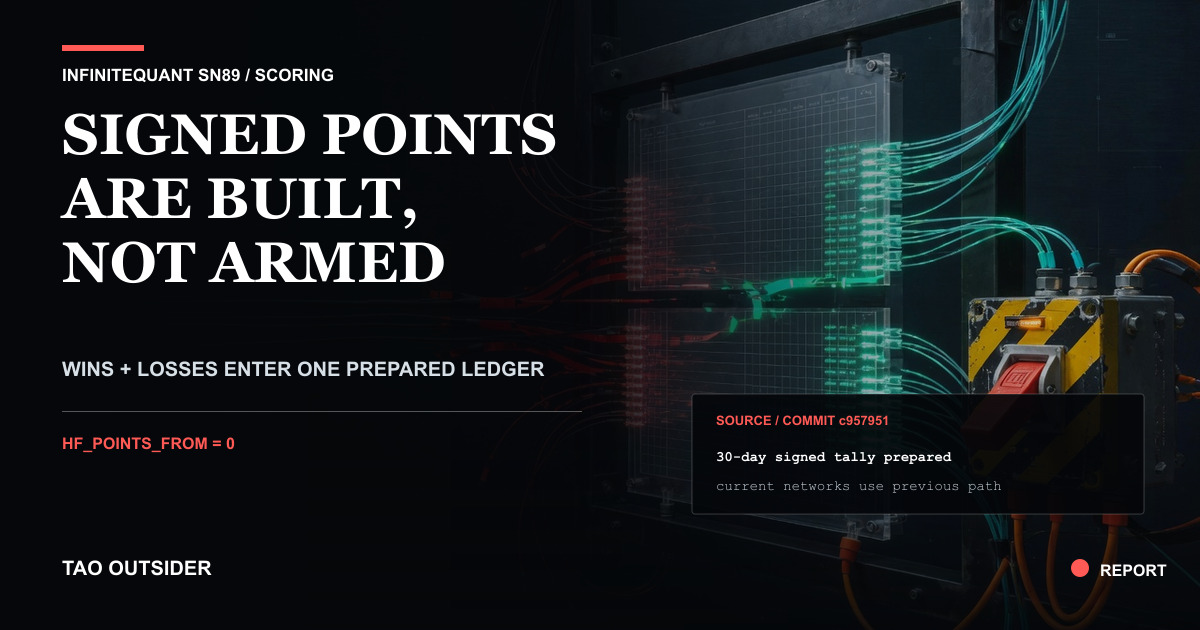
InfiniteQuant SN89 is building a new validator scoring path that puts wins and losses into the same 30-day points ledger. The code is extensive, tested and accompanied by beta operations tooling.
It is also not armed.
The subnet’s HF_POINTS_FROM setting remains 0, and the scoring code says every current network continues to use the previous wins-based path. That dormant boundary belongs in the headline. Merged code and a live mechanism are different states.
The work is still worth examining. It shows how InfiniteQuant wants to make directional market calls harder to game when the new path is eventually enabled.
Why signed points change the accounting
InfiniteQuant miners submit encrypted directional calls. Validators later resolve those calls against market data and use the results to calculate weights.
The existing scoring path centers on qualified wins. The prepared path creates a signed tally instead. Wins add points, losses subtract points and wash outcomes contribute zero before a separate wash-debt adjustment.
That symmetry is the core design choice. A score that records positive outcomes but drops negative ones would let a miner accumulate upside without carrying the full cost of being wrong. The August 29 commit explicitly rejects that ratchet.
The same qualification gate applies to both wins and losses. A miner cannot bank a win while qualified and then shed a loss because the miner later fell outside the gate. Calls enter the ledger according to their state when they are evaluated.
None of this says the score predicts markets well. It describes how outcomes would be accounted for if and when the path is activated.
The first calls of the day count, not the best calls
The signed tally uses a 30-day window and caps how many calls can count from each UTC day.
The code keeps the first eligible calls of the day. It does not look back and select the best results. Choosing the best calls after the outcome would give a high-volume miner a free option to discard losses, which would undermine the purpose of a signed score.
This also changes the time horizon relative to the older WIN_CAP behavior. A cap based on the most recent wins can represent much less than a month for a high-frequency miner. The prepared points ledger measures a fixed 30-day period with daily call limits instead.
When the total is negative, the ledger preserves that negative standing. The value is clamped only at the weight edge because Bittensor weights cannot be negative. A miner below zero would earn no weight from the points path until the tally recovered, but the reporting surface would still show how far underwater the score sits.
The code does not treat a negative tally as elimination. InfiniteQuant keeps elimination tied to a separate lifetime statistical bound.
Competitions can move one at a time
A later commit makes the points gate specific to each competition rather than one switch for the entire chain.
InfiniteQuant separates competition classes. If points were enabled globally before every class had priceable call history, a competition with no prepared points records could collapse to zero weight immediately.
The revised compute_weights path accepts an explicit decision for each competition. One competition can remain on wins while another is prepared for points. Repository replay tooling pins the low-frequency path to wins until its own data is ready.
This is rollout plumbing, not a rollout announcement. It reduces the chance that activating one class accidentally burns the share of another class whose history has not been converted.
Washes produce a separate debt
The latest scoring work also addresses wash outcomes.
InfiniteQuant lets a call describe a shape around the expected move. The code can estimate how likely that shape was to end as a wash. A miner whose declarations generate more surprising washes than the field can accumulate a debt against the raw points tally.
The adjustment depends on the miner’s standing across the field, so it is applied after raw tallies are calculated. The repository describes the top of the board paying no wash debt and the bottom paying the full calculated amount, with a continuous scale between them.
The commit includes an end-to-end example and reports 729 passing tests. Those are project-reported software results. Tao Outsider has not reproduced the simulation, audited the probability model or observed the mechanism assigning mainnet weights.
Beta tooling tries to keep the score reproducible
InfiniteQuant also added a beta leaderboard producer and a cold-rebuild parity check.
The leaderboard reads the validator’s own history and weight functions rather than reimplementing the scoring rules. This avoids a familiar analytics failure where a dashboard claims to represent validator logic while silently using an old gate or a filtered participant set.
The cold-rebuild tool reconstructs a grade cache from public receipts in a separate directory and compares it with the live validator cache. The repository says a baseline test found 104 shared keys with no outcome or void disagreements. It also says the longer mainnet rebuild was still running at the time of the commit.
Again, this is repository-reported evidence. It supports the intended reproducibility workflow, not the accuracy of InfiniteQuant’s market calls.
What is active today
The active mechanism boundary remains the simplest fact in the article. HF_POINTS_FROM = 0.
The August 29 signed-points commit says a disarmed chain never touches the new qualified-call tally. Even a miner with a heavily negative points history continues to earn through the previous qualified-wins behavior exactly as before.
A TaoSwap snapshot captured at 10:06 BRT on August 30 showed 70 active miners for SN89 and an emission_value of 0.00016095. This point-in-time subnet status does not prove trading accuracy, user demand, profitability or adoption of the dormant scoring path.
The next decisive evidence is an activation value other than zero, followed by observed validator behavior. Until then, InfiniteQuant has built a more symmetric accounting system and tools to inspect it. The network has not switched to it.
Sources
InfiniteQuant commit: Signed points tally, clamped at the weight edge
InfiniteQuant commit: Points gate per competition
InfiniteQuant commit: Apply wash debt against field-wide standing
InfiniteQuant commit: Beta leaderboard and cold-rebuild parity tooling
InfiniteQuant repository: InfiniteQuant SN89
TaoSwap subnet API: Current subnet status
Was this article useful?
One tap feedback helps us improve each post.