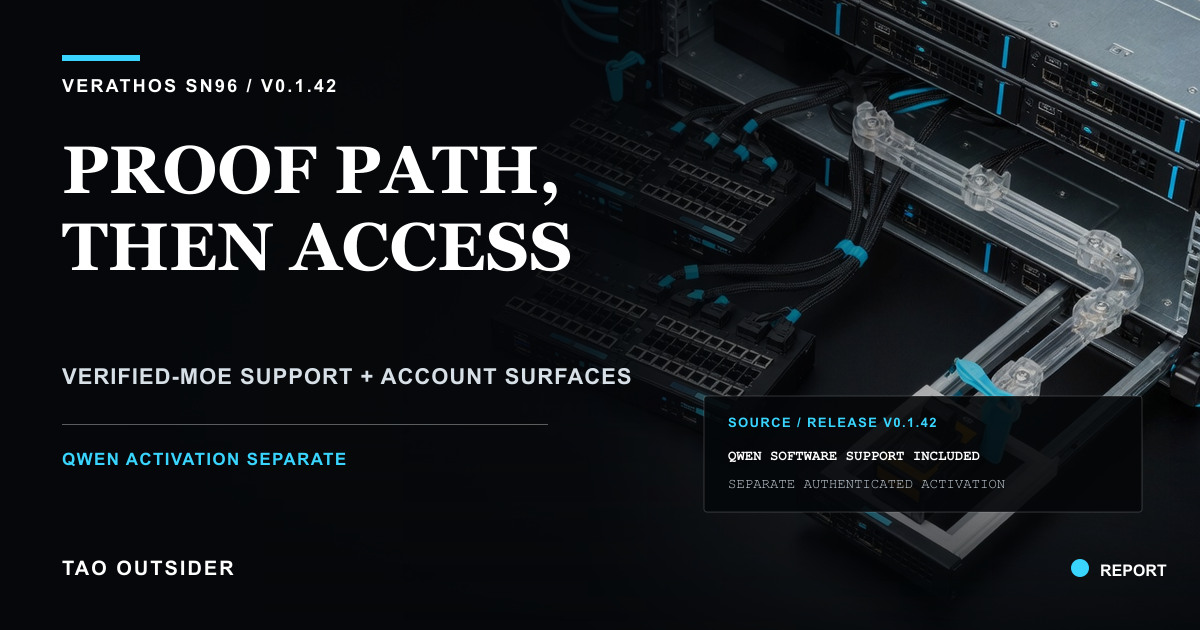
Verathos SN96 released v0.1.42 on August 28 with a practical bundle of proof path, account and payment changes for its verified inference network on Bittensor.
The release says it improves Gleipnir v3 hard audit reliability, tightens validator handling of capacity receipts and adds account access through wallets and API keys. It also packages USD inference credit, TAO and prepaid USDC funding, plus accountless x402 payments.
There is a model headline inside the release, but its state needs precise wording. Verathos added software support for the official Qwen3.6 35B sparse Mixture of Experts FP8 checkpoint. The release says that support is prepared for separately authenticated activation. Qwen3.6 35B is not active based on this source.
The stronger story today is the work around proving, routing and paying for inference.
What v0.1.42 changes in the proof path
Verathos describes itself as a verified compute network. Miners serve model requests and generate cryptographic proof material. Validators check that material and use the results when scoring miners and setting weights.
Version 0.1.42 concentrates on the points where that process can become unreliable in production.
According to the release, the software now captures an authenticated prompt boundary checkpoint required for a one token hard audit. It also preserves natural end of sequence and configured stop token terminations during exact replay after the nonce. A replay system needs to judge the computation that actually ended instead of changing termination behavior while trying to reproduce it.
The release also says capacity receipt ingestion is kept bounded and separated from deferred scoring and shared state work. Informational metagraph activity has been moved away from chronology sensitive block processing. Both changes are presented as runtime stability work, aimed at preventing secondary tasks from disturbing the order or availability of validator processing.
These are Verathos reported improvements. Tao Outsider has not independently reproduced the hard audit, measured validator stability or verified the cryptographic guarantees.
Endpoint policy becomes part of scoring
The release connects technical eligibility to validator treatment more directly.
Verathos says mainnet registrations using HTTP or a nonpublic endpoint receive zero effective score and weight without an audit probation period. Their stored score can decay normally until the registration is corrected. Miner diagnostics are supposed to provide the HTTPS setup and registration steps needed to fix the problem.
Mainnet miners are also stopped before model loading when the supplied public endpoint is ineligible. HTTP remains available for testnet and local use.
That is an important packaging decision. A miner that cannot be routed to through an eligible public endpoint should not consume model loading time and then fail later in the serving path. Moving the check forward makes the operational rule clearer for miners and easier for validators to enforce.
It does not establish public uptime or endpoint quality by itself. Those outcomes still require observation under real network conditions.
Qwen3.6 support is staged, not active
Verathos says v0.1.42 adds fail closed execution profiles, authenticated expert routing and compact hard proof verification for the Qwen3.6 35B sparse MoE FP8 checkpoint.
Sparse MoE models route different tokens through selected expert components rather than using every parameter for every token. That routing creates a specific verification question. The proof path has to account for which experts were used, along with the model weights and computation being checked.
The release presents software support for that path and reports qualification of the stock installer and serving and proof flow across A100, H100 and Blackwell GPUs. It also reports improved CUDA, Torch and vLLM installer selection on Ada, Hopper and Blackwell systems.
All model verification, hardware qualification and reliability statements here come from Verathos. The release explicitly places Qwen3.6 behind a separate authenticated activation step. Software readiness is the current claim. Live model availability is not.
Accounts and payments widen the access surface
The other half of v0.1.42 concerns how a user reaches and funds the service.
Verathos says the release adds wallet authenticated accounts and API keys, with unified USD inference credit. That credit surface includes what the project calls conviction locked inference credits. Funding options listed in the release are direct TAO and prepaid USDC top ups.
For users who do not want an account, Verathos retains x402 access for payment per request. The repository describes the gateway as OpenAI compatible and says it routes requests across miners using their scores.
This gives the product two broad paths. An account user can authenticate, hold inference credit and call the API with a key. An accountless user can use x402 for individual paid requests.
Those paths are product surfaces. They are not evidence of customers, payment volume or demand. Wallets, API keys, USD credit, TAO, USDC and x402 describe ways to access the system. No adoption claim follows from their presence in the release.
The SN96 status check
A TaoSwap snapshot captured on August 29, 2026 at 10:45 BRT showed 79 active miners for Verathos SN96 and an emission_value of 0.000392952.
That snapshot is status context only. It does not prove that all listed miners are routable, qualified for the new model profile or serving reliable verified inference. It also says nothing about account creation, paid API use, revenue or durable demand.
The next useful evidence should come from successful hard replays, stable capacity processing, eligible HTTPS endpoints and independently observable API behavior. Qwen3.6 35B also needs a separate authenticated activation notice before it can be described as active.
For now, v0.1.42 is best read as proof path and access infrastructure work. Verathos has put verification reliability, miner eligibility, hardware setup, accounts and payment routes into one release. The release makes the product easier to inspect. Its larger performance and reliability claims still need independent testing and time in operation.
Sources
Verathos v0.1.42 release: https://github.com/verathos-ai/verathos/releases/tag/v0.1.42
Verathos repository: https://github.com/verathos-ai/verathos
Was this article useful?
One tap feedback helps us improve each post.