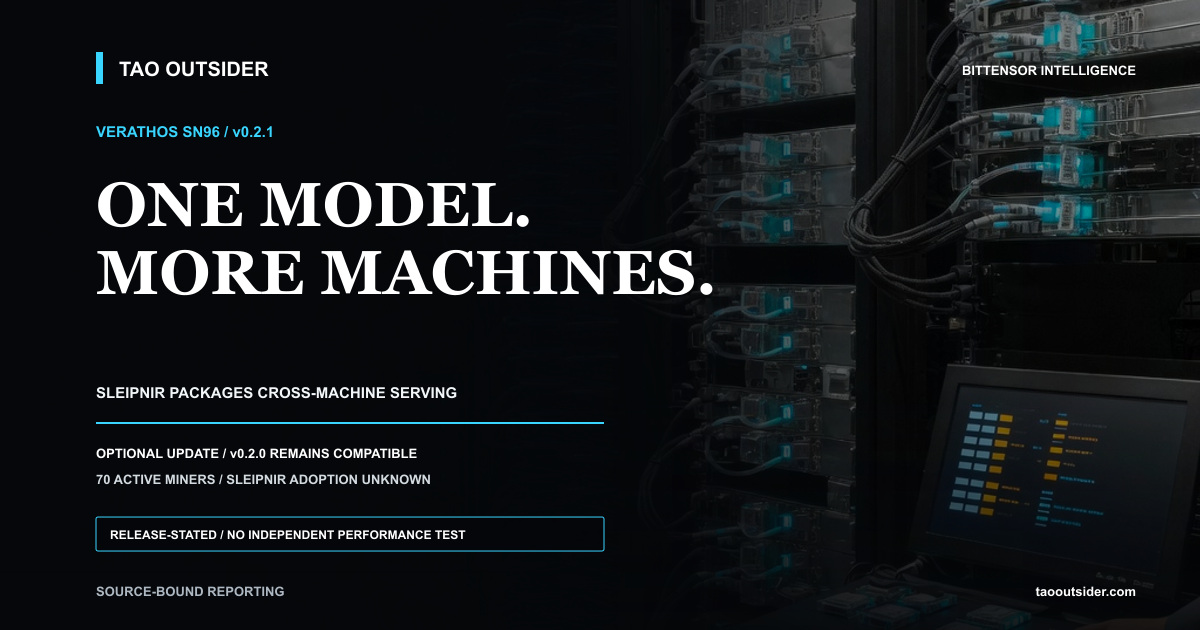
Verathos SN96 released v0.2.1 on September 7 with an optional package for serving one model across multiple machines.
The release focuses on Sleipnir, Verathos’s distributed serving path. It adds worker joining, authenticated weight retrieval, context calibration and startup readiness checks for operators who split a deployment across hosts.
Verathos says existing v0.2.0 installations remain compatible and will not update or restart automatically. Existing vLLM miners and validators do not need to install the release.
That boundary defines the story. Version 0.2.1 is an operator option, not a network-wide migration.
Why cross-machine serving is harder than adding another server
A large model can exceed the memory or practical serving capacity of one machine. Splitting it across several workers creates more capacity, but it also creates a coordination problem.
Workers need to join the same deployment, agree on the model material they are serving and become ready in the correct order. A restart on one host cannot leave the rest of the group reporting a healthy service that cannot complete a request.
The model files themselves create another constraint. Requiring every machine to retain the complete model can erase part of the reason for distributing the deployment.
Verathos v0.2.1 addresses these points as release-stated capabilities. Tao Outsider did not reproduce the deployment on a multi-machine cluster.
Authenticated weight retrieval without a full copy everywhere
The release describes distributed hard proofs that retrieve authenticated weight data for the stages that need it. Every worker does not have to store the complete model file.
That is a narrower claim than saying the network proves an entire inference universally. It describes how relevant weight material can be fetched and authenticated inside Verathos’s serving and verification design.
The practical goal is to keep a distributed worker responsible for its part of the computation without turning every host into a full model mirror.
Whether that design improves throughput or reduces cost depends on the model, network, hardware and workload. Version 0.2.1 publishes no independent benchmark that would support a general performance claim.
Joining and readiness become explicit operator steps
Distributed systems often fail at startup rather than during the steady state.
Verathos says v0.2.1 improves worker joining, delegated signing connectivity and readiness after restart across both distributed and single-machine placements. The software also performs automatic context calibration and verifies startup readiness before presenting the service as available.
Those checks matter because a partially joined group can look alive from one machine while the complete inference path is unavailable.
The release establishes intended behavior and packaged code. It does not establish uptime, restart recovery rates or production availability across current miners.
The version banner separates code from update policy
Version 0.2.1 adds verathos --version and startup banners that identify the installed code release separately from automatic update thresholds.
That distinction is useful for operators. The binary version answers what code is running. The update threshold answers which versions the system is prepared to accept or require.
Conflating those fields can make a compatible node appear outdated or make an optional release look mandatory. Verathos explicitly says v0.2.0 remains compatible.
There is no automatic restart in this release path. Mesh operators can opt in, while operators using the existing vLLM miner and validator paths can stay on their current setup.
What the subnet snapshot can and cannot say
At the reporting checkpoint, TaoSwap showed Verathos SN96 with 70 active miners and a nonzero emission_value of 0.001296834 near Bittensor block 9,022,895.
That snapshot confirms active subnet context. It does not show how many miners run Sleipnir, which version they use, how many machines serve each deployment or whether v0.2.1 has been adopted.
Miner count also says nothing about request volume, revenue, model quality or customer demand. Those require different evidence.
What operators should watch next
The first useful follow-up is adoption evidence inside Verathos itself. A version distribution or public operator report would show whether multi-machine miners are opting in.
The second is workload-specific measurement. Cross-machine serving can trade memory capacity for communication overhead. Latency, throughput and restart recovery should be measured with named models, hardware and network conditions.
The third is proof behavior under failure. Authenticated weight retrieval is most interesting when one worker is slow, disconnected or restarted. Public tests that show how the group responds would make the release easier to evaluate.
Until then, v0.2.1 should be read as a concrete packaging milestone. Verathos has made its cross-machine path easier to identify and operate, while keeping the upgrade optional and preserving compatibility with the prior release.
Sources
Was this article useful?
One tap feedback helps us improve each post.