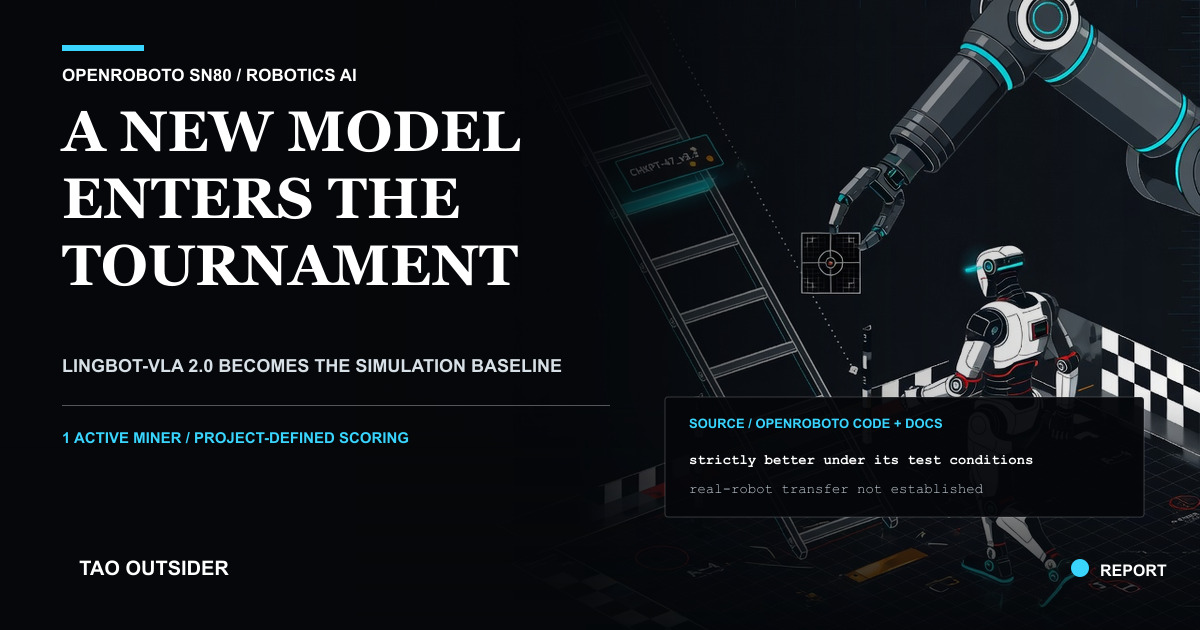
OpenRoboto SN80 has moved its current simulation tournament to LingBot-VLA 2.0, giving miners a new common model to improve under the subnet’s published evaluation process.
OpenRoboto announced the change on August 31. Repository updates published early on September 1 now direct miners away from the archived pi0.5 simulation season and toward the openroboto CLI, version 1.1.0 or newer, for the live LingBot competition.
The useful part of this update is the loop around the model. A miner pulls the same base revision, fine-tunes it, submits the candidate and waits for OpenRoboto’s evaluation. The candidate advances only when its score is strictly greater than the incumbent score plus the configured margin. Matching the threshold is a failed challenge.
That makes the tournament an iterative model-selection system rather than an open-ended training claim. It also gives miners a concrete object to beat.
One baseline, one measurable challenge
The live model is identified in OpenRoboto’s season notes as openroboto-ai/lingbot-vla-v2-6b-libero. The CLI pins the base revision so participants begin from the same checkpoint rather than selecting a convenient starting point after seeing results.
OpenRoboto’s documentation describes a repeatable sequence in which miners download the base, train a candidate, test under the same conditions and publish the result. A candidate that clears the promotion rule becomes the next base model for later challengers.
The rule is intentionally strict. If the champion margin is 0.01, a challenger must score above the incumbent plus 0.01. A score exactly at that line does not take the crown. The project says this helps prevent a copied checkpoint from replacing the incumbent through a tie.
This is still OpenRoboto’s tournament and OpenRoboto’s scoring environment. “Strictly better” means better under those conditions. It does not establish universal robotics performance, physical-robot reliability or successful transfer from simulation to the real world.
Why the baseline switch matters
Vision language action models translate visual and language inputs into actions. A public improvement loop can make that work easier to inspect because the base checkpoint, submission path and promotion rule are named.
The model switch also removes an operational ambiguity. OpenRoboto’s September 1 repository note warns that the legacy rt.py flow belongs to the archived season and can burn an entry fee on a submission the current season refuses. The current miner path runs through the newer CLI and its LingBot guide.
Separate CLI commits published on September 1 pin the model revision and adjust payment behavior when the baseline changes. Those changes reduce the chance that a miner trains against one checkpoint while the tournament expects another.
Code and documentation can show the intended path. They cannot show that miners will produce better candidates, that the evaluation will generalize or that the competition is decentralized in practice.
The one-miner caveat
A TaoSwap status snapshot captured on September 1 showed one active miner on SN80, with an emission_value of 0.000077639.
That is a meaningful caution for any story about a tournament. One active miner does not support a claim of broad participation. The snapshot also does not prove the subnet is inactive, measure the quality of submitted models or independently verify OpenRoboto’s scoring.
The current evidence supports a narrower conclusion. OpenRoboto has installed LingBot-VLA 2.0 as the live simulation baseline and published a challenge process for replacing it. The next evidence should come from distinct submissions, reproducible evaluations and a promoted checkpoint that survives outside review.
Sources
OpenRoboto announcement that LingBot-VLA 2.0 entered the tournament
OpenRoboto’s pull, improve, measure and publish workflow
OpenRoboto project documentation
OpenRoboto season update for the LingBot-VLA 2.0 simulation track
OpenRoboto CLI and current miner path
LingBot-VLA 2.0 paper on arXiv
Was this article useful?
One tap feedback helps us improve each post.