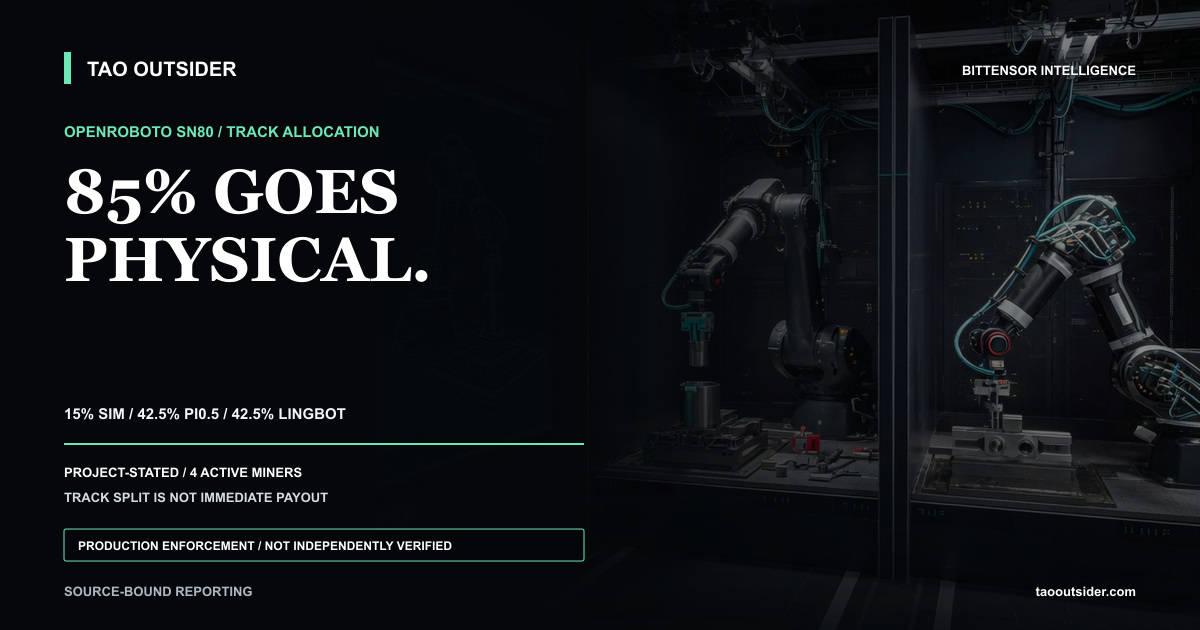
OpenRoboto SN80 says most of its track-level emission allocation now belongs to physical-robot competitions.
The split published on September 7 is 15% for simulation, 42.5% for a real pi0.5 track and 42.5% for a separate real LingBot-VLA 2.0 track.
That makes 85% of the documented allocation physical. It does not mean 85% is paid immediately to any one miner, model or hotkey.
OpenRoboto’s rules contain three different percentages that are easy to collapse into one misleading number. The 15/42.5/42.5 split divides emission between tracks. Simulation’s 70/20/10 rule ranks its Top 3 inside the simulation share. Each physical track’s 95/5 settlement divides that track’s own seasonal pool.
The economic story is the separation.
Three competitions, not one blended leaderboard
OpenRoboto runs one simulation track and documents two physical tracks.
The physical competitions use different model families: pi0.5 and LingBot-VLA 2.0. They can share a workstation interface, but they do not share a submission.
Each track has its own competition ID, model requirements, submission window, entry fee, roster, qualification baseline and results. A checkpoint entered into one physical competition is not automatically eligible for the other.
The repository warns miners not to infer a real-robot interface from a LIBERO simulation example. Physical evaluation uses a published seven-dimensional joint state and action contract, with an official program handling the hardware adapter and xArm calls.
That contract is technical preparation. It is not evidence that either model family performs well on the robot.
The 15% simulation share has its own ranking rule
Within simulation, the leaderboard is capped at three positions. The relative weights are 70% for first, 20% for second and 10% for third.
Those percentages do not divide total SN80 emission.
They divide the simulation track’s 15% share. In a simple normalized example, first place would correspond to 10.5 percentage points of the track allocation, second to 3 points and third to 1.5 points, before any separate protocol or operational effects.
That arithmetic is an explanation of the documented split, not a live payout calculation. Tao Outsider did not inspect validator weight transactions to confirm those exact proportions on chain.
The simulation competition also retains its challenge structure. A new candidate must beat the incumbent by more than the configured champion margin. A tie at the threshold does not replace the champion.
Our September 1 report covered that LingBot-VLA 2.0 baseline and promotion rule. The September 7 change is different. It tells miners how much of the documented track allocation remains in simulation after the physical tracks are separated.
Each physical model family gets 42.5%
OpenRoboto assigns 42.5% to the real pi0.5 track and 42.5% to the real LingBot-VLA 2.0 track.
Each track accounts for its own seasonal pool. The docs say 95% of that pool goes to the champion over 120 days, while 5% goes to qualified entries over 30 days. Rewards withheld under the rules are burned and recorded, according to the project.
Again, 95/5 applies inside one physical pool. It does not re-divide the full subnet allocation, and it does not combine the two model families.
The project also separates entry fees from emission rewards. A hotkey receiving a fee should not be assumed to identify the prize pool or the account distributing the physical-track emission.
That distinction matters because one visible transfer can be misread as the entire incentive system. OpenRoboto’s docs say previously accrued season rewards are not retroactively redistributed by the new allocation.
Why move the center of gravity to hardware
Simulation is cheaper to run, easier to reproduce and faster to iterate. It can also reward improvements that disappear when cameras, joints, grippers, latency and physical variation enter the loop.
Allocating 85% to physical tracks makes OpenRoboto’s stated priority explicit. The subnet wants model competition to face the workcell, not remain mainly inside a simulated benchmark.
That direction can attract teams willing to optimize for real hardware. It can also narrow participation.
Physical evaluation has higher coordination and equipment costs. A small number of workstations, evaluation windows or accepted submissions can make the competition operationally centralized even when model training is open.
The split therefore does not prove decentralization. It creates a budget for the part of the system where decentralization is harder.
Four active miners is a serious caveat
At TaoSwap block 9,015,736, OpenRoboto SN80 had four active miners and a nonzero emission_value of 0.004775331.
Four active miners do not support a claim of broad robotics participation. The snapshot also does not identify how many miners belong to each track or whether every registered physical competitor appears in TaoSwap’s miner count.
Concentrating the allocation on physical tracks before participation grows can make rewards meaningful enough to justify expensive evaluation. It can also concentrate a large share of the economics among very few eligible models.
The percentage alone tells us little about competitive depth. Distinct teams still need to enter, reproduce the interface, submit valid checkpoints and challenge winners over time.
What is verified and what remains project-stated
The September 7 commit and current OpenRoboto CLI documentation contain the 15/42.5/42.5 split. They state that the allocation is in effect.
Tao Outsider verified those public repository claims. We did not independently verify production enforcement, the balance of each seasonal pool or the validator configuration that translates the project policy into live weights.
TaoSwap exposes the subnet’s overall status, but its current response does not expose this three-track accounting model.
The physical interfaces, settlement rules and challenge process are also project-defined. They do not prove real-world performance, simulation-to-robot transfer, model safety or demand from robotics customers.
The next evidence should show complete trials from both physical model families and separate pool accounting. It should also identify qualified entries beyond one team and weight or settlement records that match the published split.
OpenRoboto’s allocation is still consequential. It moves the subnet’s stated economic center from a simulation tournament to two distinct hardware contests. Now the physical tracks have to show that they can support a competition as clear as the percentages.
Sources
OpenRoboto September 7 allocation commit
OpenRoboto parallel real-track documentation
OpenRoboto real-robot overview
OpenRoboto subnet overview and settlement rules
Tao Outsider’s earlier report on the LingBot-VLA 2.0 simulation baseline
Was this article useful?
One tap feedback helps us improve each post.