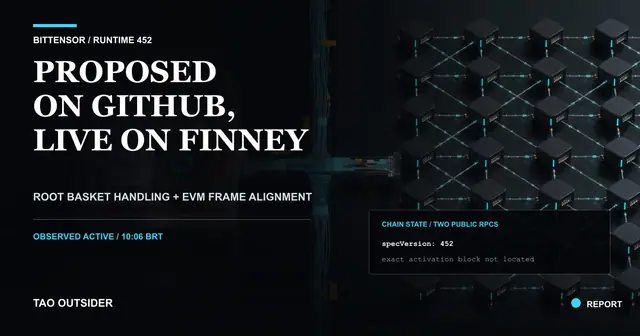

August 5 update: Root Reborn is no longer only a proposal. The release package merged on August 3 and appears in Runtime 441. The validator strategy layer is still gated. Root weight setting remains disabled until governance enables it.
Root Reborn is one of the most important validator changes in Bittensor because it rewrites the job description.
The mechanism moves Root staking away from a mechanical yield path where subnet dividends are sold back into TAO. Validators can eventually curate baskets of subnet alpha and route Root yield into those baskets.
The crucial boundary is activation. The code is packaged, but the release pull request sets RootWeightSettingEnabled to false. Until governance changes that flag, validators cannot run their own active basket strategies. Dividends accumulate in the null strategy on the origin subnet.
The user facing consequence is simple. Root validators start to act as allocators. Stakers would judge uptime, brand and historical trust, but also where a validator sends yield, what basket it builds, whether that basket performs and whether the validator can explain the risk.
The practical change
Today, Root staking is easy to describe from a user perspective. Delegate TAO to Root, receive yield, avoid choosing individual subnet alpha directly.
Root Reborn keeps the Root surface, but changes what can happen underneath the yield. Each validator receives a separate beta basket. Deposits mint shares using realizable net asset value. Withdrawals redeem those shares proportionally. Only hotkeys registered on Root are eligible to earn the related dividends.
The release also adds an unstaking hold interval. Each basket carries timing, liquidity and execution consequences beyond a simple routing preference.
The market is starting to understand this part.
The validator is no longer only a block production and scoring participant. In this model, the validator becomes a public capital curator inside the Bittensor subnet board.
Why subnet teams care
Root Reborn can change the pressure pattern on subnet alpha.
The existing complaint is that Root yield creates recurring subnet selling. Subnet dividends are converted back into TAO to pay stakers. In the proposed model, part of that flow can become reinvestment into subnet baskets.
For stronger subnets, that can mean new structural demand. For weaker subnets, it can mean public exclusion.
The political edge is obvious. If validators publish baskets and stakers compare results, subnets have a new reason to make their thesis legible. Mechanism, code, miners, liquidity, revenue, products and public updates matter more when validators must defend allocations.
Why the gated launch is sensible
Root Reborn changes capital routing across the subnet market. Switching every validator strategy on at once would make observation harder and failures more expensive.
The gated launch creates a cleaner sequence. First, migrate state and verify accounting. Then observe deposits, shares, claims and holds. Only after that does governance enable validator-directed root weights.
That is slower than a dramatic launch. It is also a better fit for code that changes how stake is represented and redeemed.
The risk
The obvious risk is opacity. If basket reporting is weak, stakers may follow validator brands instead of understanding allocation. If basket reporting is strong, validators will need to explain their decisions clearly.
There is also concentration risk. Popular validators could direct meaningful capital toward a narrow group of already visible subnets. This may help quality projects, but it can also reinforce social attention if the reporting layer is poor.
The safeguard is simple to state and hard to implement. Bad allocation must be easy to see.
The Tao Outsider read
Root Reborn matters because it brings validator judgment back to the surface and puts that judgment inside an auditable fund structure.
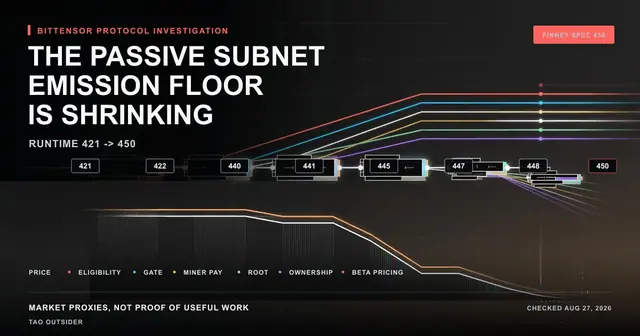
Bittensor has spent the past few weeks making the subnet board less forgiving. Emission eligibility is under review. Price based emission logic is being debated and implemented in pieces. Liquidity and market structure matter more after the cleanup.
Root Reborn fits that direction.
It asks validators to show what they believe, stakers to compare results and subnets to earn attention with evidence. That is healthy if the reporting layer is strong. It is dangerous if the ecosystem turns basket allocation into marketing copy.
The bullish case is now more concrete. Bittensor has moved from discussion to release code. The remaining question is whether the gated rollout produces accounting that ordinary stakers can inspect before validator strategies go live.
The next milestone is governance enabling root weight setting, followed by observable baskets that stakers can compare without becoming protocol engineers.
Sources
Subtensor release: Runtime 441
Subtensor release pull request: Root Reborn packaged for Runtime 441
Earlier Subtensor proposal: Root Reborn
Opentensor Subtensor PR: delegated weight vector curation for root yield vaults
Opentensor Subtensor PR: delegated weight vector management for root yield vaults
CoinDesk context: Bittensor proposal would turn validators into something like fund managers
TAO Roundtable announcement: Subnet owners debate Root Reborn
Official docs: Validating in Bittensor
Was this article useful?
One tap feedback helps us improve each post.