Score says its speed update is now live on Bittensor subnet 44.
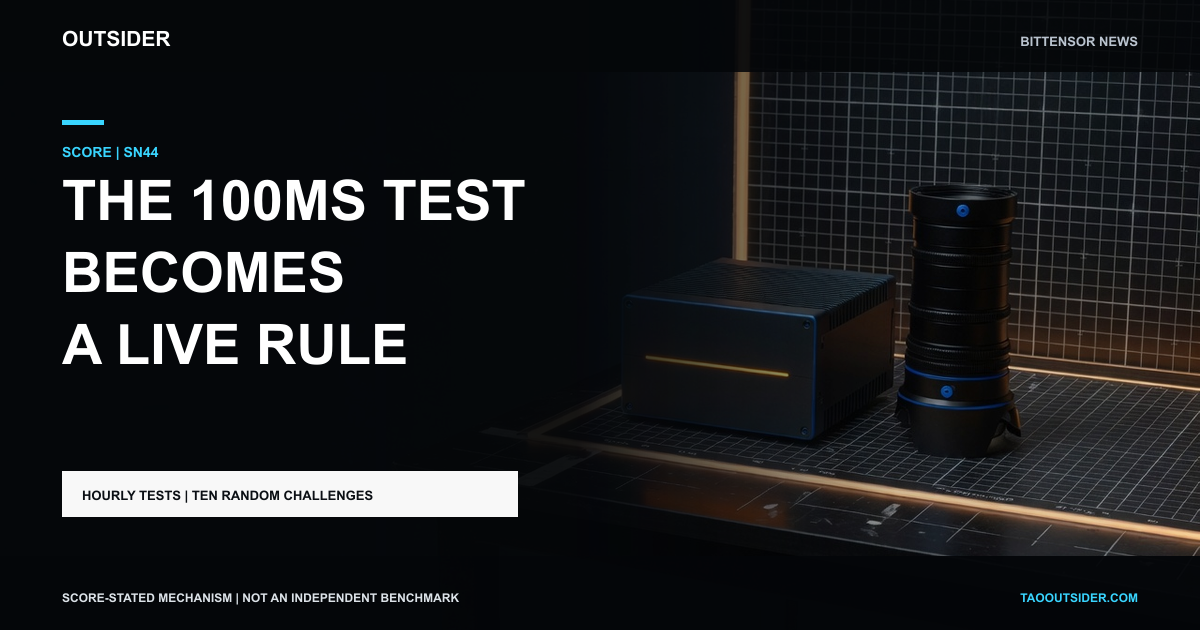
The change turns the 100ms target described earlier this month into a recurring check. According to Score, a dedicated machine tests leading models, plus models close to its leaderboard, once an hour. Each round uses ten random challenges. A model can lose rewards for that submission if it is too slow or if it returns a different answer after qualifying.
This is Score’s mechanism and its own test process. Tao Outsider has not independently benchmarked the models or measured their use in production.
The delta from the July 4 update
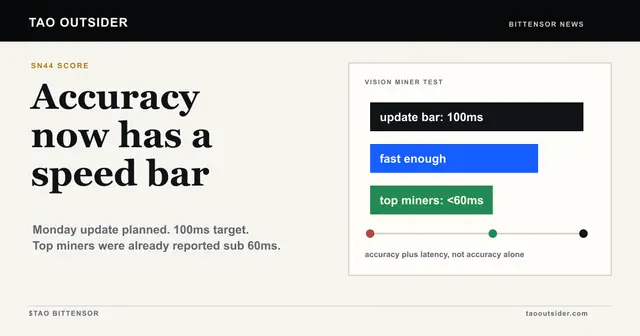
On July 4, Score said it was preparing a 100ms bar for its Bittensor vision miners. The earlier report covered the planned rule before it shipped.
The new post provides the operational detail that was missing then. Score says the update is already running and that the referee machine samples ten challenges every hour. It also says the checks cover latency and conformity, so a miner cannot qualify with one model, replace it with a weaker version, and keep the same rewards.
That is a sharper story than a headline about speed alone. The subnet is trying to make a model remain fast and behave consistently after it reaches the board.
How Score says the referee works
For a submitted model, Score describes two failure paths: missing the latency requirement or producing a different answer from the one given at qualification. The stated consequence is narrow. Rewards stop for that model until the miner submits a corrected version. Score says this is not a subnet-wide ban and does not affect the miner’s other submissions.
The team also says it publishes the test trail on its conformity page. That is useful evidence to inspect, but it is not the same as an outside audit. The practical question is whether the page continues to show tests, failures, fixes and a stable standard as more miners compete.
A harder target for vision miners
Computer vision is unforgiving about delay. An accurate result can still miss its moment if it arrives too late for a camera workflow. Score is putting that constraint directly into the competition it runs for miners.
The public update does not prove that SN44 has solved edge deployment or that its models are in commercial use. It does show a concrete attempt to make the scoring target closer to the constraint Score wants to optimize for: vision output that remains accurate while staying below its stated latency bar.
For Bittensor readers, the useful signal is visible reward rules that name the behavior a subnet wants, test it regularly and expose failure.
What remains unproven
Score’s post is a project source. Its sub-100ms target, hourly test cadence and referee process should be read as Score-stated facts. We have not reproduced the conformity tests, compared them with another benchmark, or verified production adoption.
TaoSwap listed SN44 as active when checked on July 13, with ten active miners and low deregistration risk. That is live subnet context, not evidence that the mechanism has already found broad product demand.
The next evidence worth watching is visible test history, sustained miner participation and a clear account of how accuracy holds up as latency gets tighter.
Sources
Score, live speed update and referee process
Score, SN44 profile
TaoSwap API, SN44 live subnet check
Was this article useful?
One tap feedback helps us improve each post.