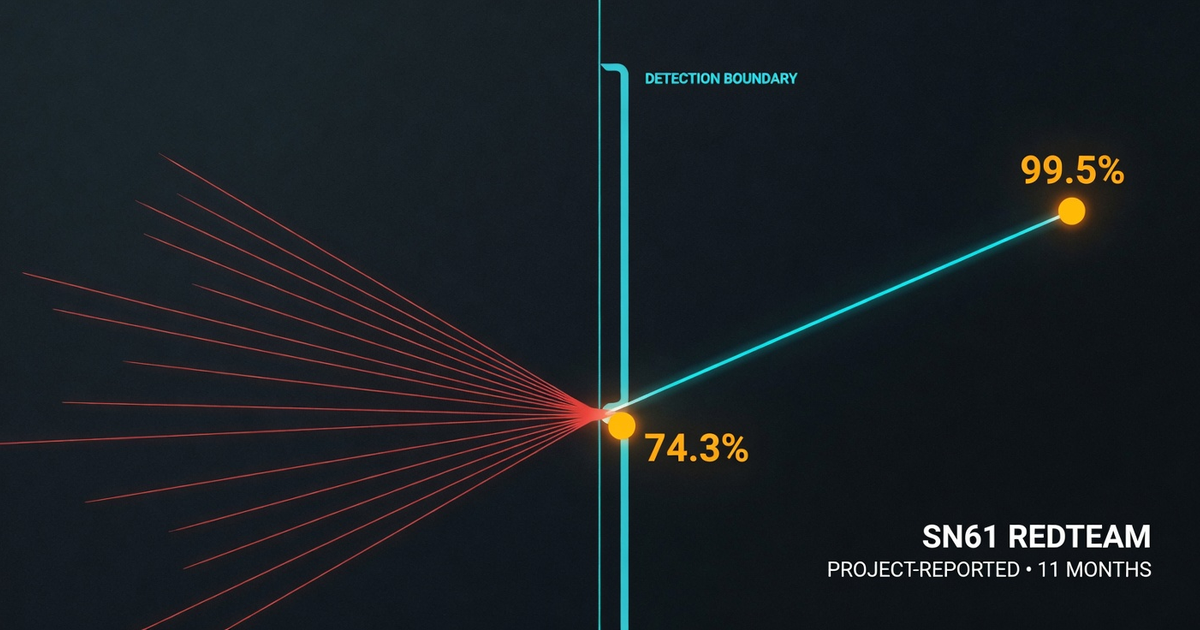
Opentensor reports that RedTeam’s bot-detection rate increased from 74.3% to 99.5% over 11 months of live attacks.
The Opentensor Foundation included the figure in its July 13 to 19 Bittensor ecosystem summary. It is a RedTeam result, not an independent Tao Outsider benchmark.
The number is worth examining because it points to the kind of feedback loop a security subnet should create: miners face changing attacks, scoring exposes weak approaches and the competition has to adapt.
What the metric can tell us
A detection rate is useful only when the test behind it is clear.
The comparison suggests RedTeam’s system became better at separating bots from legitimate participants across the period measured. It does not establish performance against every bot, application or adversarial environment.
Bot detection changes as attackers change. A detector can perform well against known behavior and lose ground when a new automation strategy appears. That makes a live attack stream more relevant than a frozen benchmark, but also harder to reproduce.
The strongest version of this update would include the sample size, false-positive rate, attack mix, scoring window and rules used when traffic changed. Those details decide whether a high detection rate protects a real system or reflects a narrow test.
Why the subnet mechanism matters
RedTeam is built around adversarial improvement.
That is a natural fit for Bittensor. Security work benefits from opponents who keep searching for failure modes instead of optimizing once against a static dataset.
The network still needs scoring that resists shortcuts. If miners can infer the test, replay known solutions or optimize for a proxy that misses real attacks, a strong headline metric can hide a weak defense.
Tao Outsider read
The reported improvement is encouraging because it describes movement across time, not a single launch claim.
It is not proof of a breach, an exploit or customer impact. It is also not an independently reproduced benchmark.
The next step is public measurement detail. If RedTeam can show how the attack distribution, false positives and scoring changed while the rate improved, SN61 will have a stronger security story than the percentage alone.
Sources
Opentensor Foundation, Bittensor ecosystem highlights for July 13 to 19
Was this article useful?
One tap feedback helps us improve each post.