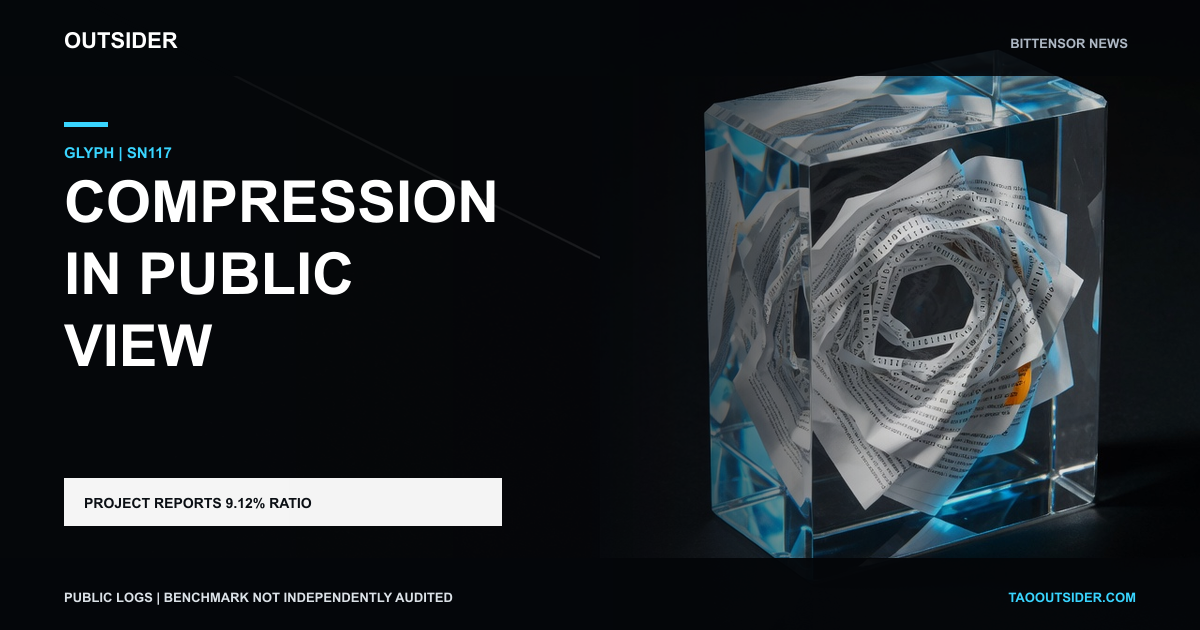
Glyph says a new winner pushed its lossless neural compression ratio to 9.12% on July 10.
The result came from model hugfan6/glyph-codec, according to the SN117 winner log. Glyph says it displaced a 10.04% incumbent after clearing the subnet’s required five percent improvement margin.
These numbers come from the project. Tao Outsider has not independently reproduced the benchmark. Glyph also opened its Weights & Biases project so readers can inspect evaluation runs, ratios, dethrone events and validator outputs.
What Glyph SN117 is measuring
Glyph describes SN117 as a competition for lossless neural compression.
Miners submit codecs. Validators test whether the original data can be reconstructed without information loss, then compare the compression ratio. A challenger must beat the incumbent by a defined margin before it takes the leading position.
That gives the subnet a narrow task with a measurable answer. A smaller file is only useful here if decompression returns the original content exactly.
For readers still learning the network, our guide to how Bittensor subnets work explains the basic logic. Miners compete on a digital task, while validators decide which output deserves weight.
Why public logs improve the story
A winner card is easy to post. Validator evidence is more useful.
Glyph says its public dashboard exposes the runs behind the leaderboard, including ratios and validator side outputs. That gives miners and outside readers a place to inspect how the result changed instead of relying on a single announcement.
The public layer does not turn a project benchmark into an independent audit. It does make the claim easier to question, compare and reproduce.
The subnet is still early
TaoSwap listed SN117 as active when checked on July 12. The snapshot showed two active miners and zero emission value.
That is thin operating context. It does not invalidate the compression work, and it does not support a mature traction claim. Glyph has a public mechanism, a visible winner and an inspection surface. The next evidence should show more sustained competition and reproducible results across additional data.
Tao Outsider read
The 9.12% figure will attract attention. The public validator trail is the more durable development.
Bittensor news becomes easier to trust when a subnet gives readers enough information to challenge its claims. Glyph has started doing that. The benchmark still needs outside reproduction, and the live miner field remains small.
Sources
Glyph, winner model and 9.12% compression ratio
Glyph, public validator logs and evaluation runs
Glyph, winner log and subnet mechanism
Glyph, official project site
TaoSwap API, SN117 active subnet check
Was this article useful?
One tap feedback helps us improve each post.