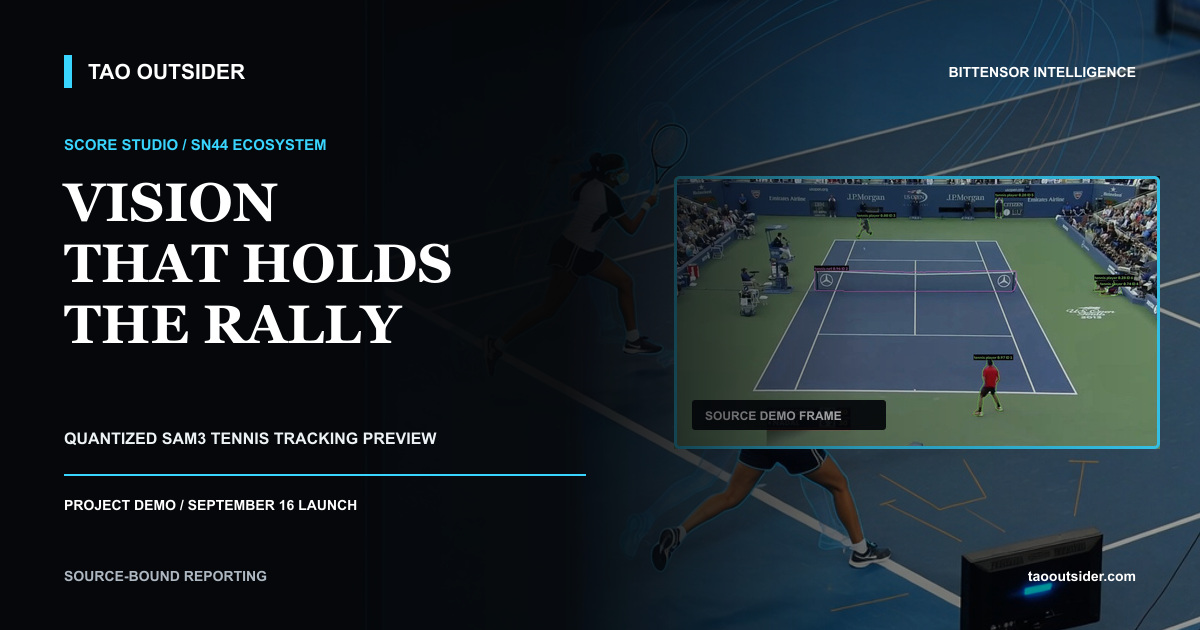
Score has previewed a quantized SAM3 model running inside Score Studio, tracking Djokovic and Nadal through a long rally and drawing a trail for each player across the court.
The September 4 demonstration expands the picture of Score Studio before its stated September 16 launch. Score says the application will include the wider computer-vision stack, rather than limiting users to models trained on Bittensor subnet 44.
That sentence is more important than the tennis clip.
Score is positioning Studio as a product where data, models, evaluation and deployment can meet. SN44 remains one source of model competition inside that story. The public site, the agent-plugin repository and the subnet are related, but they are not interchangeable.
The demonstration and performance descriptions come from Score. Tao Outsider has not replayed the source video frame by frame, benchmarked the quantized model or verified that it held both identities across the complete rally.
What the tennis clip is trying to prove
Video tracking has two jobs in this example. The system must segment each player in a frame and preserve the same identity as both athletes move, overlap and change direction.
Score’s post says both players remain tracked for the entire point. Their trails accumulate into a map of court coverage as the rally continues. The team describes its quantized SAM3 as small, fast, efficient and open source.
The source clip gives the project a clear visual test. Tennis creates fast motion, frequent direction changes and a large area of similar court color. A long rally also exposes identity drift more readily than a selected still image.
It remains a curated demonstration. The post does not publish latency, hardware, model size, tracking-error rate or a comparison with the unquantized model. It also does not show failure cases such as occlusion, camera cuts or several visually similar players entering the scene.
The useful conclusion is modest. Score has shown the type of computer-vision sequence it plans to place inside Studio and a project-demonstrated example of its output.
Score Studio is larger than one model
The public Score Studio site describes one connected process for generating and labeling data, training candidates, evaluating them, composing visual pipelines, deploying approved models and monitoring production behavior.
Users can begin with their own data and model, or ask the system to build missing parts of the process. The site presents versioned datasets, frozen evaluation criteria and visible deployment evidence as organizing principles.
As of September 4, the main call to action is still a waitlist. Score has announced September 16 as the launch date, but the public site does not establish general availability today.
That timing needs to remain explicit. The SAM3 clip is a preview of an upcoming product, not evidence that anyone can already run the full sequence in production.
A public MCP layer exists, with its own release boundary
Score also maintains a public repository for Score Studio agent plugins. The repository describes one portable MCP server for ChatGPT, Claude, Gemini, Cursor, Hermes Agent and other compatible hosts.
Its tools are deliberately narrower than the full Studio API. They cover inspection of versioned datasets and model lineage, tracked training and evaluation jobs, immutable reports, deployment checks and typed jobs. Delete operations, billing, member administration, provider credentials and release switching are excluded from the first version.
The code is useful evidence of product design. It does not mean every listed integration is publicly installable.
The repository’s own release plan preserves that boundary. A hosted HTTPS MCP service, OAuth, production-account testing and platform submissions remain steps in the release order for some channels. The README says a public ChatGPT listing cannot use the current manual-token flow and should not be claimed before the hosted authorization boundary exists.
The repository supports Score’s claim that Studio is being designed for AI assistants. It also records what is still pending.
Where SN44 fits
Score SN44 operates a Bittensor competition around computer-vision models. Earlier Tao Outsider coverage examined its sub-100ms speed target and the hourly referee process that checks latency and conformity.
The current TurboVision repository describes a broader decentralized layer for live video and imagery. Miners contribute models, validators run scoring jobs and a manifest defines the active elements and their weights. Pseudo-ground-truth generation can use SAM3 when an element does not provide real ground truth.
That technical overlap makes the Studio and subnet relationship credible. It does not prove that the tennis request in the September 4 clip was served by a current SN44 miner or that every future Studio job will produce demand for the subnet.
Score itself says Studio will run models beyond those trained on SN44. Readers should therefore avoid collapsing product usage into subnet usage.
Ten active miners provide context, not adoption
A TaoSwap snapshot captured on September 4 showed ten active miners on Score SN44 and an emission_value of 0.033151782.
The current network context does not reveal the number of Studio users, the origin of the SAM3 model, customer revenue or the quality of the tennis tracking. TaoSwap also cannot show how Studio chooses between a subnet model, an outside open-source model and a customer-supplied model.
The important measurement after launch will be the route from a user’s visual problem to a model decision. Which tasks go to SN44? Which stay inside Studio’s own compute? What evidence does a user receive when one model replaces another?
The September 16 test
Score Studio is making a broad promise. It wants one place to move from raw media to an evaluated model and then into deployment without losing the evidence behind each step.
The tennis demo gives that promise a recognizable object. People can see player masks and movement trails. They cannot yet inspect the complete model-selection record, processing time or failure rate from the post alone.
The launch will be more informative than the preview if it exposes reproducible project inputs, measurable evaluations and a clear account of where Bittensor miners participate.
Score has already built more public code around Studio than a typical product teaser. The waitlist, source repository and demonstration now need to converge into a product people can actually test on September 16.
Until then, the verified story is a project-demonstrated SAM3 tracking sequence and a public product architecture with explicit release work still ahead.
Sources
Score SAM3 tennis-tracking preview
Score Studio September 16 launch notice
Score Studio public product surface
Score Studio public agent-plugin repository
Score Studio public plugin launch commit
Score Studio distribution and release boundaries
Score TurboVision SN44 implementation
Was this article useful?
One tap feedback helps us improve each post.