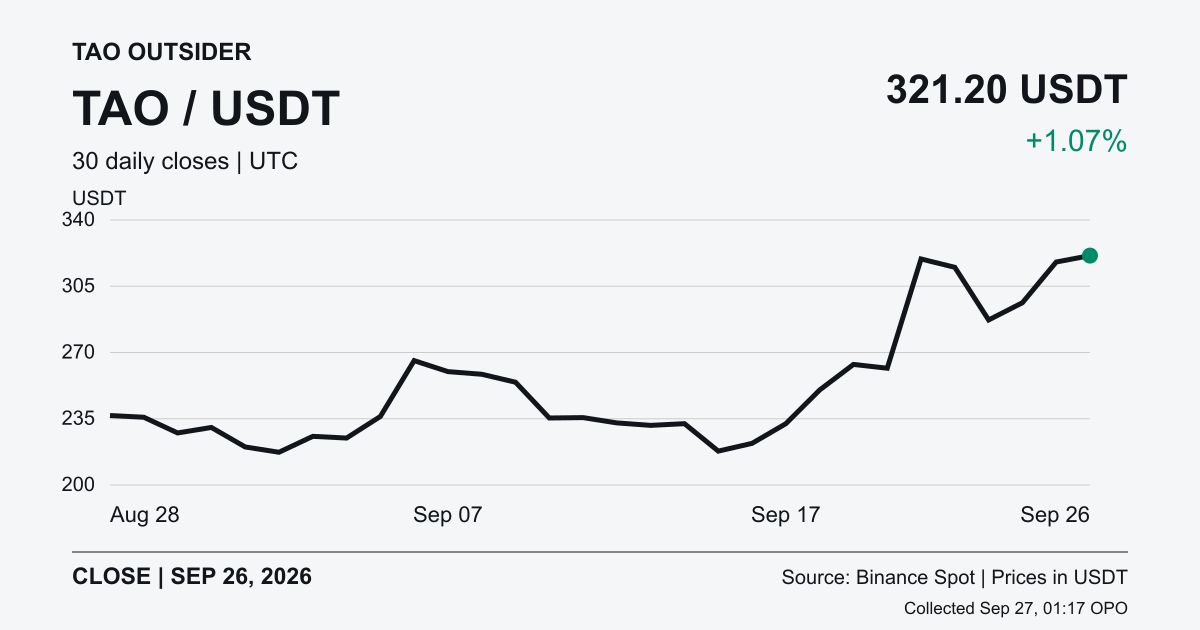
TAO closed September 26 at 321.20 USDT on Binance Spot, up 1.07% from the previous daily close of 317.80. The session reached 341.30 before finishing 20.10 USDT below that high.
Bittensor’s token extended its advance on a closing basis, but the finish was less decisive than the previous session’s close near its high. The latest candle ended in the lower half of its 309 to 341.30 USDT range.
The completed session
| Binance Spot TAO/USDT | September 26 |
|---|---|
| Open | 317.70 USDT |
| High | 341.30 USDT |
| Low | 309.00 USDT |
| Close | 321.20 USDT |
| Change from previous close | +1.07% |
| Volume | 181,122.49 TAO |
| Quote volume | 58,668,835.26 USDT |
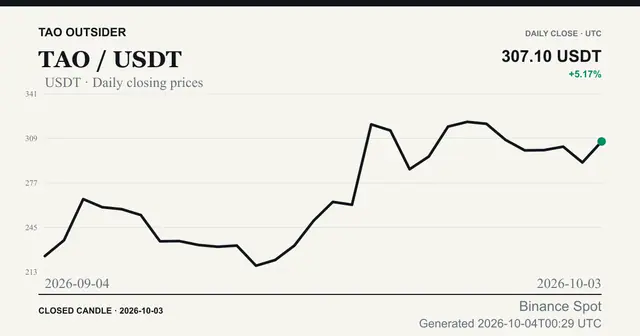
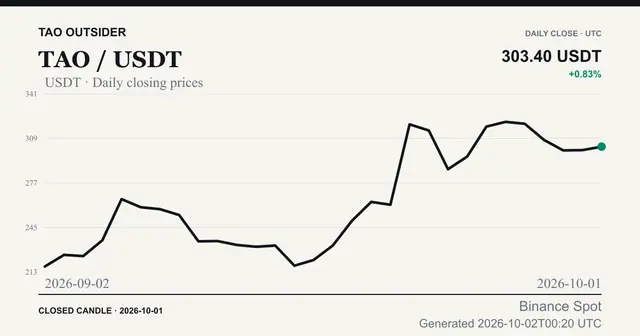
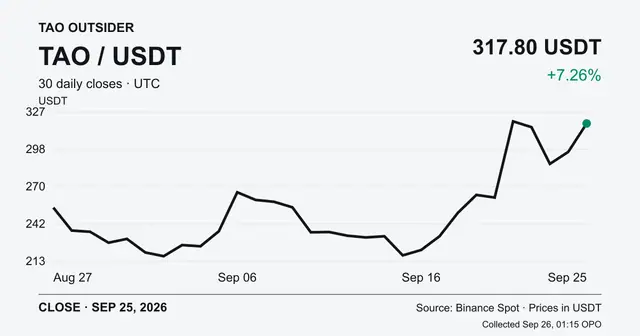
The candle covers September 26 in UTC. Data was collected on September 27 at 01:17 OPO. The chart plots 30 completed daily closes, not intraday highs and lows.
What the close changes
The 341.30 session high is also the highest high across the latest 20 completed daily candles. TAO traded beyond the previous window’s 326.50 high, but did not finish above it.
That distinction matters for a continuation reading. The session demonstrated trading above the earlier high; the close left confirmation unresolved. Price remains above the 20-day simple moving average of 262.26 USDT, although that backward-looking measure cannot establish the next session’s direction.
Conditions for the next session
A completed daily close above 326.50 would recover the earlier high on a closing basis. A close above 341.30 would confirm a break beyond September 26’s full range. A daily close below 309 would invalidate this near-term continuation scenario.
Conversely, a completed daily close below 309 would confirm a loss of the session low and strengthen a pullback reading. A subsequent close above 341.30 would invalidate that downside scenario. These are conditional interpretations of observed prices, not trading instructions.
Lium’s reward design adds subnet context
Separately, Lium SN51’s current provider documentation describes rented, unrented and burn pools. The burn allocation shares a ceiling with rewards for eligible unrented capacity, so a smaller allocation to burning can accompany more eligible idle capacity receiving rewards. That alone does not establish greater rental demand.
On September 23, Lium merged a change that can remove idle rewards from the free GPUs of a partially rented split node when fewer than three ports remain available. The feature flag defaults to off, so the merged code does not establish that payouts have changed. Rented GPUs are unaffected by that check.
The distinction is relevant to Bittensor’s buyback debate: emission allocation and customer-funded purchases describe different economic activity. Our subnet buybacks analysis explores that question. Neither the documentation nor that debate establishes a cause for this session’s price move.
This edition uses a completed spot candle from one venue, denominated in USDT. Funding, open interest and liquidations are excluded from the price analysis; retrieval-time derivatives observations are retained separately in the evidence snapshot. Lium’s documentation describes its reward design rather than independently verified current validator settings.
Sources
- Binance Spot TAO/USDT daily candles
- Binance market-data documentation
- Lium subnet emission documentation
- Lium merged split-node idle reward change, PR 1414
Was this article useful?
One tap feedback helps us improve each post.