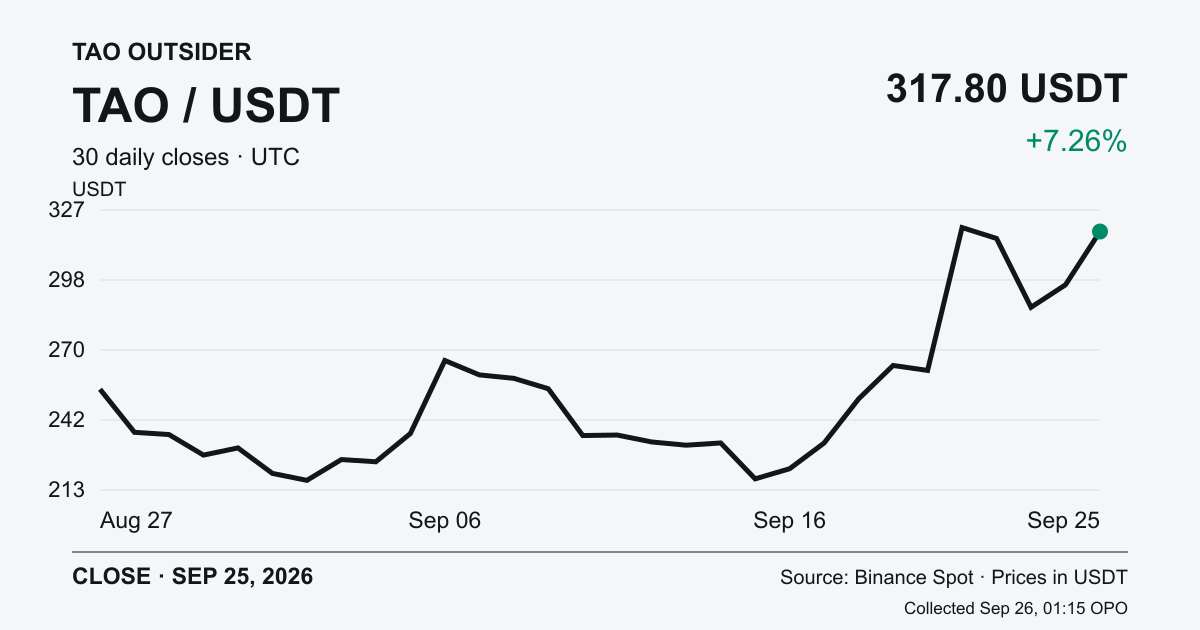
TAO closed September 25 at 317.80 USDT on Binance Spot, up 7.26% from the previous daily close. The session traded between 293 and 321 USDT, finishing just 3.20 USDT below its high.
That finish puts Bittensor’s token within 8.70 USDT of 326.50, the highest price across the latest 20 completed daily candles. The rebound has brought that level back into view without yet clearing it.
The completed session
| Binance Spot TAO/USDT | September 25 |
|---|---|
| Open | 296.40 USDT |
| High | 321.00 USDT |
| Low | 293.00 USDT |
| Close | 317.80 USDT |
| Change from previous close | +7.26% |
| Volume | 183,713.87 TAO |
| Quote volume | 56,025,376.05 USDT |
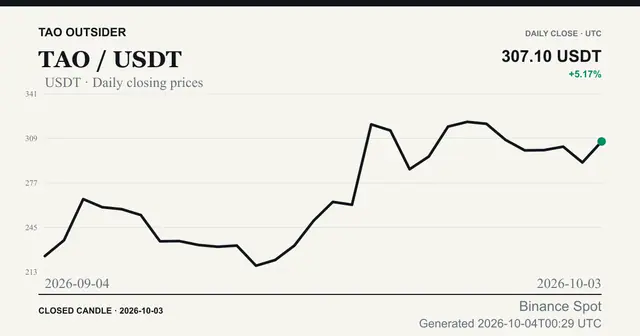
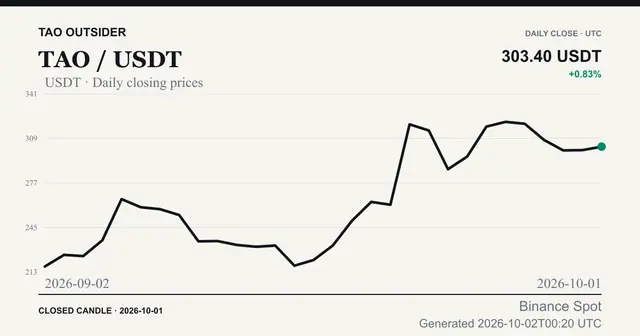
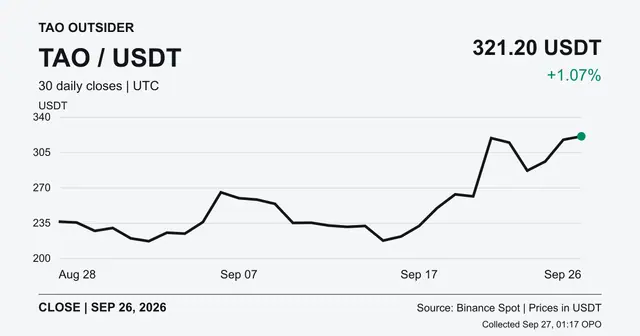
The candle covers September 25 in UTC. Data was collected on September 26 at 01:15 OPO. The chart plots the latest 30 completed daily closes, not intraday prices.
What the close changes
Finishing near the top of the day’s range is a stronger result than giving back most of the advance. The close also remains above the 20-day simple moving average of 259.49 USDT, calculated from completed daily closes.
The distance from that average shows how far the recent move has carried TAO. It does not establish that the next session will continue higher. The nearby session and 20-day highs give a more immediate test.
Conditions for the next session
A completed daily close above 321 would confirm a break above September 25’s high. A subsequent close above 326.50 would also clear the highest price in the 20-candle window. A daily close below 293 would invalidate this near-term continuation scenario.
Conversely, a completed daily close below 293 would confirm a loss of the session’s low and strengthen a pullback interpretation. A return above 321 on a daily closing basis would invalidate that downside scenario. These levels describe conditional readings of price, rather than trading recommendations.
Cascade’s forecasting work in Bittensor
Separately, Cascade SN91’s public repository describes a competition in which miners create synthetic time series data generators while model and training conditions are controlled. Validators compare the resulting checkpoints on private real-world windows. This is a concrete Bittensor application of incentives to training-data quality.
Our Cascade and Ephemeris report examines the team’s forecasting API and the wider product direction. That work provides ecosystem context; it does not establish the cause of TAO’s price move.
This edition uses one venue’s completed spot candle, denominated in USDT. Funding, open interest and liquidations are not included in the close analysis. The moving average is backward-looking, and the scenarios are editorial interpretations of observed prices.
Sources
- Binance Spot TAO/USDT daily candles
- Binance market-data documentation
- Cascade’s documented training and validation design
Was this article useful?
One tap feedback helps us improve each post.