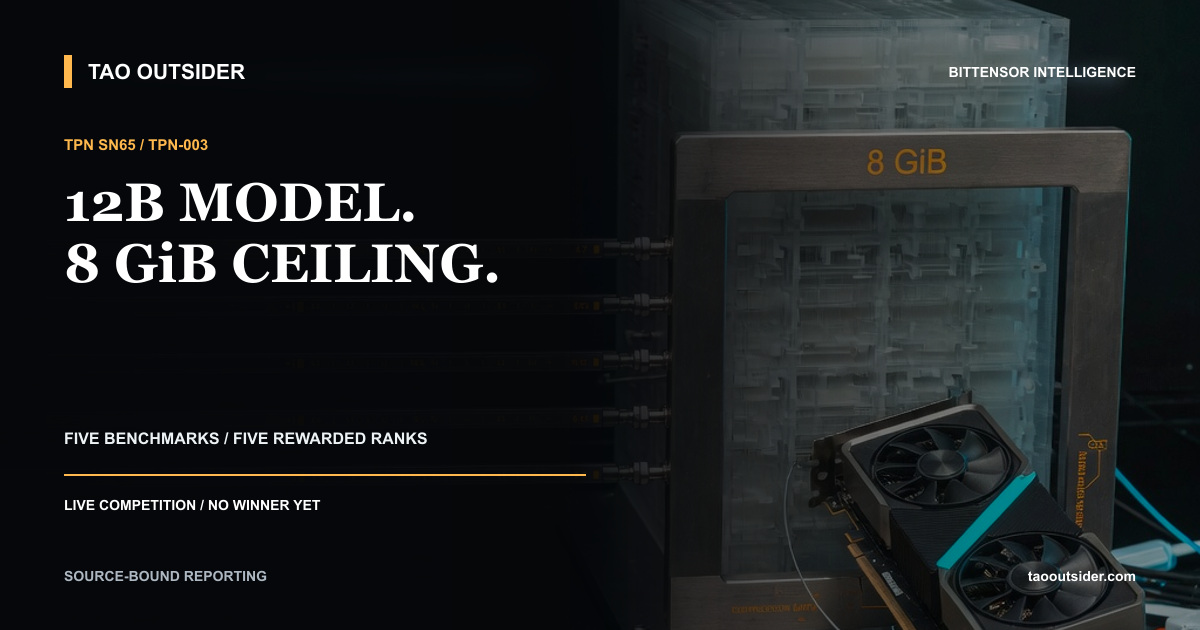
True Performance Network SN65 has opened TPN-003, a Bittensor competition that asks miners to fit a 12-billion-parameter model below an 8 GiB memory ceiling while preserving performance across five public benchmarks.
The target is listed as Gemma4 12B Uncensored. TPN says a 12B model occupies roughly 24 GB at full precision and presents the 8 GiB limit as a route toward laptops and consumer graphics cards.
The engineering target is still waiting for a result.
At the September 4 snapshot used for this article, the TPN dashboard showed the competition as live with zero revealed candidates, zero scored results and zero payout-eligible submissions. Nobody had yet demonstrated a winning compressed model through the public TPN-003 process.
The contest is news because the rules are concrete. It should not be reported as a compression breakthrough before a model clears them.
The constraint comes before the leaderboard
TPN-003 requires a GGUF derivative of the named base model. Validators measure memory against an 8,388,608 KB ceiling with a 4,096-token context. A miner also posts 0.3 TAO in collateral according to the public dashboard.
Memory fit is the entry condition. Capability is scored across MMLU, HellaSwag, ARC-Challenge, TruthfulQA and GSM8K.
The dashboard assigns 30% of the benchmark mix to MMLU, 20% to HellaSwag, 15% to ARC-Challenge, 15% to TruthfulQA and 20% to GSM8K. It lists five rewarded ranks paid at 40%, 25%, 20%, 10% and 5% inside the competition’s published scheme.
This blend gives miners several failure modes. A model can fit the memory ceiling and still lose too much capability. It can preserve broad knowledge while damaging arithmetic, reasoning or truthfulness performance. It can also perform well on the named suite and still struggle with tasks outside it.
Five benchmarks create a wider test than one score. They do not provide a complete definition of model quality.
Why 8 GiB matters, and where the claim stops
Moving a model from a rented accelerator to a local machine changes cost, privacy and availability options. An 8 GiB ceiling covers a large population of consumer GPUs and some higher-memory laptops.
Actual usability depends on more than capacity. Inference speed, context length, quantization method, operating system, driver support, thermal limits and workload all affect the experience. A file that loads successfully can still answer too slowly for the intended application.
TPN’s public contest measures a specific memory condition and a named benchmark set. It does not test every consumer device, establish energy efficiency or prove that the resulting model will be useful for a particular local task.
The most defensible description is precise. TPN-003 is searching for a GGUF version that validators can run below 8 GiB at the configured context while retaining enough benchmark performance to rank.
A third iteration of the same market
TPN launched on mainnet in August and has been increasing the size of its optimization targets.
Its first public competition focused on a 2 GB ceiling and two benchmarks. TPN-002 moved to a larger Qwen3.5 model, a 4 GiB ceiling and the same five-benchmark family now used by TPN-003. On September 4, the dashboard showed TPN-002 in scoring with 21 revealed candidates and five finalized results.
Those earlier competitions give TPN-003 operating context. They do not settle the new challenge. The larger model and doubled memory ceiling change the quantization tradeoffs, and each base model can respond differently to compression.
TPN has also opened a public gateway and a competition dashboard. The team describes the gateway as an optimization engine where a model and constraint go in and an optimized model comes out. Its product-market-fit language remains an ambition. The gateway can be visited, while demand and commercial reliability require separate evidence.
Five active subnet miners are not five submissions
A TaoSwap status snapshot captured on September 4 showed five active miners on SN65 and an emission_value of 0.000000014.
The TPN-003 dashboard showed no revealed candidate at the same research checkpoint. Those numbers describe different layers. An on-chain active miner count does not equal a submitted model count, and a competition submission does not necessarily identify a distinct operator.
The low emission snapshot is also not a model-quality score. It describes the subnet’s current network position. TPN-003 results will come from the contest’s own memory and benchmark process.
What to watch before September 8
TPN’s announcement says submissions close September 8. The public dashboard expresses the schedule in Bittensor block numbers and reported 27,835 blocks remaining at the September 4 check. Chain timing can move, so the dashboard is the better source for the live state.
Three pieces of evidence will matter once candidates appear.
First, validators need to report measured memory under the exact 4,096-token setup. Second, the benchmark scores need to remain visible per model rather than collapsing into a single unexplained rank. Third, the winning GGUF should be inspectable so outside users can test speed and quality on real hardware.
TPN-003 is a credible Bittensor competition because it turns model optimization into a measurable constraint with a public scoreboard. The outcome is still open.
If a miner produces a model that fits below 8 GiB, clears the five-way benchmark test and remains usable on ordinary hardware, that will be the story. Today, the story is that SN65 has defined the race and opened the gate.
Sources
TPN-003 public competition dashboard
TPN public competition data endpoint
TPN two-week mainnet and product update
Was this article useful?
One tap feedback helps us improve each post.