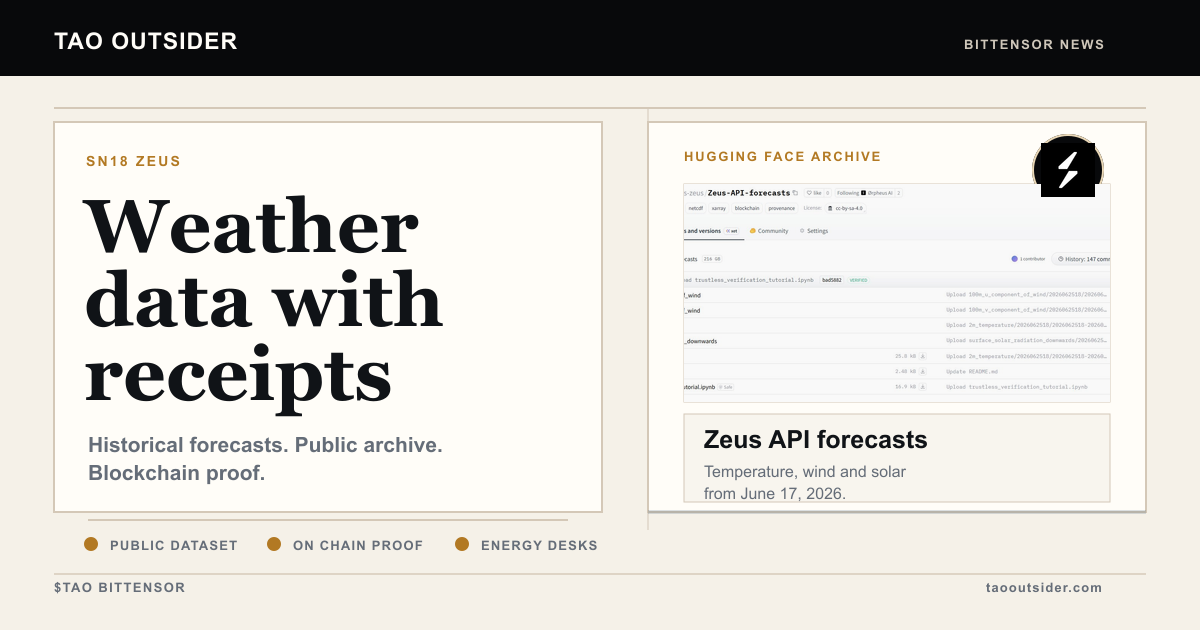
Zeus SN18 published a public archive of historical weather forecasts with blockchain proof.
Wouter Haringhuizen, founder of Zeus, framed the update in aggressive commercial language. He said the team had saved an estimated $15,000 to $50,000 by making forecast verification cheaper and directly available to users. Tao Outsider treats that as a founder claim, not as an audited customer result.
The stronger point is easier to verify. Zeus has put a forecast archive in public, tied it to proof, and made it usable by people who want to test the historical record themselves.
For TAO readers, the Bittensor relevance is practical. SN18 is producing an output that can be checked outside the usual dTAO rotation. The update does not make a weekly Bittensor price call. It gives the market a better product story to evaluate over time.
What Zeus published
Zeus linked to a Hugging Face dataset called orpheus-zeus/Zeus-API-forecasts.
The dataset page describes it as a Bittensor Subnet Zeus archive dataset. It contains historical weather forecasts generated by the Zeus API, starting from June 17, 2026. The public variables include 2 meter temperature, 100 meter wind components and surface solar radiation downwards.
Each forecast looks 15 days ahead at one hour intervals. The dataset uses NetCDF files and is built for xarray, which makes it easier for researchers, desks and technical users to load the files instead of staring at screenshots.
The important part is the verification path.
Zeus says the archive lets clients perform trustless verification of forecast quality. The dataset also points users to a notebook for downloading and checking the data. Wouter followed up by saying that the team’s historical forecasts are now open source with proof.
For a Bittensor subnet trying to sell data, that public trail matters.
Why weather forecasts need receipts
Weather data is not a toy market.
Energy traders, renewable operators, grid participants and commodity desks care about weather because small forecast differences can change power demand, solar output, wind generation and price behavior. If a weather vendor claims strong historical accuracy, the buyer has to ask a basic question.
Was that forecast really produced before the weather happened?
Zeus is trying to make the Bittensor angle clear through that question.
A centralized vendor can publish impressive historical examples, but the client still has to trust the record keeping. Zeus is arguing that forecast timing should be provable. A forecast made at a specific time should leave a receipt that can be checked later.
That does not make every forecast correct. It does make the track record harder to polish after the fact.
The hype phrase is “unfakeable data.” The practical phrase is cleaner. Timestamped forecast history that a user can audit.
How Zeus fits Bittensor
Zeus is Subnet 18 on Bittensor.
The public GitHub repository describes Zeus as an environmental forecasting subnet built by Orpheus AI. Miners run forecasting algorithms for global ERA5 environmental variables. Validators issue challenges, verify commit reveal responses, keep rank history and set weights from recent performance.
Opentensor docs describe a Bittensor subnet as an incentive based competition marketplace. Miners produce a digital commodity. Validators measure the work. Yuma Consensus turns those scores into emissions.
Zeus maps cleanly into that structure.
The commodity is weather forecast output. The customers are likely energy traders, desks and technical users who need faster or more accurate signals. The public proof layer is what makes this update more interesting than a normal product announcement.
If a subnet wants to be taken seriously by non crypto buyers, it needs more than a ticker, a chart and a Discord. It needs a thing the buyer can test.
Zeus now has a better answer to that test.
The market read
During our July 3, 2026 check, TaoSwap listed Zeus with 26 active miners and 2,247 holders. The same snapshot showed SN18 with roughly 41,728 TAO in market cap terms and about 170,395 TAO in fully diluted value terms.
TaoSwap rolling 24 hour flow data showed more TAO moving out of SN18 than into it during the checked window. The point is context rather than verdict. A public dataset does not erase liquidity conditions, short term selling or the need for paid demand.
The better read is that Zeus is building a stronger bridge between subnet incentives and external users.
Founder posts can create attention. Benchmarks can create interest. Public archives can create trust. Revenue, pilots, repeated usage and independent evaluation are what turn the story into something durable.
What to watch next
The next test is practical. Outside users should be able to reproduce the verification path without relying on the team. The dataset should keep updating on schedule. Pilots need to move toward paid energy market usage. Benchmarks need to hold across variables, regions and forecast windows. The subnet also has to show that miner competition keeps improving the output instead of turning the public archive into a static proof page.
Those questions are more useful than treating one founder post as a full investment thesis.
For readers tracking Bittensor price, updates like this matter over a longer horizon. It does not make a short term TAO call by itself. It points to the deeper question. Can Bittensor subnets produce outputs that buyers can test, trust and eventually pay for?
Zeus SN18 is now giving that question a more concrete answer.
Sources
Wouter Haringhuizen post: Unfakeable data is on Subnet 18
Wouter Haringhuizen follow up: Historical forecasts open source with proof
Zeus dataset: Bittensor Subnet Zeus Archive Dataset
Zeus website: Weather API for energy traders
Zeus GitHub: SN18 Zeus environmental forecasting subnet
Opentensor docs: Understanding subnets
TaoSwap API snapshot: Subnets endpoint
TaoSwap flow data: Rolling trade stats
Was this article useful?
One tap feedback helps us improve each post.