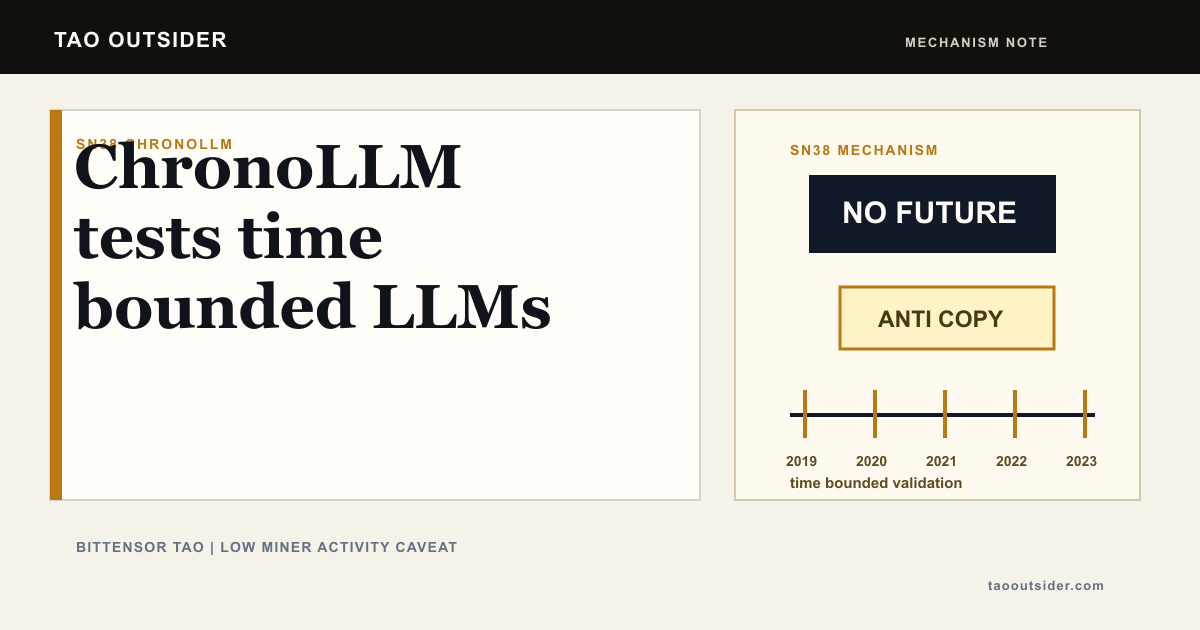
ChronoLLM SN38 belongs in the mechanism file today. TaoSwap showed only 1 active miner for SN38 when checked on July 9, 2026, so this stays in desk note territory. The reason to look at it anyway is the problem the subnet is trying to measure, chronologically consistent LLMs.
In plain terms, ChronoLLM is trying to train models that do not know the future when they answer questions about the past. That sounds narrow until you think about backtesting.
The problem SN38 is aiming at
A normal model trained on modern web data can leak future knowledge into past simulations. If a model is asked to reason from a 2012 viewpoint, it may still carry facts, language patterns or outcomes that only appeared later. For finance, research, forecasting, historical simulation and agent evaluation, that can poison the test.
ChronoLLM’s public framing is that miners train yearly models with strict time cutoffs. The output is meant to reduce look ahead bias and make evaluation closer to what a model could have known at that time. That creates a real AI evaluation problem, and a good Bittensor candidate if the subnet can turn it into measurable work.
Why the recent code deserves attention
The GitHub activity is more useful than the social chatter. Recent commits in the ChronoLLM SN38 repository include validator fixes, scoring tests, anti copy checks, model download retry logic, submission ordering, weight hash checks and round simulation tests.
That work is plain mechanism work, and it is where a subnet becomes harder to game. If miners can copy each other, spoof branches, leak data or submit weak models that pass a shallow test, the subnet fails. If validators can check submissions, score consistently and catch duplicate or low quality behavior, the mechanism has a chance. SN38 is early, and the code work is the strongest part to watch.
The caveat
This cannot be written as proof of traction. The live TaoSwap check showed low miner activity. That may change, but today’s read needs to respect the current surface.
The better frame is that ChronoLLM is building one of the more interesting evaluation problems in Bittensor, while still needing visible miner participation, product usage and stronger public results. That supports a mechanism note. The evidence is too thin for a lead story.
Tao Outsider read
ChronoLLM is a useful reminder that some of the best subnet ideas will look boring before they look important. Chronological consistency is an awkward phrase. The underlying problem is clear. If your model knows the future, your backtest is fake.
SN38 is trying to turn that problem into a Bittensor market. The near term proof is miner participation, tight validation and time bounded models that researchers or builders actually want to test. For now, ChronoLLM is a watchlist mechanism. Interesting, specific and still early.
Sources
Mark Jeffrey post: Hash Rate episode on Chronos and SN38
IntoTAO explainer: ChronoLLM SN38 overview
ChronoLLM GitHub: SN38 repository
TaoSwap live subnet data checked July 9, 2026: ChronoLLM SN38
Was this article useful?
One tap feedback helps us improve each post.