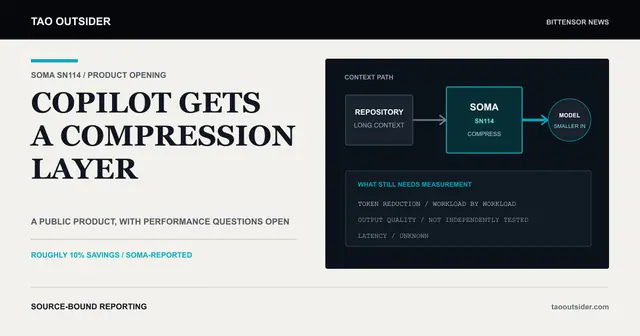
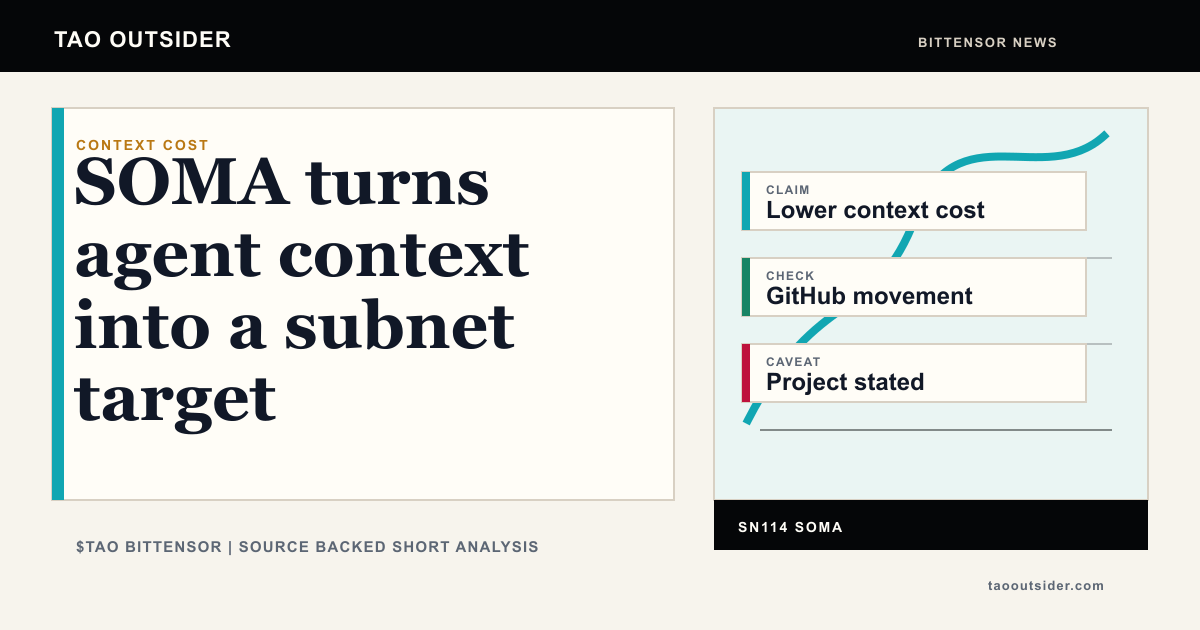
SOMA SN114 is making a specific claim about Bittensor agents: long context is expensive, and a subnet can compete on reducing that cost.
The strongest source today is the combination of a July 7 SOMA post and fresh GitHub movement in the DendriteHQ/SOMA repository. SOMA says the same 24 hour workload would cost less under its compression path. The repository also shows active work around a separate screener phase and upload flow.
Production savings still need repeatable evidence.
It does make SN114 worth covering as Bittensor news, because the target is measurable. Tokens, context length, model calls, screening and output quality can all be checked over time.
What SOMA said
SOMA’s July 7 post framed the issue around agent cost.
The project compared the cost of running a model with a large context window against the same work using SOMA. The numbers are project stated, so Tao Outsider treats them as a claim to track rather than an independent benchmark.
The useful part is the target.
Long context is becoming one of the hidden cost centers of agent systems. Teams want agents to remember more, read more and reason across larger files, but each extra token can become a bill. The larger the context, the more important compression becomes.
SOMA is trying to turn that problem into a subnet task.
Why this fits Bittensor
Bittensor works best when a subnet can define a job that miners can improve and validators can score.
For SOMA, the job sits closer to cost control for agents that need context than generic AI writing. Can a miner compress or screen context in a way that preserves the useful part of the task while reducing waste?
That is a better Bittensor question than broad claims about agents.
The project also posted recently about chain of thought compression and DeepSeek V4 style competition work. Read together, the direction is clear: SOMA wants miners competing around context efficiency instead of raw model output alone.
The GitHub check
The public repository matters here because the article should not rest only on a social post.
On July 7 and July 8, DendriteHQ/SOMA showed commits around screener runs, upload phase behavior, validator readiness and a separate screener phase. Commercial proof will need more than that. The useful signal today is mechanism work moving in public.
For a subnet like SOMA, that distinction matters.
Marketing can say cost is lower. Code activity can show whether the team is still shaping the contest that would make the claim testable.
The current read is simple. The claim needs more proof, while the mechanism is visibly alive.
What to watch next
The next useful evidence should be narrow.
First, SOMA should make the scoring path clear enough for outsiders to understand what miners submit and what validators reward.
Second, the project should publish examples that show before and after context handling. The reader should be able to see what was removed, what was kept and whether the final answer stayed useful.
Third, the cost comparison should become repeatable. A project stated number is a starting point. A public test that others can reproduce is stronger.
Fourth, the subnet needs to show that compression does not create hidden quality loss. A cheaper answer loses value if the agent misses the important part of the task.
Tao Outsider read
SOMA is one of the cleaner agent infrastructure stories in the current Bittensor field because the claim has a practical surface.
Agents can get expensive.
Context is one reason.
If SN114 can make context smaller without making the answer worse, the output has a buyer beyond the TAO circle. Developer teams, agent builders and model operators all understand that problem.
The risk is that compression becomes a scoreboard trick. The subnet has to reward useful reduction, with quality preserved after the token count falls. The screener and validator design will decide whether SOMA becomes infrastructure or another cost saving headline.
For now, this is the strongest item in today’s queue: a clear problem, recent project statements, fresh repository work and a mechanism that can be checked again.
Sources
SOMA, July 7 context cost post
SOMA, July 6 context compression post
SOMA, DeepSeek V4 competition post
GitHub, DendriteHQ/SOMA repository
GitHub, Separate screener phase commit
TaoSwap API, SN114 active subnet check
Was this article useful?
One tap feedback helps us improve each post.