SOMA SN114 has opened its context-compression product to the public, moving a Bittensor subnet experiment into a coding workflow people can reach through GitHub Copilot.
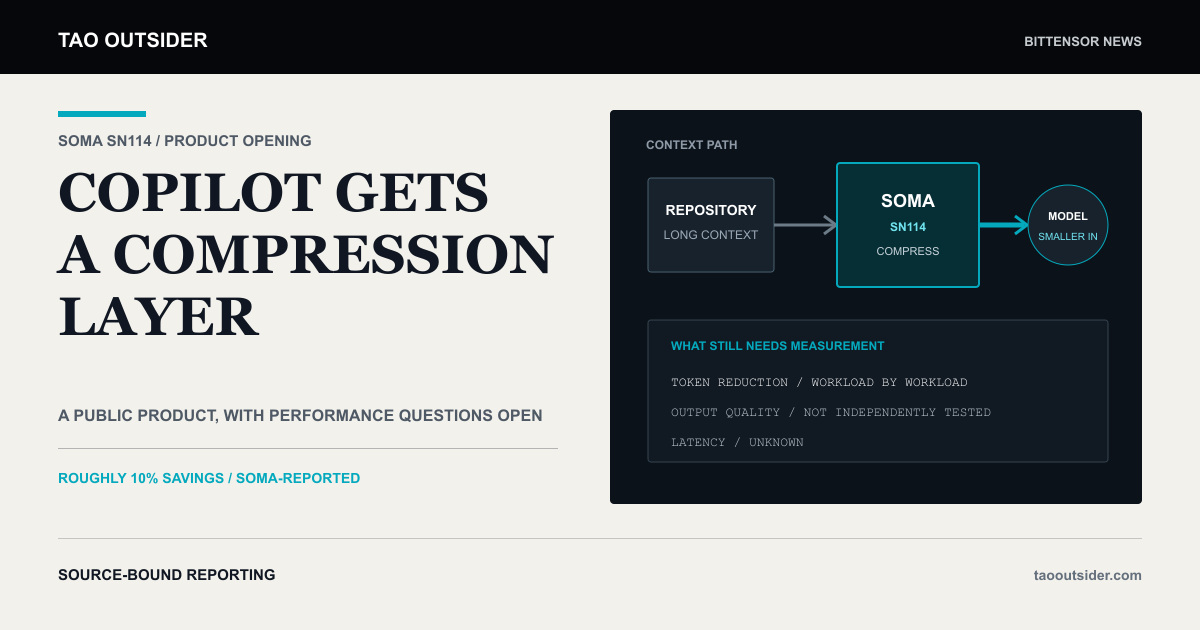
The September 1 opening follows a short early-access period. SOMA says the product places a compression layer in front of DeepSeek V4 Pro and reduces the tokens sent to the model by roughly 10%. The company is asking users to test the product on real coding workloads and report what works or breaks.
That 10% figure belongs to SOMA. Tao Outsider has not reproduced the saving, compared output quality or measured what the extra layer does to latency. A public login and a published price table show that a product surface exists. They do not establish a performance benchmark.
What SOMA is putting in the request path
Coding assistants repeatedly send repository context, conversation history and instructions to a model. As a session grows, parts of that material can recur across requests. SOMA’s premise is that it can compress context before the model sees it, reducing the number of billed input tokens while preserving enough information for the task.
The current SOMA website lists DeepSeek V4 Pro as available. GPT-5.3 Codex, Claude Sonnet 5, GPT-5.5 Pro and Qwen 3 Coder are marked as coming soon. Those labels describe SOMA’s roadmap on September 2. They do not confirm access to every model or a relationship with the model providers.
GitHub Copilot is the first named coding surface in the public announcement. SOMA describes the product as something users can plug into that workflow. GitHub has not endorsed the service, and the announcement does not establish a formal GitHub partnership.
The saving is a claim with several open variables
SOMA’s site shows a comparison of $1.32 per million tokens for the listed DeepSeek route and $1.19 with SOMA, presented as approximately 10% off. That makes the claim concrete enough to examine. It still leaves important questions unanswered.
Compression ratios can move with the repository, prompt history, language and type of task. A change that removes repeated boilerplate may behave differently from one that compresses a novel debugging trace. Output quality also needs a task-level comparison. A smaller prompt is useful only when the resulting code, explanation or tool call still does the job.
Latency is another unknown. The compression step adds work before inference. SOMA may save input tokens while adding processing time, or the smaller request may offset that delay. The public materials reviewed for this article do not provide enough measurements to settle that trade.
The result should be read as an early product claim tied to a particular route, rather than a guaranteed reduction across an entire software project.
Public access changes the evidence SOMA can collect
SOMA’s August 31 early-access post offered $5 in test credits and no platform fees to that cohort. The September 1 public-opening post does not repeat those terms. New users should not assume the early-access offer carries forward.
The broader opening is still material. A compression system can look convincing on selected examples while struggling with the uneven context of real repositories. Public use creates a chance to observe failure cases across languages, coding styles and session lengths.
That is also where SOMA’s Bittensor connection becomes more interesting. The subnet’s earlier public work centered on context compression as a research and evaluation problem. This product puts the idea in front of a recognisable workflow. It does not prove that subnet incentives produced a better compressor, that users will stay or that the product has revenue.
SN114 remains a separate network context
A TaoSwap status snapshot captured on September 2 showed 18 active miners on SOMA SN114 and an emission_value of 0.008565512.
That snapshot confirms the subnet’s current network context. It does not show how the Copilot product routes requests, which miners serve them, how many people use it or whether the public product generates demand for SN114.
SOMA has crossed a useful boundary by opening a product that can be tested outside a research announcement. The next evidence should be workload-level measurements that report token reduction, answer quality and latency together. A single percentage cannot carry all three.
Sources
SOMA public-opening announcement
SOMA early-access announcement and project-reported savings
SOMA product website and model table
SOMA repository maintenance commit from September 2
Was this article useful?
One tap feedback helps us improve each post.