I bought every Bittensor subnet once.
Some disappeared. A few winners carried a lot of the portfolio. Eventually, I stopped believing that owning everything was the best way to participate.
That experience changed how I look at TAO.
I still believe in the upside. I am much more interested now in what could sustain it.
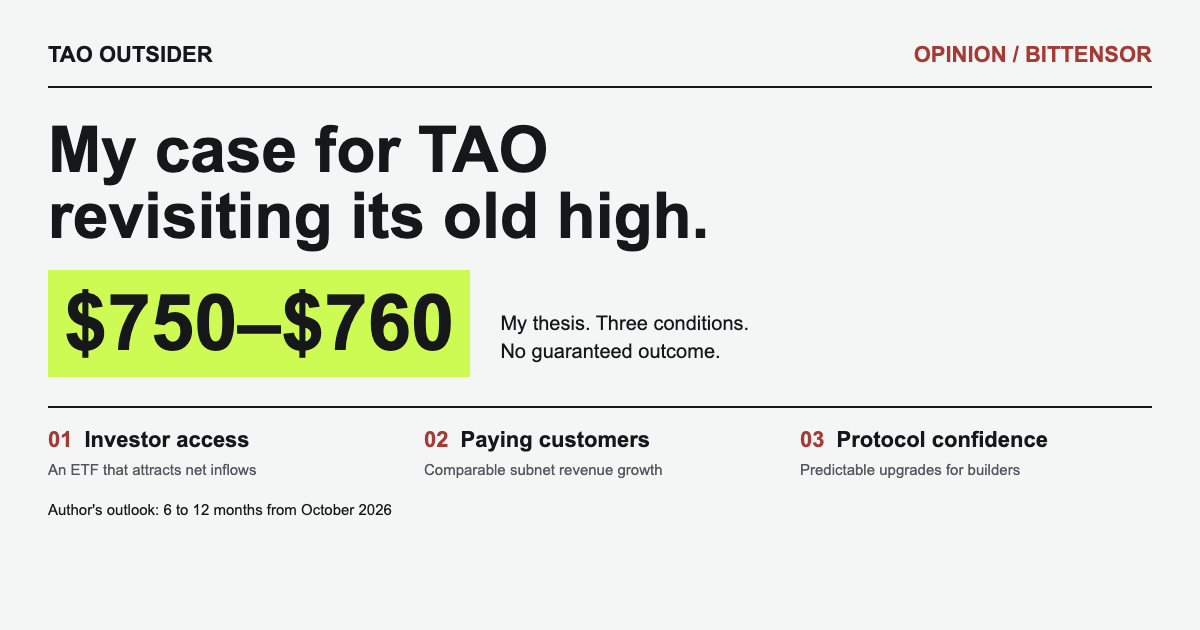
My thesis for the next six to twelve months, from October 2026, is that TAO can revisit its previous all-time-high region, around $750 to $760. If it breaks through and holds above that area, we get to have a much more interesting conversation about price discovery. Kraken lists the historical high at $757.60.
Using $295 as a round reference price, a return to $757.60 would mean approximately 2.57 times that price. A substantial move. I think the case deserves more than “AI is big” and “there are only 21 million.”
The next buyer might never own a subnet
An investor can understand the opportunity in decentralized AI and still have no intention of learning how to manage a wallet, choose a validator or evaluate alpha.
A US spot TAO ETF could give that investor a familiar way in.
Grayscale’s April 2 amended registration statement describes its intention to list on NYSE Arca and rename the product Grayscale Bittensor Trust ETF. The proposal is documented; approval and a launch date are separate questions.
There is more recent evidence of investor participation. In a September 28 filing, the trust reported issuing 151,900 shares in private placements for 2,869.41581933 TAO, representing $891,272. Those transactions involved selected accredited investors. They do not establish ETF approval or public ETF inflows.
If the ETF route opens, the number I would follow is net creations: whether the fund actually attracts additional capital and accumulates TAO. Trading existing shares between investors is a different thing.
Approval could bring attention immediately. Sustained inflows would give the move something to feed on. Redemptions could work in the opposite direction.
The opportunity is broader access to an asset whose underlying network may also be becoming easier to explain commercially.
Meanwhile, someone has to pay for the products
The executive summary of SubConnect’s August Revenue Index estimates $28 million to $35 million in annual recurring revenue across 24 subnets. Its methodology draws on public information, team disclosures, dashboards and on-chain activity, with confidence ratings that distinguish stronger evidence from informed estimates.
That gives us a reported baseline to investigate.
Now I want to see the next measurement. The same businesses, comparable accounting, returning customers. How much grew? How much came from one large contract? How much did it cost to deliver?
If those revenues keep growing, Bittensor becomes a different proposition to a prospective buyer. There are more businesses to examine, more services to try and more reasons to take the network seriously beyond its internal rewards.
Revenue still belongs to the businesses earning it. TAO holders do not automatically receive a claim on those cash flows.
The bullish connection has to be built through the mechanisms: customer-funded token purchases, demand for participation, capital committed to subnets, and services that justify keeping that capital there.
I would love to see that connection become stronger across more teams. Especially teams that can retain customers without spending every dollar trying to replace the last one.
Builders need to know what they are building on
There is another condition I care about just as much.
Bittensor needs to keep improving quickly while giving builders enough predictability to finish things.
A team hiring engineers or signing a customer contract has obligations that last longer than the next announcement. Changes to incentives, permissions or operating requirements can change the economics of that commitment.
My bullish case assumes the protocol gets safer and more dependable as it develops: tested upgrades, clear activation windows, documented migrations and enough notice for teams to adapt.
I would measure that through the actual upgrade record, incidents and migration burden. Counting releases tells us how frequently code ships. It tells us much less about how confidently a business can plan around it.
Why I keep coming back to TAO’s old high
The previous high is a price the market has already paid for TAO.
Price alone does not capture valuation. Market capitalization at a future retest would depend on the circulating supply at that time. It would also happen against a different competitive and macroeconomic backdrop.
But imagine approaching that region with sustained ETF inflows, a larger base of paying subnet customers and a protocol that teams can build on with more confidence.
That is the combination behind my prediction.
Around $750 to $760, I would expect the thesis to face a serious test. Holders who waited years could finally have their exit. New buyers would have to absorb them.
Revisiting the high would be the first part. Breaking above it and sustaining demand there would open price discovery.
I expect TAO to get another attempt. I am not assuming a straight line or assigning a date to the candle.
An ETF that attracts little capital, revenues that stall, or protocol changes that repeatedly disrupt builders would weaken my case. I would have to change the forecast, rather than keep moving its deadline.
I bought every subnet to see what would happen.
Now I’m watching whether the businesses growing inside Bittensor can help bring in the next generation of TAO buyers.
Verification and limits
This is my forecast, not a promised return. The $295 calculation is an illustrative reference, not a live quote. The SEC filings reviewed establish the ETF proposal and later private placements; they do not confirm an ETF approval. SubConnect’s estimates are not independently audited here. Its report also contains an internal discrepancy: the opening findings show $32 million to $35 million and 25 subnets, while the executive summary gives the $28 million to $35 million and 24 used above. Neither establishes subsequent growth. No future circulating-supply estimate or market-cap target is asserted.
Sources
- Kraken: TAO historical high
- Grayscale amended registration statement, April 2, 2026
- Grayscale private-placement disclosure, September 28, 2026
- SubConnect Revenue Index, Volume I, August 2026: key findings, executive summary and revenue confidence methodology
Was this article useful?
One tap feedback helps us improve each post.